Low page yield is one of the most sensitive topics in B2B toner and copier fleets. For distributors, service companies, and corporate buyers, page yield directly affects cost per page, contract profitability, and customer satisfaction.
When a cartridge does not deliver the expected number of pages, the first assumption is usually simple: the toner cartridge is underfilled or defective. However, in real B2B environments, page yield is influenced by much more than toner volume alone.
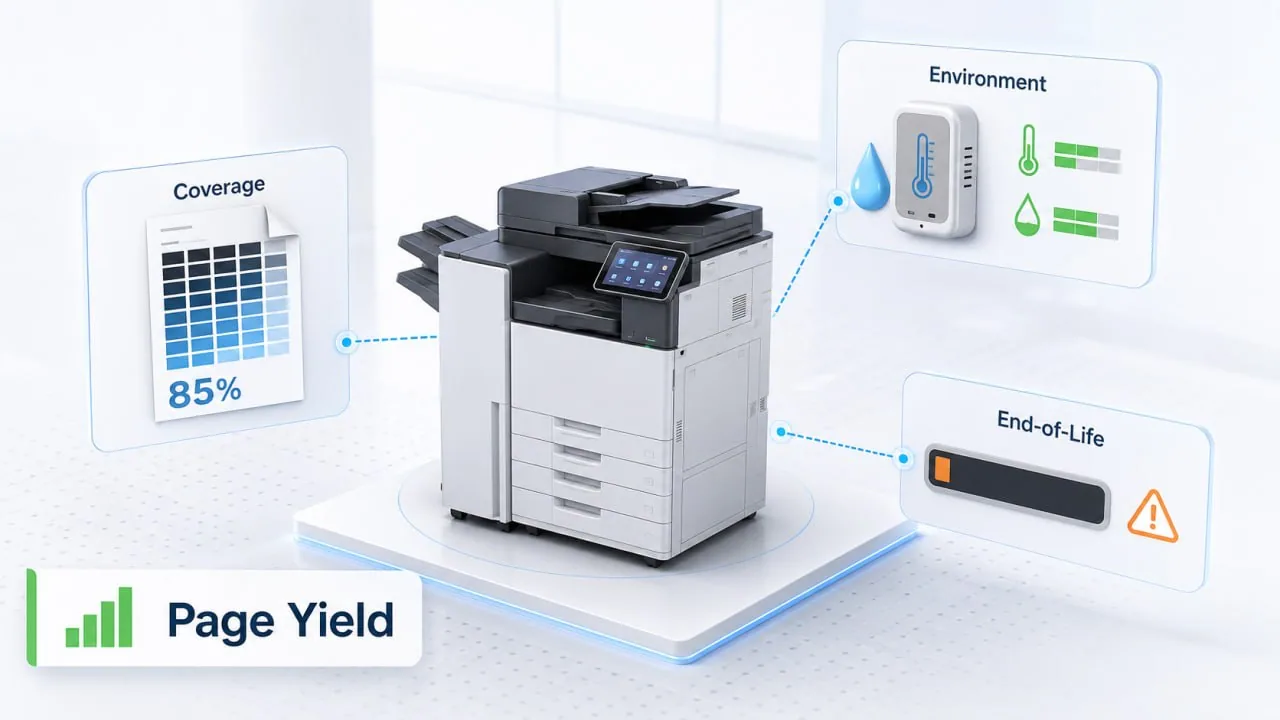
True page yield depends on coverage patterns, printing behavior, machine condition, environment, toner formulation, and system efficiency. If these factors are not considered, yield complaints can be misdiagnosed and lead to unnecessary replacements or incorrect supplier blame.
What Page Yield Really Means
Page yield is not a fixed number in real-world usage. It is an estimate based on standardized test conditions, usually around specific coverage percentages and controlled environments.
In real fleets, conditions vary:
- some documents are light text;
- others are full-page graphics;
- some users print drafts;
- others print dense reports;
- some machines run continuously;
- others run intermittently;
- some environments are dry and clean;
- others are humid or dusty.
Because of this variation, actual yield in B2B fleets often differs from theoretical values.
This is why yield should always be evaluated as a system behavior, not just a cartridge specification.
Coverage Is the Most Important Factor
Print coverage is the biggest driver of toner consumption.
A page with 5% coverage uses far less toner than a page with 20%, 50%, or full-page graphics. In copier fleets, coverage can vary significantly between departments and users.
For example:
- administrative documents: low coverage
- marketing materials: high coverage
- scanned copies: variable coverage
- reports with charts: medium to high coverage
Even if two users print the same number of pages, their toner consumption can be very different.
This is why yield complaints often come from misunderstanding usage patterns rather than actual cartridge failure.
Environment and Usage Behavior
Environmental conditions also affect toner efficiency.
Humidity can change toner flow and charge behavior. Temperature variations can affect fusing efficiency. Dust or poor ventilation can impact machine performance over time.
In addition, user behavior plays a major role:
- frequent reprints increase toner usage;
- draft mode vs high-quality mode changes consumption;
- duplex printing behavior affects coverage density;
- file types (PDF, images, scanned documents) influence toner load.
These real-world factors are rarely reflected in laboratory yield tests.
This is also why yield problems sometimes appear together with high waste toner in copier fleets, since inefficient transfer and usage patterns both reduce effective output.
Machine Condition and Fleet Aging
Printer and copier condition directly affects yield.
As machines age, several components degrade:
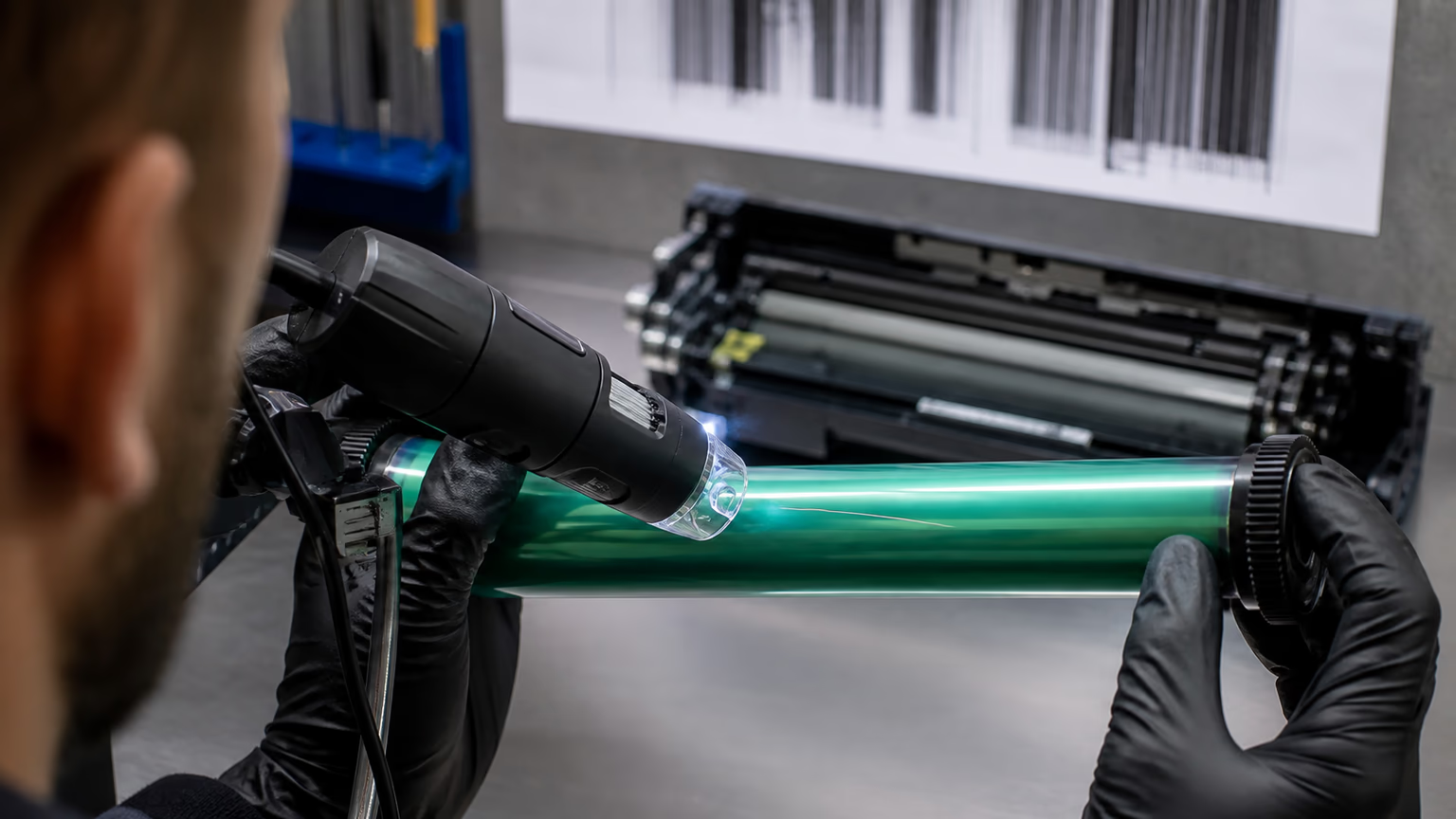
- drums lose sensitivity;
- developer units become unstable;
- transfer rollers wear out;
- fuser systems lose efficiency;
- internal contamination increases.
All of these factors reduce toner efficiency.
A cartridge installed in a new machine may deliver expected yield, while the same cartridge in an older machine may appear to underperform.
This is why fleet-based analysis is essential. Yield should not be measured only per cartridge, but per machine environment.
Toner Efficiency and Formulation
Compatible toner formulation also influences yield performance.
Toner must balance:
- charge stability;
- particle size;
- melt behavior;
- transfer efficiency;
- waste toner generation.
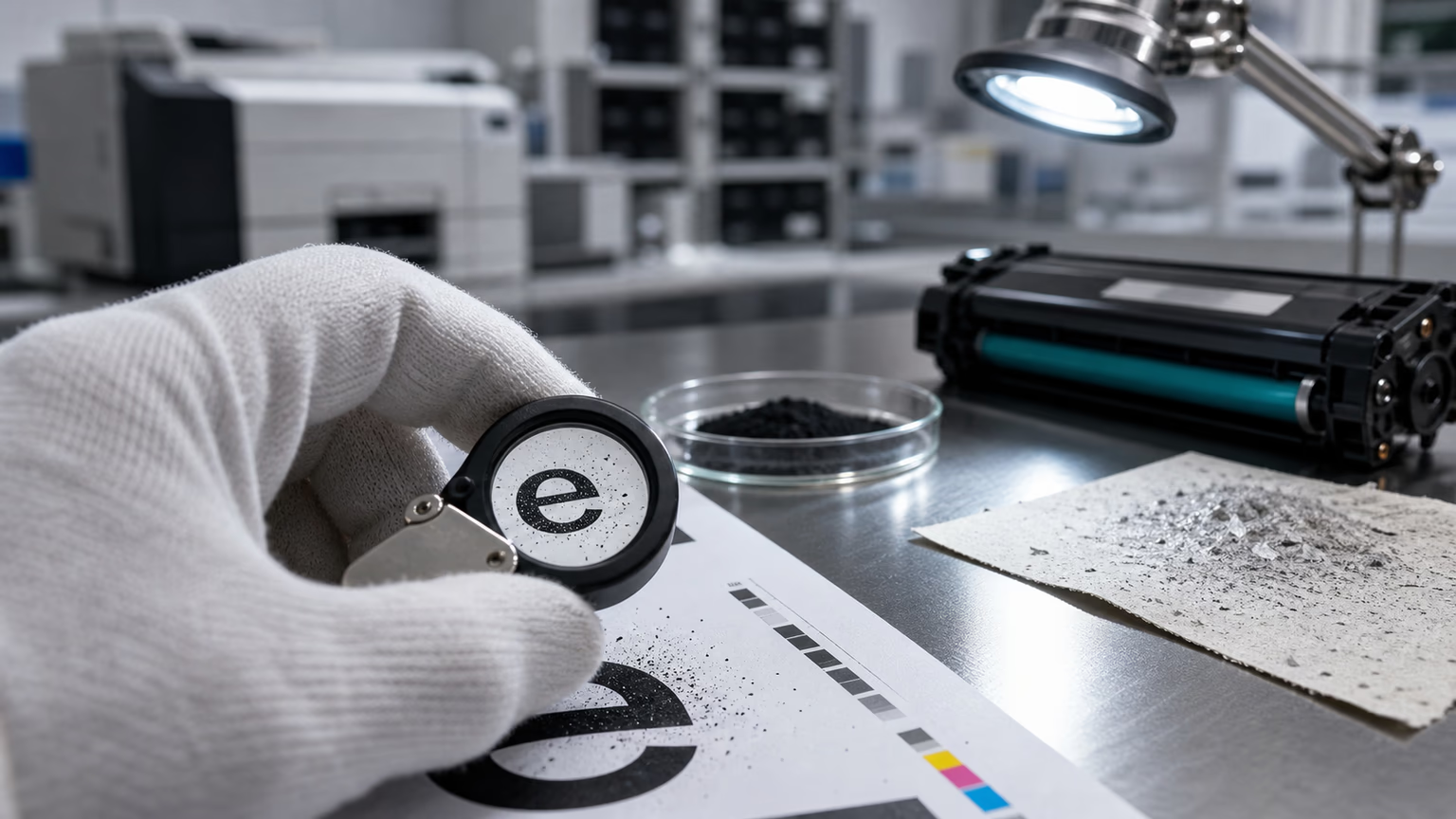
If toner is not efficiently transferred from drum to paper, more toner ends up in the waste system instead of the page. This reduces effective yield even if the cartridge contains sufficient toner volume.
This is directly related to repeating dots on printed pages and other imaging inefficiencies, where poor transfer or charge behavior affects overall system performance.
True End-of-Life Conditions
In B2B fleets, “end of life” is not always when toner runs out.
A cartridge may still contain toner but stop producing acceptable prints due to:
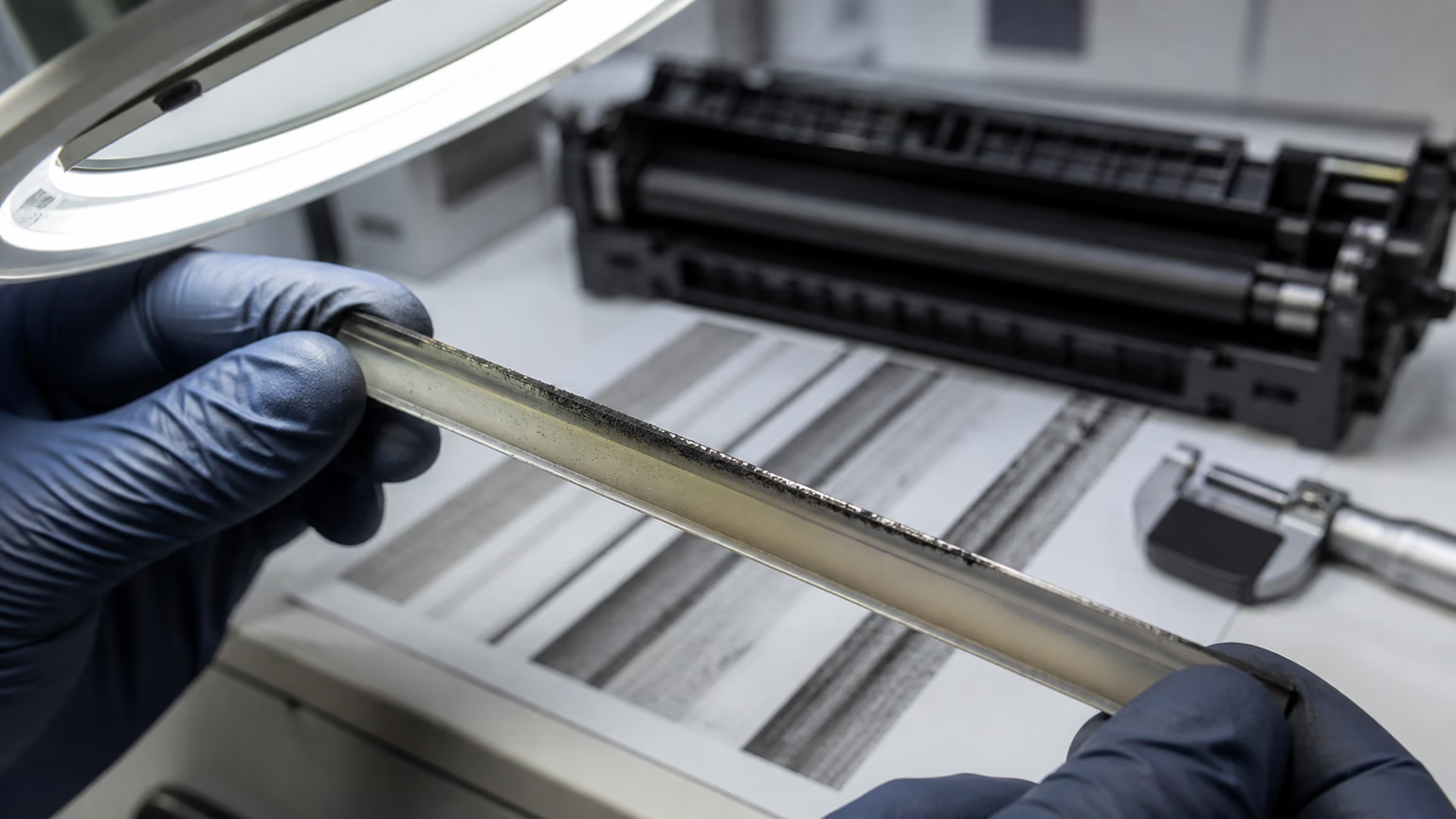
- uneven density;
- increased background;
- smearing issues;
- transfer instability;
- mechanical wear;
- waste system saturation.
This means perceived yield can end earlier than actual toner depletion.
On the other hand, some cartridges may technically run out of toner but deliver stable performance throughout their lifecycle.
This difference between physical toner volume and usable print life is often the source of yield complaints.
Misinterpretation of Yield Complaints
Many yield complaints are not actual defects.
Common misinterpretations include:
- high coverage documents treated as normal usage;
- draft vs high-quality mode differences;
- machine differences within fleet;
- environmental variation;
- mixing different cartridge batches;
- comparison with OEM assumptions without context.
This is why yield analysis must include print samples, usage data, and machine conditions.
Otherwise, the supplier may be blamed for what is actually a usage pattern issue.
Relationship With Other Print Defects
Low page yield is often connected to other system-level issues.
For example:
- inefficient transfer can lead to waste and reduced yield (linked with high waste toner in copier fleets);
- unstable fusing can increase reprints and toner consumption (linked with toner smearing after fusing);
- poor adhesion can reduce usable output (linked with why toner rubs off the page).
In some cases, mechanical instability may also lead to visible defects such as repeating dots on printed pages, which indirectly affect perceived yield.
How to Analyze Yield Properly
A structured approach is required for accurate yield analysis:
Step 1: Identify coverage patterns
Check whether documents are low, medium, or high coverage.
Step 2: Review machine environment
Include humidity, temperature, and usage frequency.
Step 3: Check machine condition
Inspect drum, developer, transfer, and fuser components.
Step 4: Compare across machines
See whether yield varies between devices.
Step 5: Analyze cartridge batches
Check if yield variation is batch-specific.
Step 6: Review user behavior
Determine printing modes and document types.
This approach helps separate real cartridge issues from environmental or usage-related factors.
Why Yield Matters in B2B Fleets
Yield directly affects business economics.
Low perceived yield can cause:
- higher cost per page;
- customer dissatisfaction;
- contract renegotiation;
- supplier disputes;
- inventory inefficiency;
- reduced profitability.
For service providers, yield stability is more important than theoretical numbers. Predictable performance allows better planning, pricing, and customer management.
Preventing Yield Complaints
To reduce yield issues, suppliers and buyers should:
- define realistic usage expectations;
- test under real fleet conditions;
- avoid mixing assumptions with laboratory data;
- monitor machine health;
- track batch performance;
- align toner formulation with usage environment;
- educate users on coverage impact.
A stable toner supply program focuses on predictable performance rather than theoretical maximum yield.
FAQ
Why is my toner cartridge not lasting as long as expected?
Low page yield can be caused by high coverage printing, machine condition, environmental factors, toner transfer efficiency, or user behavior, not only toner volume.
Does compatible toner always have lower yield?
No. Yield depends on formulation quality, machine compatibility, and usage conditions. A well-designed compatible toner can match OEM performance in real environments.
Can machine condition affect page yield?
Yes. Worn drums, developer units, transfer rollers, and fuser systems can reduce toner efficiency and shorten usable cartridge life.
How is yield measured in real fleets?
Yield is measured based on actual usage patterns, coverage types, machine conditions, and real print data, not only laboratory standards.
How can yield complaints be reduced?
By analyzing coverage patterns, maintaining machines, using stable toner formulations, and aligning expectations with real-world usage conditions.
Final Thoughts
Low page yield in B2B fleets is not a simple cartridge problem. It is a system-level outcome influenced by coverage, environment, machine condition, toner efficiency, and user behavior.
Understanding these factors helps distributors, service companies, and buyers avoid misdiagnosis and build more stable printing operations.
A reliable toner system is not defined only by how much toner is inside the cartridge, but by how efficiently that toner is converted into usable, consistent prints across real-world condition
Related reading: high waste toner in copier fleets, toner smearing after fusing, toner rubs off the page, repeating dots on printed pages, ghosting after installing a new toner cartridge, compatible toner gray background.