High waste toner levels in copier fleets are often misunderstood. Many users assume that waste toner simply means the machine is consuming too much toner or that the cartridge is inefficient. In reality, high waste toner is usually a signal of system imbalance inside the imaging process.
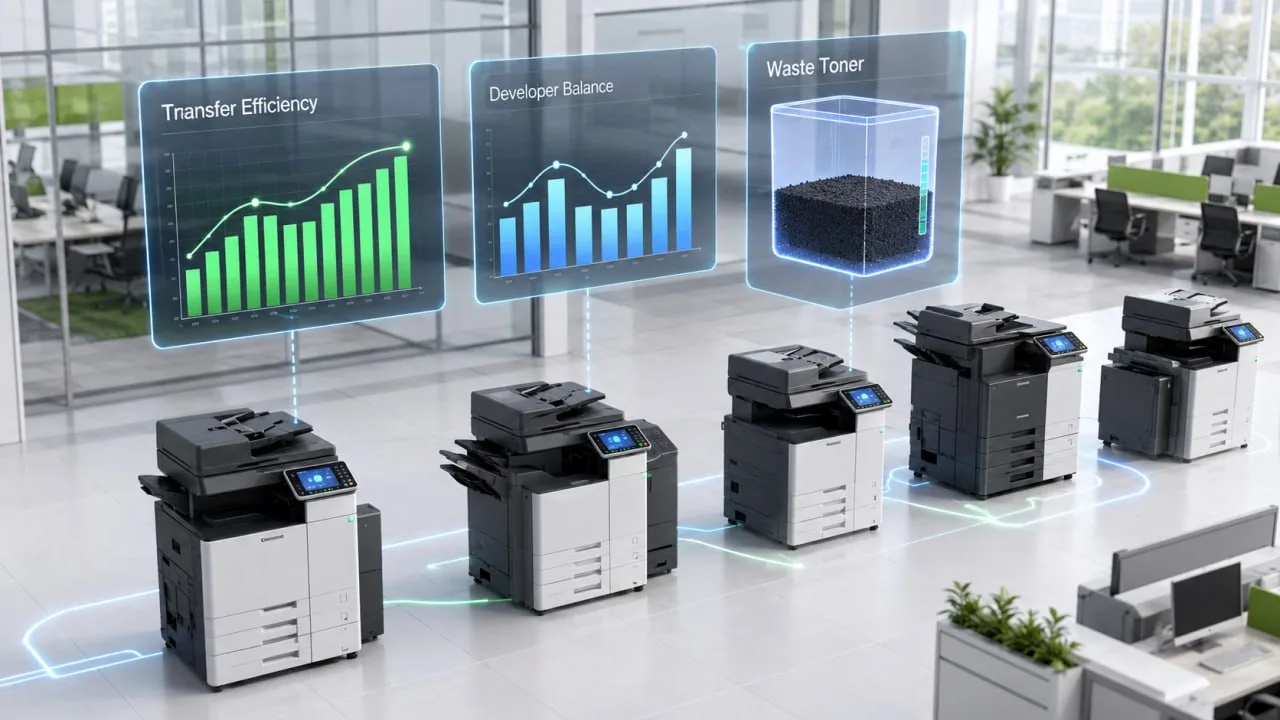
For B2B copier fleets, waste toner is not just a consumable issue. It affects maintenance cycles, operating cost, machine stability, and overall print efficiency. When waste toner increases beyond normal levels, it usually indicates that toner transfer, drum cleaning, or developer balance is not working correctly.
What Waste Toner Actually Means
Waste toner is the toner that does not reach the paper during printing and is instead cleaned from the drum and stored in a dedicated waste container.
This happens because not all toner particles transfer perfectly from:
- developer roller to drum;
- drum to paper;
- or remain correctly fixed during fusing.
In a normal system, a small amount of waste toner is expected. However, when the system is not balanced, waste toner levels can increase significantly.
This creates several problems:
- faster waste container filling;
- increased maintenance frequency;
- reduced effective page yield;
- higher cost per page;
- increased contamination risk;
- unstable print quality over time.
In copier fleets, where machines operate at high volume, this becomes a serious operational issue.
Transfer Efficiency Is the Core Factor
The most important factor behind high waste toner is transfer efficiency.
Transfer efficiency refers to how much toner successfully moves from the drum onto the paper during each print cycle.
If transfer efficiency is low, more toner remains on the drum and is cleaned into the waste system.
Low transfer efficiency can be caused by:
- weak electrostatic charge;
- incorrect toner formulation;
- worn transfer roller;
- drum surface degradation;
- humidity affecting toner behavior;
- improper voltage settings;
- incorrect machine calibration.
When transfer efficiency drops, the system compensates by consuming more toner, but not all of it reaches the paper. The unused portion becomes waste toner.
This is why high waste toner is often linked with low page yield in B2B fleets.
Developer Balance Problems
The developer unit is responsible for carrying toner and delivering it to the drum. If the developer system is unbalanced, toner distribution becomes unstable.
Developer imbalance can occur due to:
- uneven toner mixing;
- worn developer rollers;
- incorrect toner particle size;
- weak magnetic control;
- contamination inside the unit;
- aging developer components;
- poor compatibility between toner and system.
When the developer system is unstable, it may supply too much toner in some areas and too little in others. This leads to inconsistent transfer, increased waste, and uneven print density.
In some cases, developer imbalance can also contribute to defects like repeating dots on printed pages due to uneven toner deposition on the drum.
Drum Wear and Cleaning Load
The drum plays a central role in toner transfer. If the drum surface is worn or contaminated, it cannot transfer toner efficiently to the paper.
- more toner remains on the drum;
- cleaning systems work harder;
- waste toner increases;
- and print quality becomes unstable.
Drum wear is common in high-volume copier fleets. Over time, the coating loses efficiency, especially under heavy duty cycles or high coverage printing environments.
When this happens, even a good toner formulation cannot fully compensate. The system will naturally generate more waste toner.
Drum-related issues may also appear alongside toner smearing after fusing if the overall imaging system becomes unstable.
Environmental Influence on Waste Toner
Environmental conditions such as humidity and temperature have a direct impact on toner behavior.
High humidity can cause:
- toner clumping;
- unstable charge;
- poor transfer;
- increased residual toner;
- and higher waste output.
Low humidity can also create issues by increasing static behavior and affecting toner flow inside the developer system.
In B2B copier fleets, machines often operate in different environments:
- offices;
- warehouses;
- schools;
- government buildings;
- service centers.
Each environment can affect waste toner levels differently, even if the same cartridge model is used.
Compatible Toner and Waste Toner Behavior
In compatible toner systems, formulation plays a major role in waste toner levels.
If toner is not properly matched to the machine’s electrostatic system, transfer efficiency decreases. This leads to:
- more residual toner on the drum;
- higher cleaning load;
- increased waste accumulation;
- reduced page yield;
- and inconsistent performance across batches.
This is why high waste toner is often not just a machine issue, but also a compatibility issue between toner formulation and imaging system design.
A properly engineered compatible toner should balance:
- charge control;
- particle size distribution;
- melt behavior;
- and transfer efficiency.
Without this balance, waste toner levels will naturally increase.
Symptoms of High Waste Toner in Fleets
High waste toner does not always appear directly as a visible print defect. Instead, it shows up operationally.
Common symptoms include:
- waste container filling faster than expected;
- frequent maintenance alerts;
- reduced cartridge lifespan;
- inconsistent print density over time;
- increased service calls;
- higher cost per page;
- toner depletion before expected page yield.
In some cases, waste toner issues may appear together with toner rubbing off the page or other fusing-related problems, because system instability affects multiple stages of printing.
Diagnosing High Waste Toner
A proper diagnosis should not focus only on the waste container. It must examine the entire imaging system.
Key checks include:
- Transfer efficiency test
- measure toner usage vs output coverage
- Developer system inspection
- check roller condition and toner distribution
- Drum surface analysis
- inspect wear and contamination
- Charge system stability
- evaluate PCR and voltage consistency
- Environmental conditions
- humidity and temperature influence
- Toner compatibility check
- ensure correct formulation match
- Long-run testing
- observe behavior over extended print cycles
Only by combining these checks can the root cause be identified correctly.
Why Waste Toner Affects Business Cost
For copier fleets, waste toner is not just a technical issue. It directly affects operating cost.
Higher waste toner leads to:
- more frequent service visits;
- increased consumable replacement;
- shorter maintenance intervals;
- reduced machine uptime;
- higher total cost of ownership.
Even if print quality looks acceptable, the hidden cost increases over time.
This is why waste toner efficiency is an important metric in B2B environments.
Relationship to Other Print Defects
High waste toner is often part of a wider system imbalance.
It may be connected to:
- repeating dots on printed pages due to uneven drum transfer;
- toner smearing after fusing when fusing and transfer are not aligned;
- toner rub-off when fusing and transfer are weak;
- low page yield in B2B fleets when toner is not efficiently used.
Understanding these connections helps service engineers see the system as a whole rather than isolated defects.
How to Reduce Waste Toner Levels
Reducing waste toner requires system-level optimization:
- use properly matched toner formulation;
- maintain drum and developer components;
- calibrate transfer settings;
- control environmental conditions;
- replace worn rollers and blades;
- ensure correct machine maintenance;
- avoid mixing incompatible toner batches;
- monitor long-term performance trends.
In many cases, waste toner issues cannot be solved by replacing a single component. The full imaging system must be evaluated.
FAQ
What causes high waste toner in copier fleets?
High waste toner is usually caused by low transfer efficiency, developer imbalance, drum wear, toner formulation mismatch, or environmental factors affecting printing stability.
Is high waste toner a cartridge problem?
Not always. It can be caused by the cartridge, but also by the machine’s drum, developer unit, transfer system, or environmental conditions.
Can compatible toner increase waste toner?
Yes, if the toner formulation is not properly matched to the machine’s imaging system, transfer efficiency may decrease and waste toner may increase.
How does waste toner affect cost?
Higher waste toner reduces effective page yield, increases maintenance frequency, and raises overall cost per page in B2B copier fleets.
How can waste toner be reduced?
By improving transfer efficiency, maintaining imaging components, using compatible toner formulations correctly matched to the system, and ensuring proper machine maintenance.
Final Thoughts
High waste toner in copier fleets is a sign of system imbalance, not just a consumable issue.
It reflects how well the entire imaging system works together: toner formulation, transfer efficiency, developer stability, drum condition, and environmental factors.
For B2B operations, controlling waste toner is essential for reducing cost, improving reliability, and maintaining stable long-term performance across copier fleet
Related reading: repeating dots on printed pages, toner smearing after fusing, low page yield in B2B fleets, toner rubs off the page, ghosting after installing a new toner cartridge, compatible toner gray background.