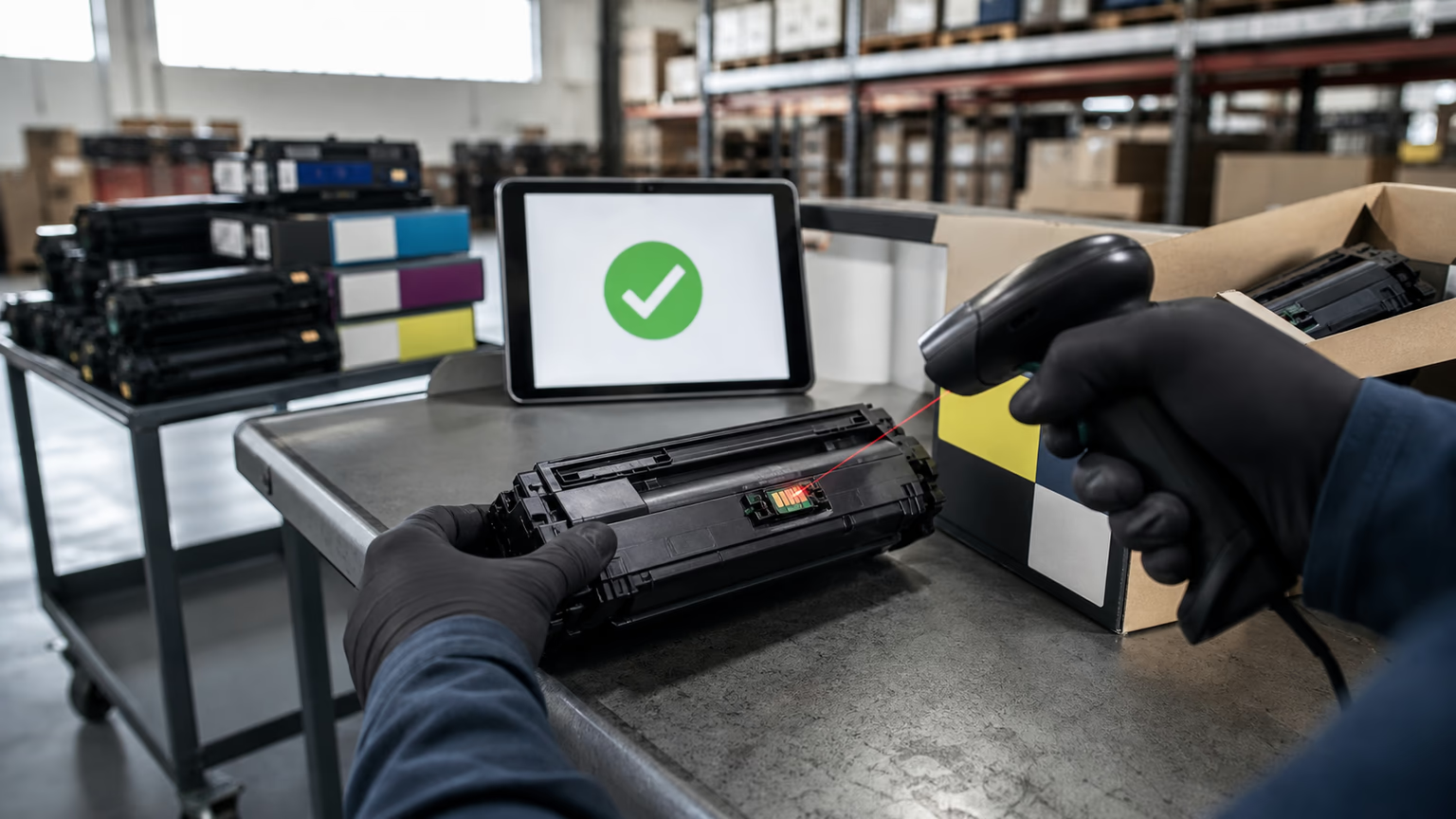

Introduction: The Tiny Chip That Can Shut Down Your Toner Supply
The global semiconductor shortage has evolved from a temporary supply hiccup into a persistent structural threat that reaches deep into the printer consumables market.
For procurement professionals managing toner cartridge programs, the risk is not abstract.
A single chip—often smaller than a fingernail—can halt production lines, delay deliveries, and unravel service level agreements.
As the brains of every modern laser printer toner cartridge, these integrated circuits govern authentication, page counting, and toner dispensing.
Without a stable supply, even the most seasoned procurement strategies built on cost efficiency can collapse overnight.
This guide reframes the chip shortage as a permanent procurement challenge and provides a practical framework to protect service reliability, margins, and customer trust without resorting to guesswork or panic buying.
The Chip Inside: Why It’s the Brain of Your Toner Cartridge (and Your Business)
A toner cartridge chip is far more than a simple counter.
It orchestrates critical functions: communicating with the printer to authorize use, reporting toner levels, controlling print density, and ensuring the device’s safety protocols.
In a managed print services (MPS) context, chip reliability directly correlates with contract profitability.
A misreading chip can falsely signal an empty cartridge, triggering wasteful replacements.
Inconsistent toner dispensing from a poorly calibrated chip leads to subpar print quality and increased service calls.
Worse, a defective chip can overheat, damage sensitive printer electronics, and escalate maintenance costs.
For distributors and service providers, the chip is not just a component—it is the linchpin of customer satisfaction and SLA adherence.
Ignoring its resilience is a gamble with your service promise.
Mapping the Chip Shortage: From Global Semiconductor Crisis to Your Warehouse Shelves
The semiconductor shortage that started in the automotive sector has cascaded through legacy node manufacturing, where many toner cartridge chips are fabricated.
These chips, typically built on mature 28nm and above process technologies, compete for production capacity with automotive, IoT, and industrial applications.
Smaller compatible toner manufacturers with limited fab allocation are disproportionately affected, facing extended lead times and allocation uncertainty.
Geopolitical tensions and export restrictions further complicate cross-border procurement, making chip availability unpredictable.
For a B2B buyer, this translates to volatile order fulfillment: a familiar toner cartridge SKU can suddenly go out of stock, forcing emergency sourcing at inflated prices.
The shortage is not evenly distributed across printer models, so procurement teams must adopt a risk-aware inventory posture rather than a one-size-fits-all approach.
The Risk Cascade: Four Ways Chip Shortages Threaten Your Procurement Program
The chip shortage is not a single-point risk; it sets off a cascade that hits multiple operational dimensions. Understanding these interconnected threats is the first step toward building resilience.
Procurement Risk
When chip supplies tighten, prices surge and sole-source dependency becomes a liability. Long-term contracts locked at fixed prices can quickly become unsustainable, eroding margins. Without alternative supply routes, a single supplier’s production halt can leave service fleets without toner for weeks, triggering contract penalties and customer churn.
Quality Risk
Rushed chip substitutes—often sourced from alternative fabs without rigorous validation—can lead to premature cartridge failure, inconsistent print density, and toner leakage. Quality compromises not only increase product returns but also damage your reputation as a reliable consumable provider.
Compatibility Risk
OEM firmware updates are a constant arms race. A chip that works today may fail tomorrow if it lacks robust security handshake protocols. Incompatibilities can render entire inventories unusable, especially across mixed fleets where multiple printer models require seamless integration.
Service Risk
The end result of chip-related failures is a spike in help desk calls, technician dispatches, and unhappy end users. Every service complaint that originates from a faulty chip translates into operational cost and diminished trust. Competitors who demonstrate a tested, stable supply chain will capture your customers.
Building a Resilient Procurement Framework: Strategic Supplier Evaluation
Moving beyond transactional buying requires a supplier evaluation model that weighs chip resilience as heavily as price. The following criteria form the backbone of a chip-resilience scorecard:
- Chip sourcing transparency: Demand a documented map of chip origin, including fabrication node, wafer foundry, and contingency inventories. Suppliers who cannot disclose this likely lack control over their own supply.
- Inventory buffering policy: Ask for evidence of safety stock levels for high-demand printer models. A supplier with dedicated buffer inventory can absorb short-term disruptions.
- In-house chip development or R&D partnerships: Manufacturers that own their chip design or maintain strong R&D ties can rapidly redesign and test alternative chips when primary sources fail.
- Rigorous compatibility testing: Insist on regular testing against the latest OEM firmware in fleet simulation environments. A supplier that cannot demonstrate real-world compatibility validation is a liability.
- Scalable production capacity and geographic diversification: A resilient supplier should have multiple assembly locations to mitigate regional shocks.
- Transparent lead-time communication and contractual SLAs: Clear communication and committed lead times, backed by service level agreements, reduce guesswork and enable proactive planning.
Periodic re-assessment is crucial. A supplier’s resilience today does not guarantee tomorrow’s performance. Embed chip-risk audits into your quarterly business reviews.
Mitigation Tactics: Diversification, Inventory Intelligence, and Contingency Planning
Strategic evaluation must be paired with actionable mitigation tactics.
Start by segmenting your toner SKU portfolio based on chip dependency risk.
High-dependency models—those with frequent firmware updates or limited alternative chip sources—require deeper safety stock.
Low-dependency SKUs can operate with leaner inventory.
This tiered approach avoids overcapitalizing on stock while protecting critical items.
Contractual flexibility is non-negotiable. Negotiate clauses that allow for price adjustment mechanisms tied to verifiable chip cost increases, multi-source approval rights, and mutual supply risk sharing. A well-structured contract includes partial termination options if a supplier fails to meet lead-time commitments for a predefined period.
Develop a chip-shortage playbook: predetermined steps triggered when a supplier’s lead time exceeds a threshold.
The playbook should include pre-approved backup sources, expedited testing protocols for substitute chips, and escalation matrices.
Pilot a dual-source program for your top-moving toner SKUs, engaging two pre-qualified suppliers and comparing their performance quarterly.
This not only spreads risk but also creates competitive pressure for consistent quality and pricing.
Establish a cross-functional early-warning team with members from procurement, service, and logistics to monitor chip market intelligence. This team can track foundry capacity news, regulatory changes, and supplier financial health to trigger preemptive adjustments to inventory and sourcing. The cost of a small monitoring cell is negligible compared to a sudden stockout.
The Testing Protocol: Ensuring Compatibility and Quality in a Disrupted Market
In an environment where chip redesigns are rushed to market, in-house testing is the only reliable defense against field failures. A robust testing procurement policy must mandate sample lot approval before any large order. The following tests are essential:
- Firmware update stress test: Flash the latest OEM firmware on target printer models and run full cartridge initialization to verify seamless communication.
- Full-lifecycle print-yield validation: Print continuously from the first page to the last, monitoring toner yield consistency, density, and error rates.
- Extreme-temperature performance: Subject cartridges to high and low temperatures to simulate storage and operational conditions without chip malfunction.
- Multi-printer model cross-compatibility: Test the same chip across different devices in the fleet to ensure no model-specific lockouts or misreads.
For procurement teams lacking internal testing facilities, partnering with third-party testing labs or industry consortiums can provide unbiased resilience assessments.
Industry consortiums or independent testing houses can also offer batch-level validation at scale, providing a cost-effective way to ensure compatibility without building an in-house lab.
Their reports can serve as objective evidence in supplier negotiations.
Future-Proofing Your Toner Supply Chain: A Strategic Outlook
The chip shortage is not a temporary storm to be weathered; it is a structural shift that demands a new procurement mindset.
Moving forward, chip resilience will differentiate market leaders from laggards.
Innovations in chip design, such as reprogrammable architectures and on-cartridge diagnostics, will offer more flexible supply options.
However, these advances will only benefit those who actively demand transparency and invest in durable supplier relationships.
Procurement leaders who embrace a culture of verification, multi-source flexibility, and contractual agility will convert supply chain risk into a competitive advantage.
Your service promise depends not on the lowest consumable price, but on the guaranteed performance of every component inside the cartridge.
Start your supplier audit today with the scorecard and testing protocol outlined here.
The tiny chip may be hidden, but its impact on your business should never be underestimated.
FAQ
What causes the chip shortage specifically in toner cartridges?
The shortage is driven by global semiconductor capacity constraints on mature process nodes, competition from automotive and IoT industries, and geopolitical trade restrictions that disrupt chip fabrication and distribution for smaller toner manufacturers.
How can I verify if a compatible toner supplier has reliable chip sourcing?
Request a documented chip sourcing map that includes fabrication node, foundry location, and contingency inventory levels. A transparent supplier will also provide evidence of regular firmware compatibility testing and safety stock policies.
What are the most common printer problems caused by faulty toner chips?
Common issues include false toner-low warnings, inconsistent print density, complete cartridge rejection by the printer, overheating, and permanent damage to printer electronics. These problems often lead to increased service calls and premature cartridge replacements.
Can firmware updates break compatibility with existing toner cartridges, and how do I test for it?
Yes, OEM firmware updates frequently include security patches that can block non-OEM chips. To test, simulate the update on a sample device with the cartridge installed and observe if the printer recognizes it, initializes correctly, and prints without errors over its full lifecycle.
What contract clauses should I insist on to protect against chip-related supply disruptions?
Essential clauses include price adjustment mechanisms linked to chip cost fluctuations, multi-source approval rights, mutual supply risk sharing, and partial termination options if lead times exceed agreed thresholds for a specified period.
Conclusion
The semiconductor shortage has permanently altered the toner cartridge supply landscape.
Reacting to each disruption with emergency purchases and hope is no longer viable.
By adopting a strategic procurement framework that prioritizes chip resilience—transparent supplier evaluation, rigorous testing, inventory segmentation, and contractual agility—you can protect service reliability and preserve margins.
The choice is not between OEM and compatible; it is between a reactive supply chain and a resilient one.
Start implementing these strategies now to ensure that your toner supply remains a source of competitive stability, not constant crisis.