Why Your Frontline Holds the Key to Smarter Toner Decisions—And You're Ignoring It
Walk into most B2B toner purchasing conversations and you'll find the same scene: procurement teams comparing price-per-cartridge spreadsheets, spec sheets, and maybe a sample test on a single machine.
The decision gets made on cost, familiarity with a device brand, or a supplier's persuasive pitch.
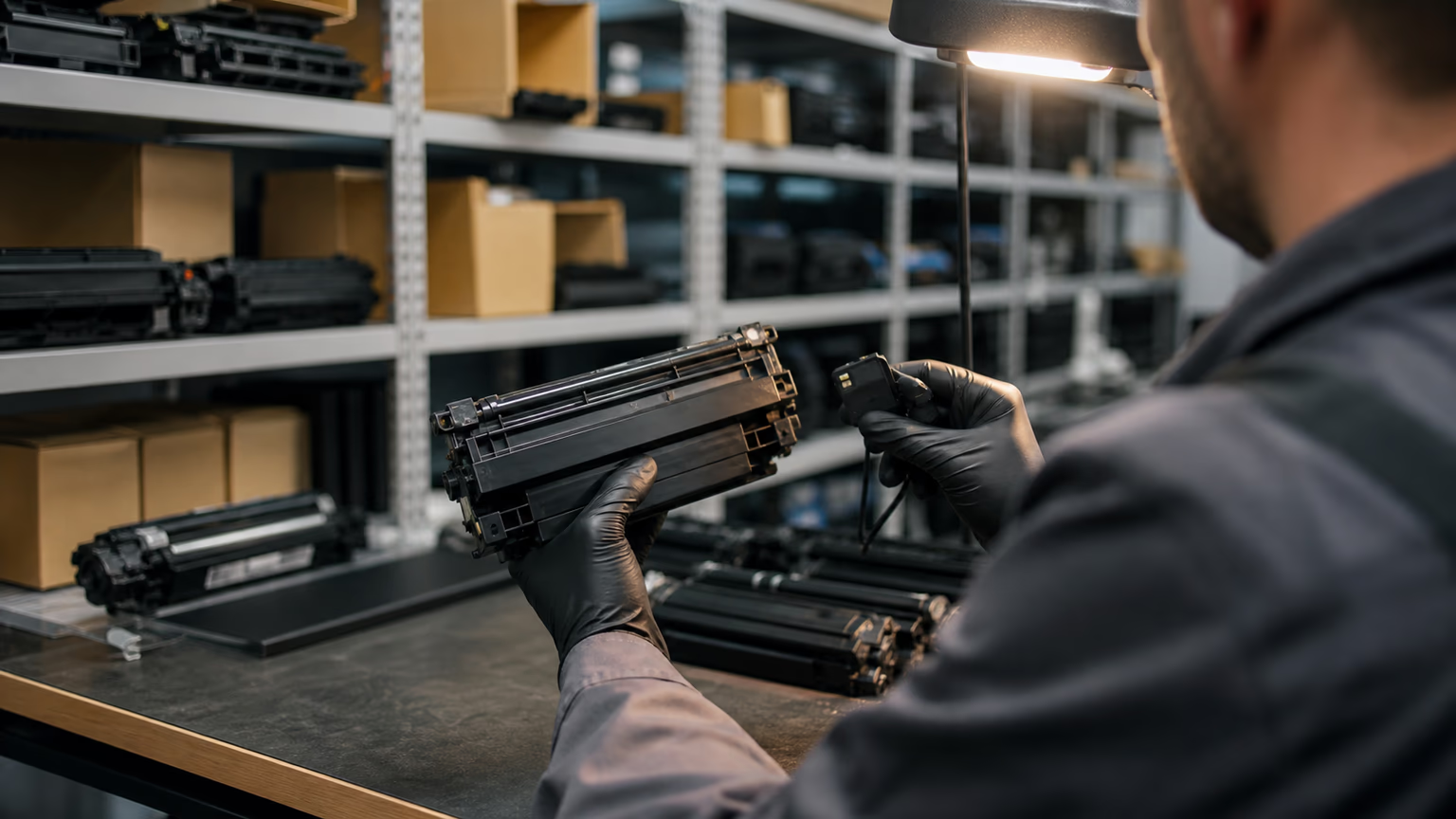
But there's a critical piece missing from this equation—the lived experience of the service engineers who install, diagnose, and replace those cartridges every day.
These frontline technicians see patterns that no lab test can replicate: intermittent fuser errors linked to a specific toner batch, chip authentication failures after a firmware update, or a spike in 'no fault found' call-outs that trace straight back to the cartridge.
When that feedback never reaches procurement, the organisation is flying blind.
This guide is about closing that gap with service engineer feedback loops : a practical, systematic way to capture field data and use it to select, evaluate, and partner with toner suppliers who deliver uptime, not just boxes.
Consider an anonymised example: a large managed-print provider lost a major financial services client not because of hardware failures, but because of persistent print-quality complaints that the helpdesk couldn't resolve.
The service engineers knew the cause—a new compatible toner for high-speed mono devices was causing uneven density and drum wear—but their reports stayed in the ticketing system, unread by procurement.
When the client walked, the cost dwarfed any 'savings' from that cheaper cartridge.
The lesson?
Every service call-out caused by toner is a free data point.
Suppliers should fear it; smart buyers will weaponise it into better decisions and stronger client retention.
Your Service Engineers Are the Most Underused Quality Sensor in Print
Lab-based ISO/IEC yield tests tell you how many pages a cartridge prints under controlled conditions.
Supplier certificates promise quality.
But neither replicates the variable real world of a print fleet: different humidity levels, paper stocks, duty cycles, and firmware versions across dozens of mixed fleet devices.
Service engineers, however, operate precisely in that messiness.
They see that a toner's melting point variance is causing paper jams in a high-speed device, or that a 'universal' chip fails to authenticate on a sub-model that received a last-patch firmware update.
This aggregated, cross-client intelligence is more reliable than any lab test because it captures the actual failure modes that disrupt your clients' business.
The key is to turn engineer anecdotes into documented trends.
A single complaint about streaks is just noise; five identical complaints across three clients with the same cartridge batch become a trend that demands a supplier conversation.
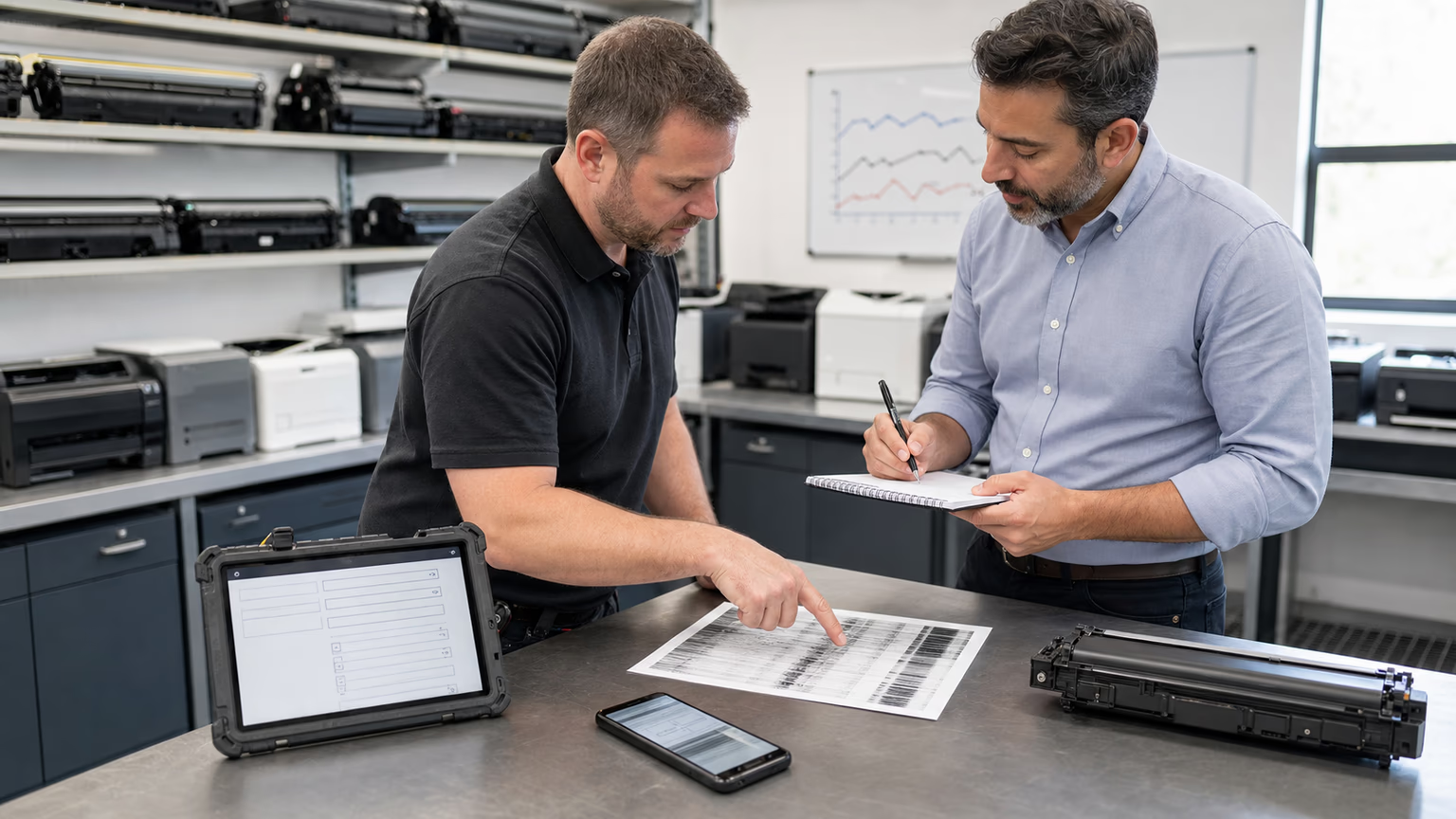
Simple digital logs—whether a custom field in your ticketing system or a mobile form—can capture cartridge model, batch ID, fault code, pages printed before failure, and a photo of the output.
This doesn't require expensive IoT sensors.
It requires intent and a five-second habit during close-out.
When that data flows, procurement stops guessing and starts negotiating with evidence.
The question isn't whether your engineers are a quality sensor; it's whether you're listening.
The Procurement Blind Spot: Price Per Cartridge Kills Fleet Margins
There's a cognitive trap in B2B toner purchasing: the upfront price per cartridge feels concrete and safe, while the future cost of service interventions feels vague and unlikely.
This bias leads teams to celebrate a 5% cost reduction on a bulk toner order, only to watch service margins erode as call-outs spike.
A simplified TCO picture makes the math visible.
Imagine a fleet of 100 mid-volume devices.
A toner that saves £2 per cartridge but triggers just two additional service visits per machine per year—at a fully loaded cost of £50 per visit—adds £10,000 in unplanned expense.
The procurement 'win' becomes a net loss.
Yet without field data, finance never sees that trade-off.
Organisational silos deepen the blind spot.
Service leadership is measured on first-time fix rates and SLA penalties; procurement is measured on spend reduction.
These KPIs can be adversarial.
A service engineer feedback loop bridges this gap by translating service pain into procurement language: cost per page served, not cost per cartridge.
It lets a procurement director walk into a negotiation and say: 'Your cartridge may be cheaper, but our field data shows it causes a 15% higher service intervention rate.
Let's talk about how we reduce that.' Suddenly, the supplier's incentive aligns with uptime, and the conversation shifts from squeezing pennies to protecting margins.
What a Closed Feedback Loop Looks Like in Real Operations
Building a feedback loop doesn't require a massive IT project.
It starts with defining the data points that matter most: cartridge model or SKU, batch/date code, printer model, fault code or symptom, environmental notes (e.g., high-humidity location), pages printed before failure, and a photo.
Then, create a simple capture mechanism.
For a low-tech start, a shared spreadsheet or a dedicated WhatsApp group with a structured template can work.
A better approach is adding a custom field to your existing service management platform, or using a free tool like Google Forms linked to a dashboard.
The goal is to make logging as frictionless as closing a ticket.
Engineer buy-in is crucial, and it rarely comes from a top-down mandate.
Instead, make it part of the daily close-out routine: 'Before you finish the job, snap a photo and log three fields.' Incentivize it by celebrating the engineer who spots the costliest trend each quarter—recognition, not just overtime pay.
Within weeks, patterns emerge.
You might discover that a specific cartridge model fails consistently after 12,000 pages in high-humidity basements, or that a new batch is causing backgrounding across multiple client sites.
This intelligence transforms procurement from a price-shopping function into a strategic risk-management force.
Re-engineering Your Supplier Evaluation Scorecard with Field Data
Once field data flows, your supplier scorecard must evolve.
Move beyond a single line item for 'cost per cartridge' and adopt a Field Performance Index that weights multiple dimensions: real-world MTBF (mean time between failures derived from your own logs), first-call resolution rate for toner-related calls, engineer satisfaction score (a simple NPS-like survey of your own service team), and supplier responsiveness when issues arise.
This index should become the language of RFPs and quarterly business reviews.
When meeting a potential supplier, don't accept glossy brochures.
Ask direct questions: 'Can you provide the last three months of field failure data from your customer base, and walk me through how you closed those loops?' A supplier that cannot or will not share such data is signalling that they either don't track it or don't value field intelligence.
Co-creating a performance dashboard with a willing supplier turns the relationship from transactional to collaborative.
You become a partner that gives them real-world reliability data they can use to improve their product—and they give you preferential treatment, faster issue resolution, and batch consistency guarantees.
This is procurement as a competitive weapon.
From Cost Centre to Profit Centre: How Feedback Loops Boost Your Commercials
For MPS operators and service companies, toner-procurement discipline directly impacts client retention and contract expansion.
Armed with field data, you can show a client: 'We standardised on this specific toner SKU after our engineers logged 12 months of failure data, and we've seen a measurable reduction in your print-quality incidents.' That story justifies your service premium and creates stickiness.
It also reduces SLA penalty risk: when a finance team asks why incident rates dropped last quarter, you can link it to a supplier decision informed by your feedback loop.
Take it further: build a premium service offering called 'Performance-Optimised MPS,' where your supplier selection is auditable and data-backed.
In sales conversations, this becomes a differentiator.
Competitors might bid on price, but you bid on evidence: 'We don't guess which toner works; our engineers have logged 15,000 data points across similar fleets, and we use that to deliver 99.5% uptime on print.' That's a narrative that wins multi-year contracts and lets you avoid the race to the bottom on price-per-page.
But What About OEM vs Compatible? The Feedback Loop Decides
The debate between OEM and compatible toner is often religious, not rational.
A feedback loop removes the emotion.
There are documented cases where a high-quality compatible toner outperforms an OEM cartridge in a specific machine class—for instance, a compatible with better fusing properties in a high-speed mono device reduces jamming and drum wear.
Conversely, there are compatible batches that cause chaos.
The loop doesn't take sides; it surfaces truth.
A blanket OEM-only policy can hide a poorly performing OEM batch that your field data would catch, just as a 'compatible always cheaper' mindset ignores consistent quality issues.
The strategic answer is a hybrid fleet approach: use field data to standardise on the best-performing SKU per machine model, regardless of its origin.
This shifts the conversation from brand loyalty to performance evidence, and it gives you the confidence to challenge any supplier—OEM or third-party—when the data says so.
Your 90-Day Field-Feedback Sprint: A Practical Roadmap
Start small and prove value fast.
In weeks one and two, choose one high-volume printer model across your fleet and create a one-screen digital log using a tool your engineers already know (a ticketing system custom field, a Google Form, or even a structured note in your mobile workforce app).
Define three data points: cartridge batch, fault symptom, and a photo.
Communicate the purpose to the service team: this is about making their jobs easier by flagging bad toner before it escalates, not policing their performance.
Weeks three through six: run the log, and hold a weekly 15-minute stand-up with lead engineers to review submissions.
Spot early patterns.
Is one batch failing at 8,000 pages consistently?
Is a certain cartridge model spiking after a recent firmware update?
Weeks seven to ten: compare your logged data with service call volumes and parts consumption for that model.
You might see a correlation that wasn't visible before.
Weeks eleven and twelve: present your findings to procurement.
Select a supplier engagement pilot—perhaps a dual-source trial where you run two suppliers' cartridges in the same environment and track engineer call-outs.
Negotiate a test batch with explicit feedback terms: if failure rates exceed a threshold, the supplier replaces the batch at their cost and collaborates on root-cause analysis.
This sprint turns a theoretical concept into an operational habit that pays for itself within a quarter.
FAQ
What exactly is a service engineer feedback loop in toner procurement?
It is a structured process where field service engineers systematically record toner-related issues—such as fault codes, cartridge model, print-quality problems, and environmental conditions—and that data is routinely shared with procurement and supplier management.
How do I convince my engineers to log toner issues when they're already overworked?
The key is to minimise friction.
Can feedback loops work if I have a mixed fleet of different printer manufacturers?
Absolutely.
How much can I realistically save by switching to a supplier selected using field data?
While specific savings depend on your fleet size and current failure rates, the financial impact usually comes from reduced service interventions, not just a lower cartridge price.
What if my toner supplier refuses to act on my feedback data?
That refusal is itself a critical data point.
Is a feedback loop an IT project, or can I start with just a spreadsheet?
You can absolutely start with a shared spreadsheet or a cloud-based form.
How do I present field-toner data to my clients without sounding negative about my own supply chain?
Frame it as a commitment to transparency and continuous improvement.
Conclusion
Procurement teams that continue to select toner based on price alone are leaving money on the table and exposing their business to preventable risk.
The missing piece is not more lab tests or bigger sample evaluations—it's the systematic use of service engineer intelligence.
Service engineer feedback loops convert everyday frustrations into a decision-making asset that reduces service costs, increases fleet reliability, and builds unshakeable client trust.
The roadmap is not theoretical; it's a practical discipline that starts with a form, a weekly huddle, and a willingness to let field data challenge old assumptions.
Distributors, MPS operators, and service companies that embrace this approach will differentiate themselves in a crowded market and build a procurement capability that directly contributes to bottom-line success.