
The Margin-Reliability Trap: Why Cheaper Toner Often Costs More
In the competitive world of B2B toner distribution, the pressure to reduce supply costs is relentless.
End-customers demand lower per-page rates, forcing distributors and printer service companies to squeeze every cent out of their consumable spend.
The most obvious reflex is to source cheaper wholesale toner cartridges .
After all, if you can buy a cartridge for less and sell it at the same price, margins expand instantly.
But this logic ignores a dangerous reality: short-term cost savings from unreliable toner can trigger a cascade of hidden expenses that eat away long-term profits and destroy customer loyalty.
The real problem is not the search for lower cost itself, but the assumption that all toner cartridges are equal.
A cartridge with a lower unit price often fails more frequently, produces inconsistent page yields, or causes print defects.
When these failures occur, the costs shift from the procurement ledger to the service ledger.
Every service call, every return, every frustrated client interaction chips away at the very margin you thought you had gained.
For a distributor managing hundreds of devices, a failure rate that rises from a fraction of a percent to just a few percent can double or triple the operational workload, turning a seemingly profitable contract into a loss-maker.
Consider a distributor who decided to switch a portion of their fleet to an ultra-cheap alternative toner.
Initially, the per-cartridge savings looked impressive.
Within three months, however, service tickets for print quality issues spiked.
Technicians were dispatched to replace cartridges, clean contaminated printer interiors, and troubleshoot firmware recognition errors.
The cost of these extra truck rolls and the labour hours quickly surpassed the procurement savings.
Worse, two major accounts chose not to renew their contracts, citing inconsistent output and unplanned downtime.
The distributor not only lost the immediate margin gain but also the lifetime value of those clients.
This scenario is not hypothetical; it plays out repeatedly across the industry when buyers prioritise price over performance.
The margin-reliability trap is that it seems safe until it is not.
A single batch of poorly manufactured toner can lead to a wave of complaints that overwhelm support teams, damage your reputation, and force you to buy emergency OEM stock at premium prices.
The path to better margins toner dealers without sacrificing reliability starts with rethinking what a cartridge actually costs your business.
The true cost per page must include consumable price, expected failure rate, labour for replacement and troubleshooting, and the risk of client churn.
Only then can you make procurement decisions that genuinely improve profitability.
Defining Reliability in Distributor Terms: What Actually Matters
Reliability is often discussed in vague terms, but for a distributor it must be measurable. When you depend on laser printer toner to keep hundreds of client devices running, abstract promises from suppliers are not enough. You need hard data and benchmarks that align with your service level agreements. So what does reliability look like in practice for a B2B toner operation?
First and foremost, page yield consistency is critical.
When a cartridge is rated for 5,000 pages, it must deliver close to that number across multiple batches and under normal usage.
Wide variability disrupts managed print billing models.
If a cartridge consistently yields only 4,200 pages, your cost per page jumps unexpectedly, eroding margins.
Equally important is the failure rate.
A benchmark for high-quality compatible toner is a dead-on-arrival (DOA) rate of less than 0.5%.
That means for every 200 cartridges shipped, no more than one should be non-functional on installation.
Anything above this threshold begins to generate a noticeable service burden.
Print quality stability over the cartridge life is another non-negotiable.
Defects such as streaking, ghosting, or fading that appear mid-life suggest inferior materials or poor manufacturing control.
For clients producing professional presentations or client-facing documents, such defects are unacceptable.
Additionally, compatibility longevity matters.
Modern office printer toner relies on chips that communicate with the printer.
OEM firmware updates can sometimes disable third-party cartridges.
A reliable alternative toner must be engineered to withstand these updates, or the supplier must have a robust process to issue updated cartridges quickly.
Finally, the definition of reliability extends to the supplier’s own behaviour: transparent reporting of batch test results, consistency in component sourcing, and a proven track record of few defects.
When you can track these metrics and share them with your clients, you transform reliability from a marketing claim into a competitive advantage.
Leading distributors often maintain their own internal reliability scorecards for each supplier, tracking not only failure rates but also ease of return, speed of credit, and responsiveness to technical issues.
The True Cost of Unreliable Toner: Beyond the Invoice Price
The invoice price of a toner cartridge is just the tip of the iceberg.
To calculate the real impact of a failure, you must factor in all the operational consequences.
Start with the most direct cost: the replacement cartridge itself.
If a cartridge fails, you ship a new one and often write off the defective unit.
But the larger cost is the labour involved.
A typical service call might cost anywhere from $50 to $150 depending on geography and response times.
If a technician spends half an hour swapping a cartridge, diagnosing the contamination, or cleaning the printer, that time is not billable—it comes straight out of your margin.
Then consider the administrative overhead.
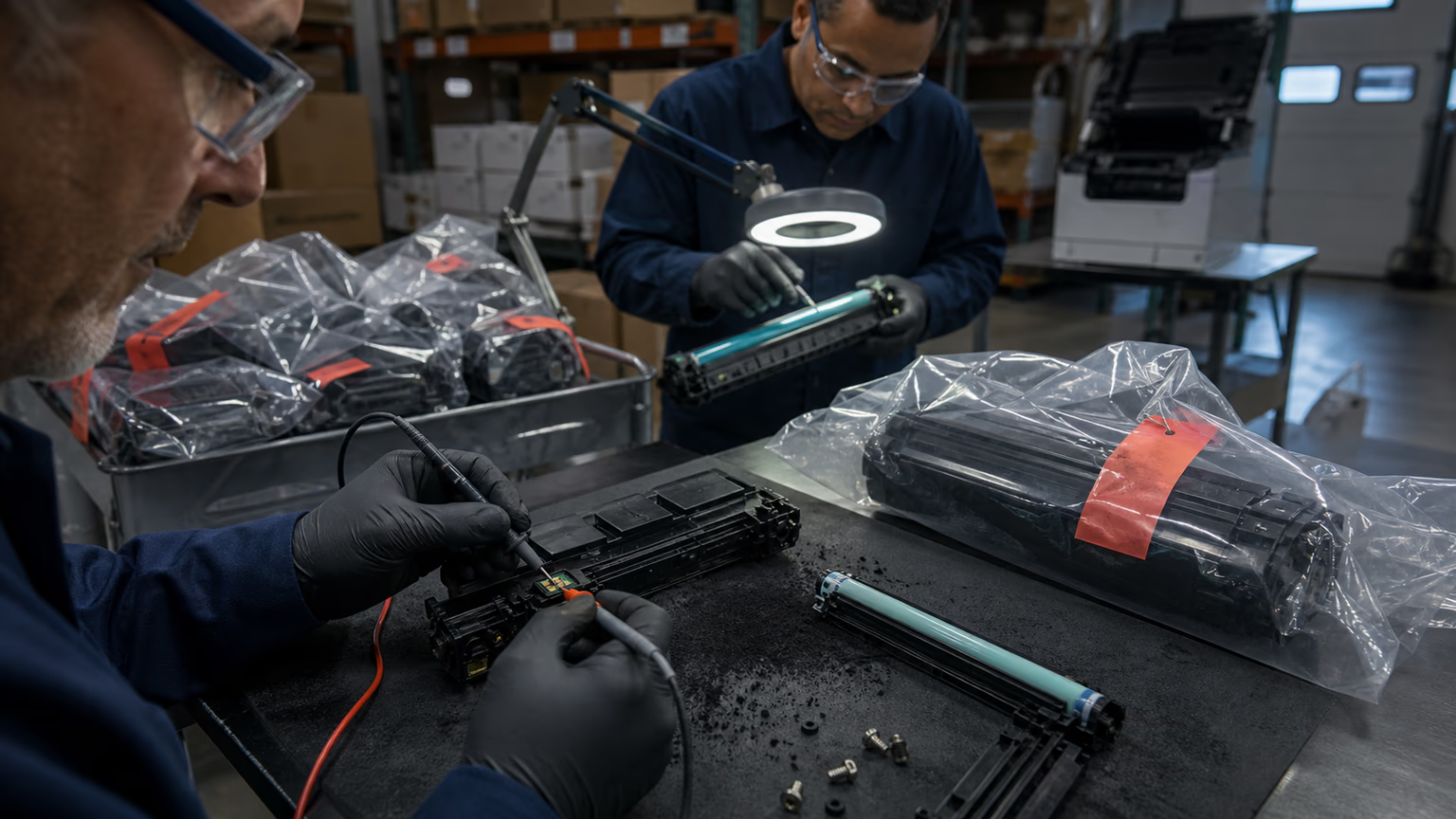
Returning defective cartridges requires processing RMAs, generating shipping labels, tracking refunds, and managing inventory discrepancies.
Each return probably consumes 15–30 minutes of admin time.
Multiply this across dozens or hundreds of failures, and you have a significant hidden cost centre.
Beyond these tangible costs lie the customer relationship risks.
When a client complains about poor print quality, they don’t blame the cartridge—they blame you, the supplier.
Their trust erodes, and they may start looking for alternatives, even if you resolve the issue quickly.
The lifetime value of a managed print services contract can run into tens or hundreds of thousands of dollars; losing a single account due to toner quality issues is a catastrophic loss that far outweighs any short-term cartridge savings.
Inventory buffers are another hidden expense.
When you know a certain percentage of cartridges might fail, you are forced to keep extra stock to fulfil the same contracted page coverage.
That ties up working capital and warehouse space.
You might also need to keep OEM units as emergency backups, paying premium prices when everything else fails.
All these layers add up to a total cost of ownership that makes the cheapest cartridge on the market look like the most expensive choice.
How to Evaluate Alternative Toner Suppliers: An 8-Point Checklist
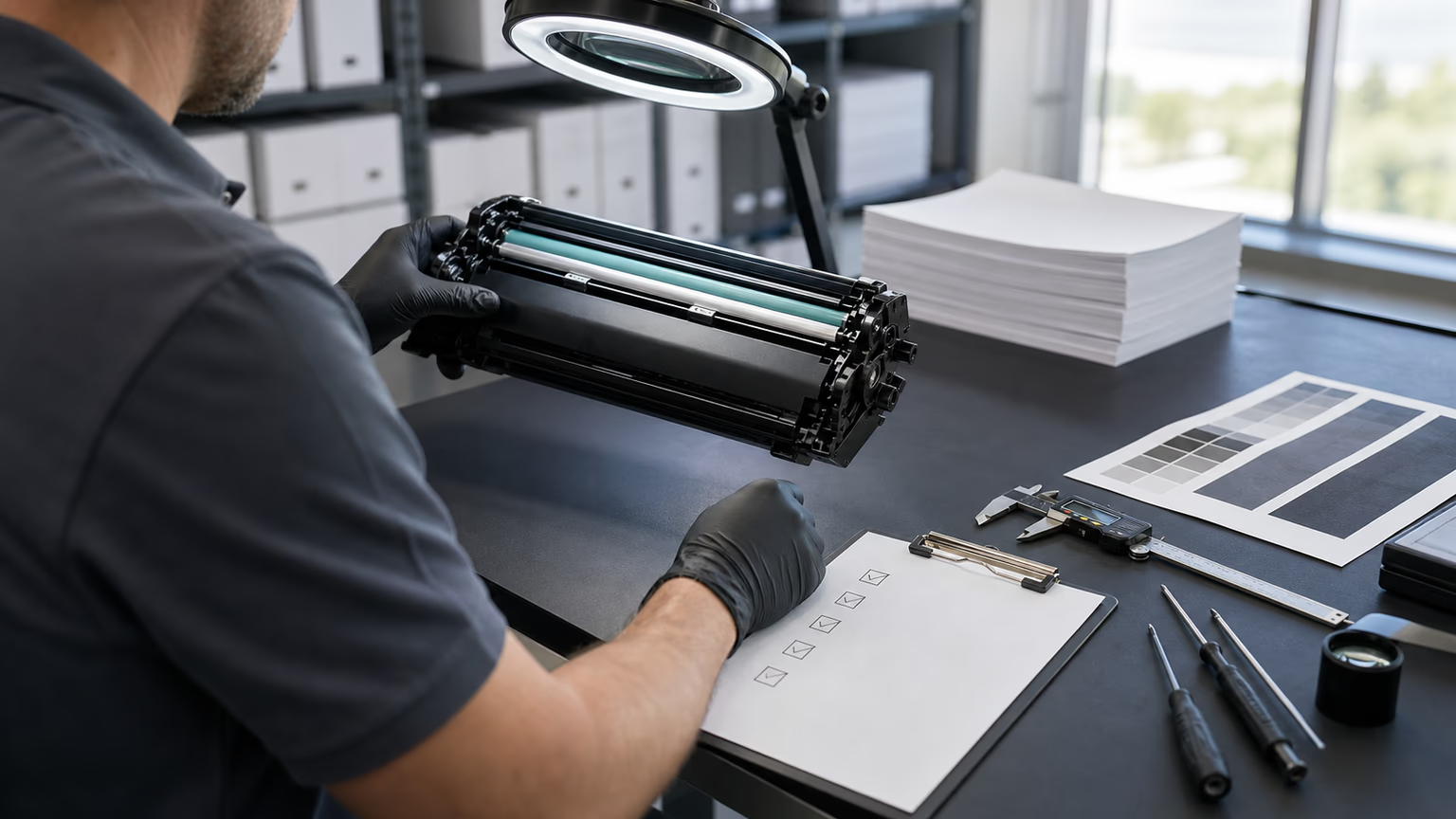
Shifting to alternative toner does not mean embracing risk. It means applying a disciplined evaluation process to separate suppliers who produce consistently reliable products from those who cut corners. Use this eight-point checklist to qualify any potential source before placing a full purchase order.
- Documented quality management system: Verify that the supplier operates under a recognised framework like ISO 9001, which ensures process control and continuous improvement.
- Transparent failure rate and yield data: Demand per-model testing reports with actual page yields and defect rates. A trustworthy supplier will share this without hesitation.
- Component sourcing integrity: Enquire about the origin of critical components—drums, chips, toner powder, and wiper blades. Consistent, high-grade inputs lead to consistent output.
- Firmware compatibility lab: The supplier must have an active testing programme that verifies cartridge performance against the latest OEM firmware versions across a broad mix of printer toner models.
- RMA and support SLAs: Review the return process, turnaround times for credit or replacement, and the availability of technical support. A supplier that hides behind long, bureaucratic procedures is not a partner you want.
- Financial stability: Request trade references and, if feasible, financial statements. You need confidence that the supplier will be around to honour performance guarantees and handle volume orders over time.
- Willingness to provide pilot batches: Any reputable supplier will agree to send sample cartridges for in-house testing. If they resist, consider it a red flag.
- Performance guarantees and contractual terms: Look for suppliers that are willing to put failure rate commitments into the contract, with clear remedies if they fall short.
Using this checklist transforms the procurement conversation from a price negotiation into a quality partnership. It protects your business from the batch-to-batch variability that plagues many low-cost sources and ensures you are buying toner cartridges for distributors that truly support your margin goals.
Managing Compatibility Across Mixed Printer Fleets
One of the greatest fears among distributors considering alternative toner is compatibility. Their clients operate mixed fleets—devices from multiple manufacturers, different ages, and varying firmware levels. A single incompatible cartridge can bring a printer down, trigger a service call, and embarrass the account manager. Fortunately, this risk is manageable with the right protocols.
Start by creating an accurate fleet map for each client.
List every model, its current firmware version, and the monthly volume it prints.
This database becomes the foundation for testing compatible toner for mixed printer fleets .
Before you commit to a new supplier, request sample cartridges for the top five or ten models that represent the bulk of your volume.
Test these in your own lab or with a willing, non-critical client segment.
Run them through their full life cycle, including periods of high duty and idle time, to see how they behave.
Firmware updates are the primary compatibility threat.
Printer manufacturers periodically release updates that can block specific chip configurations.
A proactive approach is essential.
Subscribe to OEM update alerts for the brands you service, and maintain a close relationship with your toner supplier’s engineering team.
The supplier should be able to tell you which firmware versions their chips support and provide revised cartridges within days if a new update causes issues.
Some distributors designate certain high-risk printers to remain on OEM toner, such as those used for colour-critical marketing materials or those under active OEM service contracts.
This segmentation reduces exposure while still capturing savings on the majority of the fleet.
Physical compatibility issues—cartridges that do not fit correctly or cause jams—should be flagged during your pilot testing.
A cartridge that has passed a lab test from hundreds of installation cycles is far less likely to cause field failures.
With a rigorous validation process, you can offer OEM alternative toner cartridges for distributors with confidence, knowing that the compatibility risk has been systematically reduced.
Building a Profitable and Safe Toner Portfolio
A sustainable margin improvement strategy does not demand a 100% switch to alternative toner overnight. It calls for a carefully constructed portfolio that balances cost, risk, and client expectations. The goal is to create a blend where the majority of the fleet runs on reliable, high-quality compatible toner, while critical devices remain on OEM until you have enough data to expand.
Client segmentation is the key.
Categorise your accounts by their sensitivity to brand names, the nature of their output, and their contractual terms.
For clients who produce external-facing marketing collateral or have leadership teams that demand the original brand, keep them on OEM.
For high-volume accounts that print primarily internal documents, pitch the alternative as a way to reduce their per-page cost.
This tailored approach demonstrates that you are not compromising quality but optimising value.
Run controlled pilots before any full rollout.
Select a handful of cooperative clients who agree to test the alternative office printer toner for a defined period.
Monitor failure rates, print quality complaints, and actual page yields against your benchmarks.
Share these data with the client to build transparency and trust.
Once the pilot proves stable, gradually scale up to more devices and clients, all while tracking performance against the supplier’s promises.
This methodical approach allows you to capture better margins toner dealers without sacrificing reliability by aligning procurement with real-world evidence, not supplier claims.
Procurement Contracts That Protect Your Business
A strong supply contract is your best defence against quality drift and hidden costs. When negotiating with alternative toner suppliers, the agreement must go beyond price and delivery schedules. It should embed performance metrics that reflect the real impact of toner failures on your operation.
Include a clear definition of acceptable failure rate—for example, less than 0.5% DOA and less than 2% premature end-of-life.
Link these metrics to financial remedies.
If the failure rate exceeds the threshold over a rolling quarter, the supplier might be required to issue credits, cover labour costs for replacement, or accept returns with no restocking fee.
Such clauses keep the supplier accountable and align their interests with yours.
Pricing structures can also be designed to reward consistency: tiered pricing that becomes more favourable as volume increases, with long-term price stability clauses that protect you from sudden hikes.
Always negotiate an exit strategy.
A contract should allow you to reduce or cancel orders without excessive penalties if the product quality does not meet agreed standards.
Consider multi-supplier risk pooling: instead of relying on a single source, qualify two or three suppliers and split volumes.
This creates competitive pressure on quality and service, while ensuring continuity if one supplier encounters a production issue.
The procurement contract, therefore, is not just a purchase order but a risk management tool that directly contributes to better margins toner dealers without sacrificing reliability .
What Leading Distributors Do Differently: Principles, Not Promises
Observing the practices of successful toner distributors reveals a common thread: they treat toner sourcing as a strategic function, not a clerical task. They do not simply compare unit prices and pick the lowest bidder. Instead, they invest in capabilities that give them an information advantage over competitors.
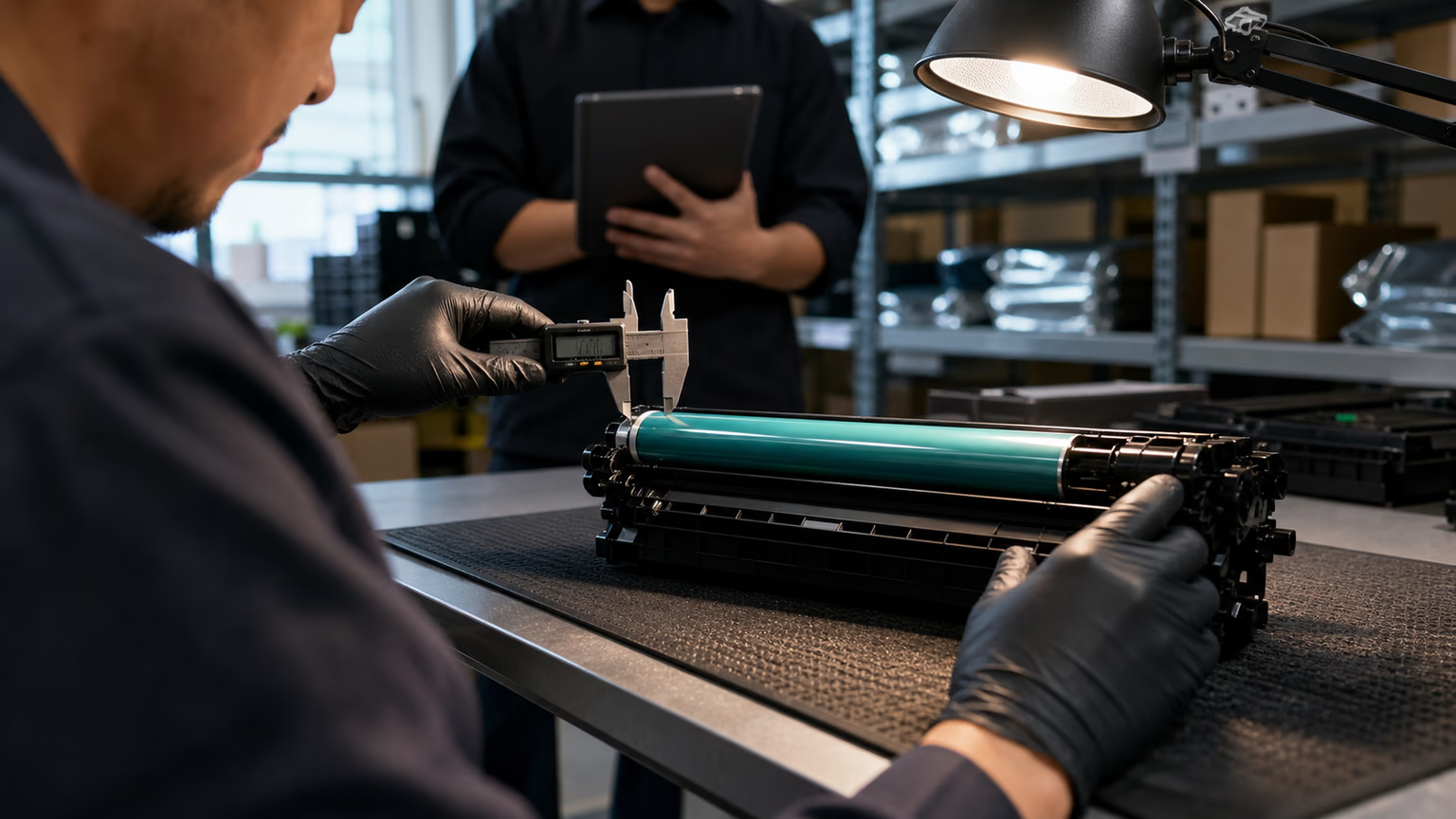
Some maintain a modest in-house testing facility where they regularly sample cartridges from current and potential suppliers.
They print thousands of pages, inspect output quality, measure toner usage, and simulate the stress of a mixed fleet.
This empirical data becomes the basis for supplier scorecards and client reassurance.
When a client asks about reliability, these distributors can show actual performance data instead of providing vague assurances.
They also stay ahead of firmware issues by running compatibility tests immediately after every major OEM update, often before the supplier even notifies them.
Another principle is transparency with clients.
Leading distributors share aggregated quality data—such as average failure rate and page yield consistency—without revealing specific supplier identities.
This practice builds trust and positions the distributor as a credible advisor rather than just a box-shipper.
They also categorise their supplier base, maintaining a mix that includes one or two high-quality alternative manufacturers and keeping OEM relationships for specific situations.
This multi-source strategy insulates them from supply shocks and keeps all suppliers keen on performance.
Ultimately, these distributors understand that their reputation is their most valuable asset. By sourcing printer toner on the basis of total cost of ownership and reliability evidence, they achieve sustainable profitability and customer loyalty that price-alone competitors cannot match.
Your 90-Day Action Plan to Safer Margins
Implementing a reliability-focused toner strategy does not require an upheaval. By following a structured 90-day plan, you can transition methodically while protecting your existing revenue and client relationships.
Weeks 1–2: Audit your true cost per page.
Pull data from your service logs, helpdesk tickets, and accounting system.
For each client contract, calculate the actual cost per page including consumable expense, technician labour for toner-related calls, and returns processing.
This audit will reveal which accounts are already bleeding margin due to poor toner quality and establish a baseline for improvement.
Weeks 3–4: Shortlist and evaluate two alternative suppliers. Using the eight-point checklist, identify potential suppliers that demonstrate strong quality controls and a willingness to share data. Request sample cartridges for your highest-volume models and begin pilot testing in a controlled internal environment.
Month 2: Pilot with a controlled client segment.
Select one or two clients with low brand sensitivity and clear communication.
Explain that you are exploring a value-tier programme to lower their costs, and that they will benefit from early insights.
Equip their devices with the test cartridges, monitor performance daily, and collect feedback.
Keep OEM backups on-site to manage any incident quickly.
Month 3: Review data and scale gradually.
Analyse the pilot results: actual page yields, failure rates, and any service disruptions.
If the results meet your reliability benchmarks, present them to a broader set of clients and gradually expand the programme.
Negotiate a volume agreement with the successful supplier that includes the performance clauses discussed earlier.
Continue to monitor batch quality and firmware updates as you grow, never letting up on the due diligence that made the pilot succeed.
This 90-day approach turns the abstract promise of better margins toner dealers without sacrificing reliability into a concrete, data-driven reality that strengthens your business model for years to come.
FAQ
Can I really achieve better margins without compromising toner reliability?
Yes, by shifting from a price-centric view to a total-cost-of-ownership model. When you factor in the cost of failures, service calls, and customer churn, a reliable alternative toner that costs a bit more up front often delivers far higher net margins than the cheapest option. The key is rigorous supplier qualification and ongoing performance monitoring.
What is the typical failure rate of a high-quality alternative toner cartridge?
A well-engineered alternative cartridge should exhibit a dead-on-arrival rate below 0.5% and a premature end-of-life rate under 2%. These figures are comparable to or even better than some OEM lines when sourced from manufacturers with strict quality systems. Always request batch testing data and confirm these benchmarks before committing to large orders.
How do I test alternative toner without risking my customer relationships?
Start with a controlled pilot. Select a friendly, low-risk client who is open to trying a value programme. Communicate transparently that you are testing a cost-saving initiative, and keep OEM backup cartridges ready. Use only a few devices initially, and monitor them closely. The data you collect will build the confidence to expand.
What should I do if a firmware update blocks compatible cartridges in my fleet?
Proactive communication is vital. Subscribe to OEM update notifications and maintain a direct line to your toner supplier’s technical team. A trustworthy supplier will have a rapid-response plan and can ship updated cartridges within days. Meanwhile, keep a small buffer of OEM cartridges to cover critical printers until the fix arrives.
What are the most important signs of a reliable toner manufacturer?
Look for transparency in failure rate and yield data, ISO 9001 certification, a dedicated compatibility testing programme, and a straightforward RMA process. A supplier that openly shares batch testing reports and welcomes pilot programmes is far more likely to deliver consistent quality. Financial stability and positive trade references also reduce your supply chain risk.
Conclusion
Achieving better margins as a toner dealer does not require you to gamble with reliability.
By shifting the focus from cartridge unit price to total cost of ownership, you can build a supply strategy that protects your service margins and strengthens customer loyalty.
The most profitable distributors are those who invest in careful supplier evaluation, demand transparent quality data, manage compatibility risks, and construct contracts that enforce performance standards.
They treat every toner cartridge as both a cost item and a potential risk to their reputation.
The difference between a thriving distributor and one struggling with service issues often comes down to the discipline of evidence-based procurement.
Do not let the appeal of a slightly lower price override the real costs of failures, returns, and client dissatisfaction.
By applying the frameworks and checklists outlined in this guide, you can steadily migrate a portion of your fleet to reliable alternative toner, capture meaningful margin improvements, and do so without triggering the service nightmares that destroy trust.
In the end, reliability is not the enemy of profit—it is the foundation upon which sustainable profit is built.