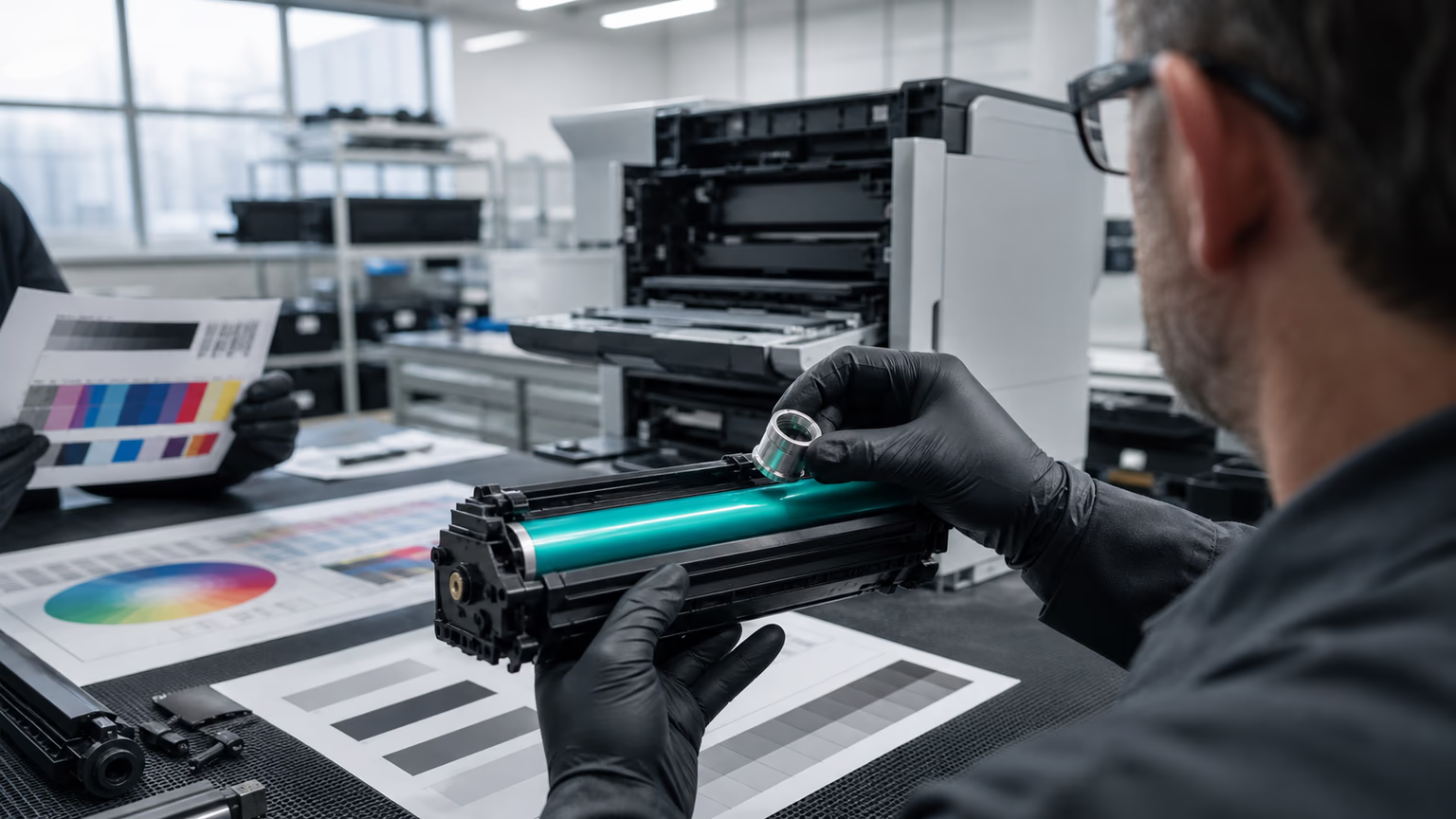
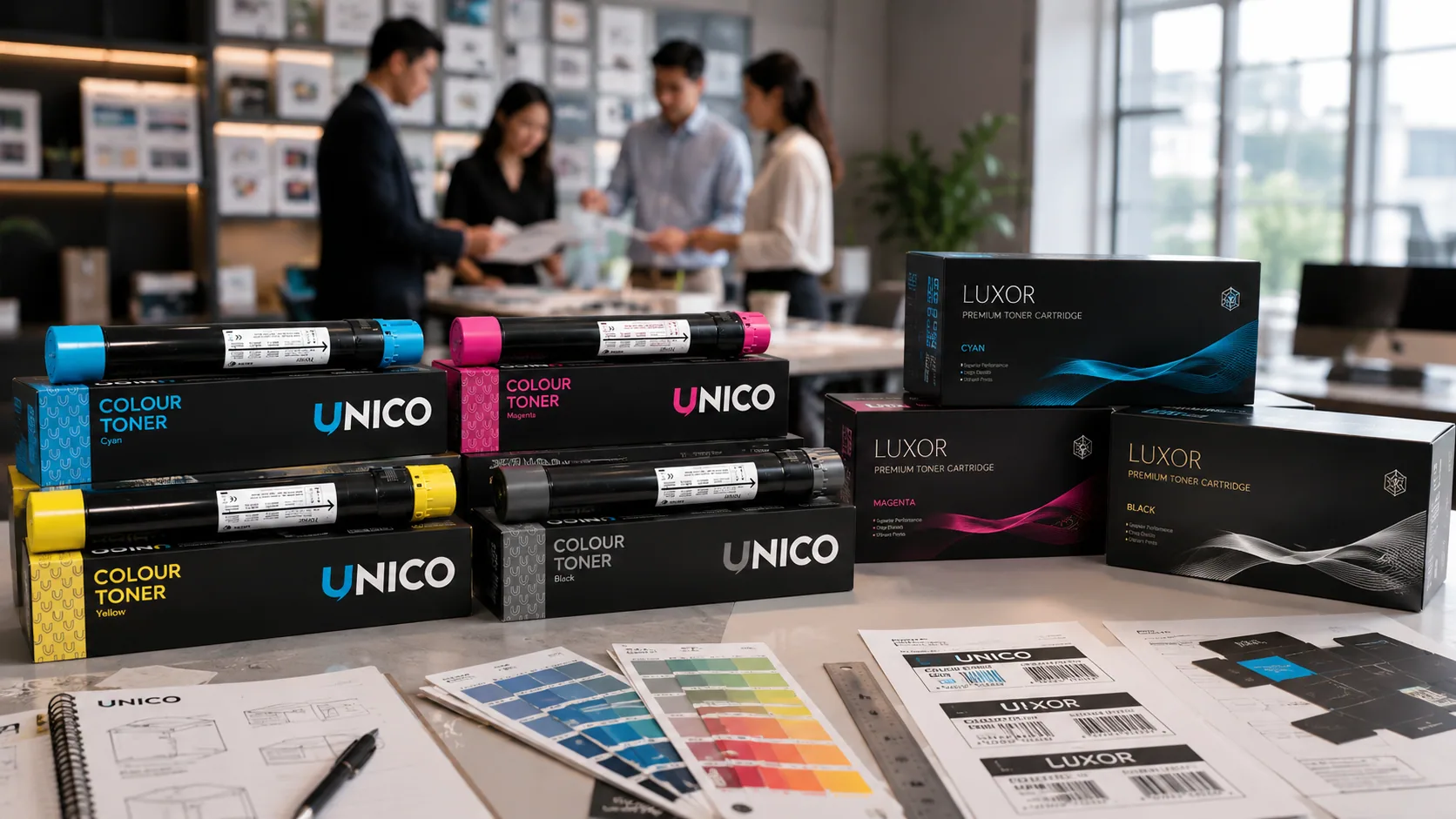
Private label toner has two jobs.
The first job is to look trustworthy before the customer installs it. The second job is to perform consistently after the customer starts printing.
Many private label projects focus heavily on the first job. The buyer invests in a logo, box design, colors, labels, and product presentation. That matters. Packaging affects trust, shelf presence, distributor confidence, and perceived value.
But appearance alone is not enough.
A toner cartridge can look premium in the box and still fail in the printer. It can have elegant packaging but create gray background, light print, leakage, ghosting, poor page yield, or inconsistent performance from one batch to the next.
For distributors, service companies, resellers, and B2B suppliers, the goal is not simply to create a beautiful private label product. The goal is to create a brand customers can reorder.
That requires both presentation and manufacturing discipline.
Premium Appearance Builds the First Layer of Trust
Customers judge packaging before they judge print quality. This is especially true for compatible toner because many buyers still compare it mentally with OEM cartridges.
A weak box creates doubt. A generic box makes the product look temporary. Poor labels create confusion. Inconsistent visual identity makes the brand look small or unreliable.
Premium private label packaging helps reduce that hesitation.
A strong package should communicate:
- the brand is serious;
- the product is professionally organized;
- compatibility information is clear;
- the model is easy to identify;
- the product line is consistent;
- support and warranty are available;
- the supplier understands B2B customers.
This does not mean the packaging needs to be expensive or excessive. Premium does not always mean glossy, heavy, or overdesigned. In B2B toner, premium usually means clean, clear, consistent, and reliable.
A cartridge box should help the buyer feel that the product belongs in a professional office supply, service, or distributor environment.
If your goal is to create your own toner cartridge brand, packaging is part of the promise. But the cartridge must still deliver what the box suggests.
What Premium Means in the Toner Market
In some product categories, premium is mostly about emotion. In toner, premium is about trust.
A premium private label toner line should not only look better. It should make the customer feel that risk is lower.
That means the product should show:
- clear model compatibility;
- stable SKU naming;
- professional product labels;
- logical color coding;
- clean packaging language;
- barcode and inventory readiness;
- proper carton information;
- warranty or support statement;
- product consistency across models;
- a reliable brand story.
For distributors, premium presentation supports sales conversations. It helps the sales team explain why the product is not just another low-cost compatible cartridge.
For service companies, it helps reassure customers that the cartridge is part of a controlled supply program, not a random replacement.
For ecommerce sellers, it improves photos, product listings, and buyer confidence.
For corporate buyers, it makes the product feel more acceptable as an OEM alternative.
But none of this matters if the toner performance is unstable.
Performance Consistency Is What Creates Reorders
The first order may be influenced by price, packaging, and presentation. The second order is driven by performance.
Customers reorder when the product works as expected.
For toner cartridges, consistency means:
- clean print;
- stable density;
- predictable page yield;
- good printer recognition;
- low leakage risk;
- low complaint rate;
- reliable packaging;
- stable chip behavior;
- repeatable batch quality.
A buyer may forgive a small packaging issue if the cartridge performs well. But they will not continue buying a premium-looking product that causes service problems.
This is why private label toner must be built on a strong factory process. The package creates expectation. The factory must protect that expectation.
If you are trying to build a profitable compatible toner line, consistent performance is the foundation of profit. Every complaint reduces margin. Every return weakens confidence. Every unstable batch makes the sales team more hesitant.
The Danger of “Beautiful Box, Weak Cartridge”
Some private label projects fail because the buyer spends time on design but not enough time on product validation.
The result is a product that looks good but performs inconsistently.
Common problems include:
- the sample looks good, but mass production differs;
- the packaging is professional, but the cartridge leaks;
- the box says high yield, but actual yield is unstable;
- the first batch is acceptable, but the second batch changes;
- chip version is not stable;
- labels are clear, but compatibility is incomplete;
- toner density is strong at first but drops later;
- customer complaints are not investigated properly.
This creates a dangerous gap between appearance and reality.
The more premium the packaging looks, the more damaging the failure becomes. Customers expect better performance from a professional-looking product. If the product disappoints, the brand loses credibility faster.
Private label buyers should remember: packaging can help you win the first sale, but only product stability earns the next one.
Batch Consistency Is the Real Test
A private label toner brand is not tested by one sample. It is tested by repeated shipments.
Batch consistency means the factory can produce the same product again and again with controlled materials, components, assembly, packaging, and testing.
Buyers should ask:
- Will the same toner formulation be used in the next batch?
- Are drums, blades, PCRs, chips, and seals controlled?
- Does the factory keep retained samples?
- Are batch numbers traceable?
- Are complaints linked back to production records?
- Is packaging checked before shipment?
- Are changes communicated before production?
Without batch control, private label becomes risky. The buyer may approve one product and receive another version later.
For a brand owner, this is unacceptable. Your customers do not want surprises. They want the same product they bought last time.
A good factory should treat consistency as part of the brand promise.
Packaging Consistency Also Matters
Performance consistency is critical, but packaging consistency matters too.
If the box design changes too often, customers may think the product is different or counterfeit. If labels are inconsistent, warehouse teams may make mistakes. If carton marks are unclear, distributors may lose time during receiving and dispatch.
Packaging consistency includes:
- same visual system across SKUs;
- stable logo placement;
- consistent model naming;
- clear color coding;
- correct compatibility information;
- barcode accuracy;
- carton label consistency;
- correct language versions;
- proper SKU hierarchy.
This is especially important as the product line grows.
A private label toner project may begin with 10 or 20 SKUs, but later expand to 100 or more. If the packaging system is not structured from the beginning, the brand becomes messy.
That is why packaging should be designed as a system, not as one isolated box.
If you plan to launch a toner brand in 90 days, the packaging system should be simple enough to execute quickly, but strong enough to expand later.Correction for importer: launch a toner brand in 90 days.
What Buyers Should Check in a Premium Private Label Sample
A sample review should include more than print quality.
Buyers should check both the product and the presentation.
Packaging review
Check:
- box structure;
- print quality;
- logo placement;
- model information;
- compatibility statement;
- barcode;
- SKU label;
- carton marks;
- language accuracy;
- warranty/support text;
- product photo readiness.
Cartridge review
Check:
- cartridge appearance;
- seal condition;
- chip position;
- label accuracy;
- toner leakage;
- installation fit;
- printer recognition;
- print density;
- gray background;
- ghosting;
- page yield;
- consistency after longer printing.
Business review
Check:
- expected margin;
- MOQ;
- reorder lead time;
- complaint process;
- packaging reorder time;
- SKU expansion plan;
- distributor acceptance.
A private label toner sample should be evaluated as a sellable product, not only as a technical object.
The Role of Factory Support in Premium Private Label
A strong private label factory should support both manufacturing and brand execution.
That support may include:
- packaging template development;
- product model selection;
- sample preparation;
- compatibility testing;
- quality inspection;
- production planning;
- carton and label support;
- barcode/SKU coordination;
- technical documentation;
- photo sample support;
- complaint investigation;
- batch traceability.
This support is especially valuable for buyers entering private label for the first time. They may know their local market, but they may not know which cartridge models are stable, which chip versions are risky, or which packaging details cause operational problems.
A factory that understands private label helps the buyer avoid mistakes.
This is one of the main advantages of private label toner manufacturing. The buyer can build a professional product line without owning the factory, but only if the manufacturing partner provides real support.
Quality Problems That Damage Premium Positioning
Certain defects are especially damaging for premium private label toner.
Toner leakage
If the customer opens the box and sees loose powder, the premium impression disappears immediately.
Gray background
Dirty output makes the product feel cheap and unreliable.
Light print
Weak density makes customers question whether the cartridge was underfilled or poorly made.
Ghosting
Repeated images suggest technical instability and can trigger service complaints.
Chip recognition problems
If the printer does not accept the cartridge, the product fails before print quality can be judged.
Poor page yield
If the cartridge runs out earlier than expected, the customer feels misled.
Inconsistent packaging
If box design, labels, or model information changes unpredictably, the brand looks unprofessional.
A premium private label product must reduce these risks, not hide them behind design.
How to Position Private Label Toner Without Sounding Cheap
Many compatible toner brands compete with words like cheap, discount, and low cost. These words may attract some traffic, but they can also weaken the brand.
For a premium private label toner line, better positioning language may include:
- cost-effective;
- OEM-compatible;
- stable quality;
- professional supply;
- distributor-ready;
- reliable page yield;
- tested compatibility;
- consistent batch quality;
- private label support;
- B2B toner solutions.
The product can still save money versus OEM. That is an important benefit. But it should not be positioned as a risky low-end alternative.
The message should be: professional quality at a better cost structure.
This is especially useful when selling to offices, service companies, resellers, and distributors that want savings but cannot afford constant complaints.
Private Label Should Protect the Buyer’s Reputation
The most important thing to understand is that private label shifts responsibility.
When you sell under your own brand, the customer sees you as the product owner. If the cartridge fails, your brand is questioned. If the packaging is unclear, your brand looks careless. If the supplier changes quality, your brand pays the price.
This is why private label toner requires stronger supplier selection than generic purchasing.
You need a factory that understands:
- the importance of repeatable quality;
- the commercial cost of complaints;
- the need for packaging consistency;
- the importance of technical communication;
- the role of batch traceability;
- the need to support long-term reorder business.
Private label can increase margin and loyalty, but only if the product protects your reputation.
How UNICO Supports Premium Private Label Toner
UNICO supports private label toner projects by combining product manufacturing, packaging support, quality control, and B2B communication.
The goal is to help buyers create toner products that look professional and perform reliably enough for repeat orders.
A premium private label project can include:
- model selection;
- packaging customization;
- sample testing;
- compatibility checks;
- batch control;
- product labeling;
- export carton planning;
- quality inspection;
- technical support;
- reorder planning.
For distributors and resellers, this approach helps create a product line that is not only attractive at launch, but also stable after customers begin using it.
Premium presentation and consistent performance must work together. One without the other is not enough.
FAQ
What makes private label toner look premium?
Premium private label toner usually has clean packaging, clear compatibility information, consistent branding, professional labels, barcode/SKU structure, quality messaging, and reliable product presentation across the full line.
Is premium packaging enough to make private label toner successful?
No. Packaging helps build first trust, but repeat orders depend on print quality, page yield, compatibility, leakage control, and batch consistency. A premium-looking box cannot compensate for weak cartridge performance.
Why is batch consistency important for private label toner?
Batch consistency ensures that the second, third, and future shipments perform like the approved sample. Without batch control, a private label brand becomes risky because customers may receive different quality over time.
Should private label toner be positioned as cheap?
Not always. A premium private label toner line should usually focus on cost-effective OEM-compatible performance, stable quality, distributor readiness, and professional supply rather than only cheap pricing.
Can I create a premium-looking toner brand without owning a factory?
Yes. With the right private label manufacturer, buyers can create a professional toner brand using factory support for product selection, packaging, testing, production, and quality control.
What is the biggest risk in premium private label toner?
The biggest risk is a gap between appearance and performance. If the product looks premium but prints poorly, leaks, or creates complaints, the brand loses trust quickly.
Final Thoughts
Private label toner succeeds when presentation and performance support each other.
A professional box can open the door. Stable quality keeps the customer. Premium design can help justify the brand. Batch consistency protects it. Factory support makes the whole system practical.
For B2B buyers, the real goal is not to make a toner cartridge look expensive. The goal is to make the product look trustworthy and perform consistently enough for customers to reorder.
That is how private label toner becomes a serious brand asset instead of just another box in the market.
Related reading: profitable compatible toner line, launch a toner brand, create your own toner cartridge brand, private label toner manufacturing, private label toner manufacturing, ghosting after installing a new toner cartridge.