Many distributors, office supply companies, service providers, and regional importers reach the same point sooner or later: selling another company’s toner products is useful, but building their own toner brand would create more control, better margins, and stronger customer loyalty.
The problem is obvious. Building a real toner cartridge factory is expensive, complex, and risky.
You need production lines, cartridge molds, toner formulation knowledge, component sourcing, quality control systems, packaging design, compatibility testing, warehouse space, export documentation, trained staff, and a long period of trial and error. Even after all that, you still need stable orders to justify the investment.
For most B2B companies, that does not make sense.
Private label toner manufacturing exists because there is a smarter path.
Instead of building your own factory, you work with an experienced compatible toner manufacturer that already has the production base, testing capability, supply chain, packaging support, and technical knowledge.
Your company builds the brand, controls the market positioning, and sells under your own name, while the factory handles the manufacturing.
When done correctly, private label toner is not a shortcut. It is a practical way to enter the market with lower risk and better speed.
What Private Label Toner Manufacturing Really Means
Private label toner manufacturing means that a factory produces toner cartridges, toner products, or compatible printing consumables under your brand name.
The product may be based on an existing factory model, customized packaging, a selected product range, or a more developed brand program. Depending on the supplier, private label may include:
- your logo on the packaging;
- custom box design;
- product labels and model information;
- selected compatible cartridge models;
- customized packaging language;
- barcode and SKU structure;
- carton marks;
- user instructions;
- warranty cards;
- product photos;
- brand presentation materials;
- export-ready documentation.
At a basic level, private label means your brand appears on the product. At a professional level, it means the product line looks consistent, performs reliably, and gives your customers a reason to trust your company.
That second level is where many buyers fail.
Some companies think private label is only about putting a logo on a box. That is not enough. A real private label toner line needs product selection, quality consistency, packaging discipline, model coverage, inventory planning, and supplier support.
If you want to create your own toner cartridge brand, the product must look and perform like something customers can rely on, not like a temporary sticker on a generic cartridge.
Why Companies Choose Private Label Instead of Factory Ownership
Owning a factory sounds attractive in theory. In practice, it creates a long list of problems.
A toner cartridge factory needs constant production volume.
If order volume is unstable, fixed costs become a burden.
You need to manage raw materials, components, labor, machines, waste, testing, rework, complaints, packaging, and export operations.
You also need technical people who understand toner behavior, cartridge structures, drum systems, chips, seals, blades, rollers, packaging, and model compatibility.
Most distributors do not need that level of operational complexity. They need stable products, reliable supply, and the ability to sell under their own brand.
Private label toner manufacturing allows them to focus on what they already do best:
- customer relationships;
- local market knowledge;
- sales channels;
- distribution;
- service support;
- pricing strategy;
- brand positioning;
- repeat orders.
The factory focuses on what it should do best:
- production;
- quality control;
- compatibility testing;
- component sourcing;
- packaging execution;
- batch consistency;
- export preparation.
This division of roles is what makes private label practical. It allows a company to build a toner brand without becoming a manufacturer from zero.
The Real Value Is Not Only the Box
A private label toner project can fail if the buyer focuses only on packaging. A nice box may help the first sale, but performance decides whether customers reorder.
- Does it fit the printer?
- Does the printer recognize it?
- Is the print clean?
- Is the page yield stable?
- Does the cartridge leak?
- Does the toner create gray background?
- Does the density remain consistent?
- Are complaints handled quickly?
- Does the next batch perform like the first batch?
That is why the best private label toner programs combine packaging and technical control.
Your brand may attract attention, but the factory’s quality system protects the brand after sale.
This is especially important for distributors and service companies. If the product fails, the customer does not blame the factory in China. The customer blames the brand printed on the box. That brand is yours.
So private label toner must be treated as a long-term product line, not a quick logo project.
Choosing the Right Product Range
A common mistake is launching too many SKUs too quickly.
A buyer may want to cover every major printer brand immediately: HP, Canon, Brother, Samsung, Xerox, Ricoh, Sharp, Kyocera, Toshiba, and more. On paper, this looks impressive. In real operations, it can create inventory pressure, quality risk, and confusion.
A better approach is to start with a focused product range.
For example:
- high-demand models in your current market;
- models already used by your existing customers;
- cartridges with stable demand and clear compatibility;
- products where you can compete against OEM pricing;
- models with reliable factory testing data;
- SKUs suitable for distributor or service contract sales.
A private label toner brand does not need to launch with hundreds of models. It needs to launch with the right models.
This is why launch a toner brand in 90 days should be treated as a structured plan. The goal is not to create the biggest catalog on day one. The goal is to create a product line that can be sold, tested, replenished, and expanded intelligently.
Factory Support Makes the Difference
Private label toner manufacturing works best when the factory provides more than production.
The right factory should help with:
- model selection;
- packaging structure;
- compatibility confirmation;
- sample preparation;
- print testing;
- page yield expectations;
- carton and label details;
- export documentation;
- complaint analysis;
- reorder planning;
- product line expansion.
This type of support is especially important for companies entering toner under their own brand for the first time. They may understand their market very well, but not every buyer understands cartridge engineering, chip risks, drum selection, toner formulation, or packaging for export.
A good factory helps reduce these gaps.
That is why the goal is not only to find a cheap supplier. The goal is to find a manufacturing partner that can help you build a profitable compatible toner line without learning every lesson the hard way.
Packaging: Where Many Private Label Projects Look Weak
Packaging is not just decoration. It is part of customer trust.
In many markets, compatible toner still carries a perception risk. Customers may worry that non-OEM cartridges will print poorly, leak, damage machines, or create service problems. A weak box design makes those doubts stronger.
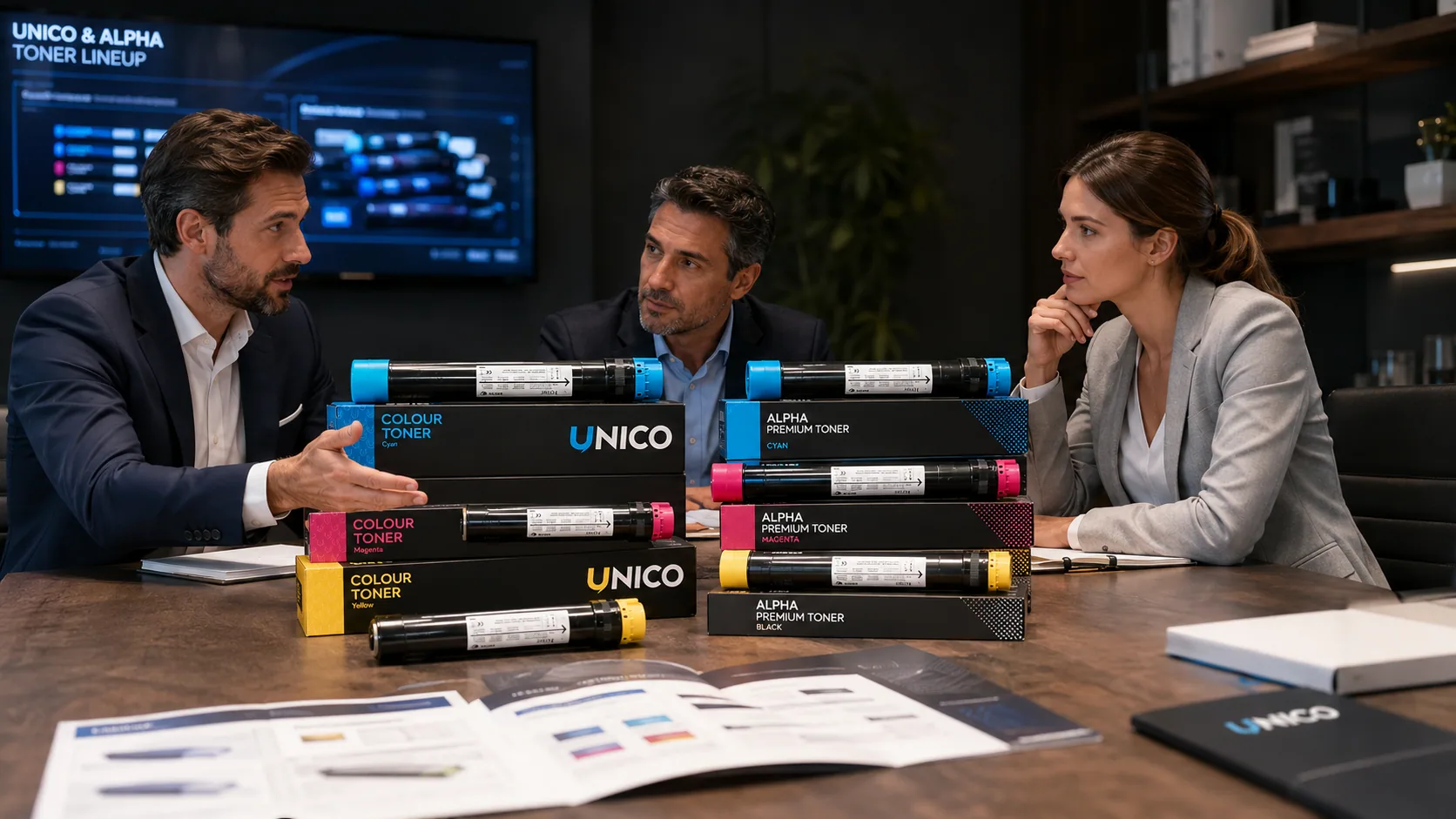
A strong private label package should communicate:
- clear model compatibility;
- professional brand identity;
- product category;
- quality confidence;
- warranty or support information;
- clean barcode/SKU structure;
- proper language for the target market;
- export and handling information;
- visual consistency across the line.
The packaging should look like it belongs on a professional shelf, not like a generic export box.
This is where private label toner that looks premium becomes important. Premium appearance is not about making the box expensive for no reason. It is about reducing customer hesitation and supporting the brand’s pricing power.
A product that looks cheap is often forced to compete only on price. A product that looks professional has more room to communicate quality, reliability, and service.
Quality Consistency Is the Core of Brand Protection
Private label is powerful because it builds brand equity. But that also means quality problems become brand problems.
If a generic cartridge fails, the customer may forget the supplier name. If your branded cartridge fails, the customer remembers your brand.
This is why batch consistency is one of the most important parts of private label toner manufacturing.
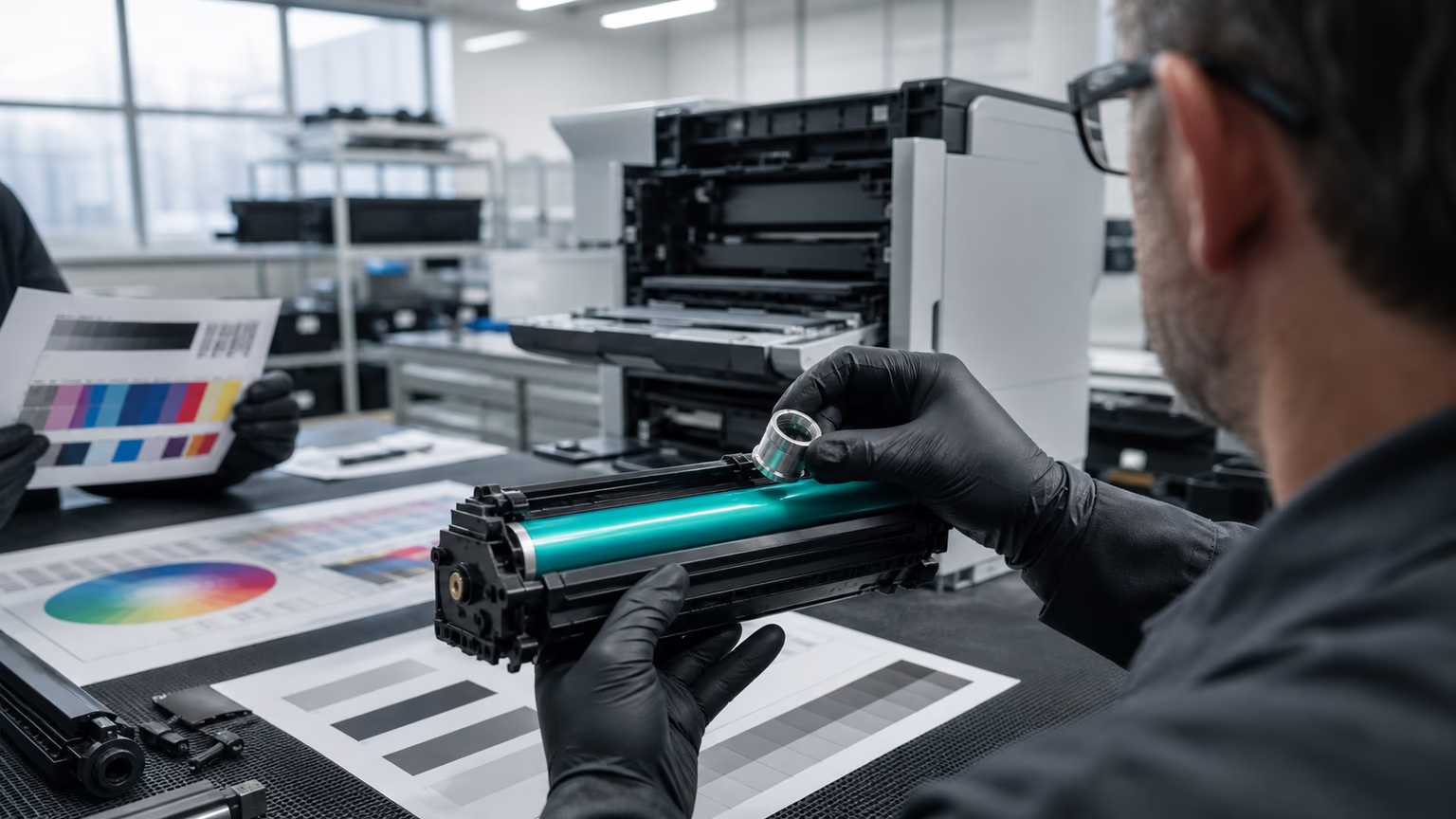
A serious factory should control:
- toner formulation;
- component sourcing;
- drum quality;
- PCR quality;
- blade stability;
- seal strength;
- chip compatibility;
- cartridge assembly;
- print testing;
- packaging inspection;
- retained batch samples.
Private label buyers should ask whether the factory can keep quality stable from the first order to the fifth order and beyond.
A sample is not enough. A good first shipment is not enough. The real test is repeatability.
For B2B buyers, repeatability is what allows the brand to grow. If every batch behaves differently, sales teams lose confidence, customers complain, and the brand becomes difficult to defend.
The Role of Samples
Samples are important, but they must be used correctly.
Some buyers test samples only by printing a few pages and checking whether the text looks dark. That is too limited.
A proper sample test should include:
- installation experience;
- printer recognition;
- first-page quality;
- solid black density;
- fine text clarity;
- grayscale areas;
- longer print run;
- page coverage variation;
- leakage inspection;
- background check;
- ghosting check;
- storage and handling review;
- packaging quality;
- comparison with current product or OEM.
If possible, samples should be tested by real users, not only internal procurement staff. Service technicians and sales teams can often identify issues that buyers miss.
After sample approval, the buyer should confirm whether mass production will use the same materials, same components, same toner, and same packaging structure. The worst situation is approving one sample and receiving a different product in production.
Minimum Order Quantity and Risk Control
Private label toner usually requires a minimum order quantity because the factory must produce custom packaging, labels, and sometimes product-specific materials.
However, a good launch plan should control risk.
Instead of placing a huge first order, buyers can start with:
- a limited SKU range;
- selected high-demand models;
- pilot market launch;
- controlled first shipment;
- customer feedback collection;
- reorder planning after real market response.
This approach helps the buyer avoid overstocking slow-moving models or committing too much capital before demand is proven.
Private label should be built step by step. The first goal is not to impress everyone with catalog size. The first goal is to prove that the market accepts the product and that customers reorder.
Who Should Consider Private Label Toner?
Private label toner manufacturing can be a strong option for:
- office supply distributors;
- copier and printer service companies;
- regional importers;
- B2B resellers;
- ecommerce sellers with repeat demand;
- managed print service providers;
- corporate procurement suppliers;
- private label brands in office consumables;
- wholesalers looking for higher margin.
It is especially useful for companies that already sell toner or cartridges but want more control over brand identity, pricing, and customer retention.
If your business already has customers asking for compatible toner, private label may help you capture more value from demand you already control.
If your business has no customer base, private label is still possible, but you need a stronger launch plan, marketing strategy, and product positioning.
What Can Go Wrong
Private label toner can fail when buyers treat it too casually.
Common mistakes include:
- choosing a factory only by lowest price;
- launching too many SKUs;
- ignoring compatibility testing;
- using weak packaging;
- not checking chip requirements;
- approving samples too quickly;
- skipping long-run print tests;
- not defining quality standards;
- failing to plan reorder cycles;
- not preparing after-sales support;
- changing suppliers too often.
The biggest mistake is thinking private label is only a branding exercise. In toner, branding and manufacturing are connected. The box creates expectation. The cartridge must fulfill it.
If the product does not perform, the brand becomes a liability instead of an asset.
How UNICO Supports Private Label Toner Projects
UNICO supports private label toner projects by combining manufacturing capability with practical B2B support. The goal is to help distributors and resellers build a product line that looks professional, performs consistently, and can grow over time.
A private label project can include:
- product model selection;
- sample preparation;
- compatibility confirmation;
- packaging customization;
- brand presentation;
- production planning;
- quality inspection;
- export support;
- batch consistency control;
- after-sales technical communication.
For buyers who want to enter the market without building their own production base, this approach reduces time, cost, and operational risk.
The buyer does not need to become a toner engineer overnight. But the buyer does need a factory partner that understands toner manufacturing and protects the brand behind the box.
FAQ
What is private label toner manufacturing?
Private label toner manufacturing means a factory produces toner cartridges or compatible printing consumables under your brand name. The buyer owns the brand positioning and sales channel, while the factory handles production, packaging, testing, and supply.
Do I need my own factory to launch a toner brand?
No. You can launch a toner brand through private label manufacturing without building your own factory. This allows you to use an existing manufacturer’s production capability while selling products under your own brand.
What should I prepare before starting a private label toner project?
You should prepare your target market, brand name, expected product range, packaging requirements, model list, quality expectations, sales channels, and launch timeline. A good factory can help refine the product selection and packaging plan.
Is private label toner only about putting my logo on a box?
No. Logo placement is only one part of private label. A serious project should include product selection, compatibility testing, quality control, packaging structure, SKU planning, and after-sales support.
How many SKUs should I launch with?
Most buyers should start with a focused range of high-demand models instead of launching too many SKUs at once. A smaller but reliable range is easier to test, sell, replenish, and improve.
What is the biggest risk in private label toner?
The biggest risk is quality inconsistency. If the product fails, customers blame your brand, not the factory. That is why factory selection, batch control, testing, and complaint handling are critical.
Final Thoughts
Private label toner manufacturing gives distributors and B2B suppliers a practical way to build their own brand without building a factory. It reduces production risk, speeds up market entry, and allows companies to focus on customers, sales, and market development.
But private label toner should never be treated as a simple logo project. The brand on the box must be supported by real manufacturing discipline, stable quality, reliable packaging, and factory-level support.
The companies that succeed with private label toner are not the ones that only ask for the lowest price. They are the ones that build a product line customers can trust and reorder.
With the right factory partner, your own toner brand can become more than a resale product. It can become a long-term business asset.
Related reading: profitable compatible toner line, launch a toner brand, create your own toner cartridge brand, private label toner, private label toner manufacturing, compatible toner manufacturer.