Launching a toner brand sounds like a long and complicated project. For many distributors and B2B suppliers, the idea feels attractive but difficult: create a brand, choose cartridge models, test samples, design packaging, organize production, arrange shipment, and then convince customers to buy.
If you try to build everything from zero, it can take years.
But if you work with the right private label toner manufacturer, the first version of your brand can be launched much faster. In many cases, a focused toner brand can move from sample selection to shelf-ready products in about 90 days.
That does not mean rushing the process or skipping quality checks. It means using an existing manufacturing base, proven cartridge models, packaging support, and a structured launch plan.
The key is discipline. A 90-day launch works only when the buyer and factory focus on the right product range, clear quality expectations, packaging execution, and realistic first shipment planning.
What “Launch in 90 Days” Really Means
Launching a toner brand in 90 days does not mean building a global brand from nothing in three months. It means preparing a commercially usable private label product line that can be sold to customers, placed in inventory, listed in a catalog, shown to distributors, or used for market testing.
A realistic 90-day launch may include:
- brand name confirmation;
- first SKU selection;
- sample testing;
- packaging design;
- carton and label setup;
- barcode and SKU planning;
- production confirmation;
- pre-shipment inspection;
- export packaging;
- first shipment;
- launch materials;
- sales presentation;
- product listing support.
This is a practical first step, not the final version of the brand. The goal is to enter the market with a controlled product line, collect customer feedback, and improve the next order.
The biggest mistake is trying to launch too much too soon. A focused first launch is usually stronger than a large but poorly controlled catalog.
If you need to start without building your own production base, private label toner manufacturing is the fastest and lowest-risk route.
Day 1–10: Define the Brand Position
Before selecting cartridges, the buyer should define what the brand is supposed to represent.
Many toner brands fail because they have no clear position. They are just another box with another logo. Customers do not understand why they should trust it, buy it, or reorder it.
Your brand position should answer:
- Are you targeting offices, distributors, resellers, schools, service companies, or ecommerce customers?
- Will the product compete mainly on price, quality, availability, or service?
- Is the brand positioned as premium compatible, cost-effective, eco-conscious, high-yield, or private label for B2B supply?
- What customer problem does the brand solve?
- Why should a buyer choose your product instead of generic compatible toner?
For example, a distributor selling to corporate offices may position the brand around stable quality and lower cost than OEM. A service company may focus on fewer complaints, predictable page yield, and technical support. A reseller may focus on shelf presentation, model coverage, and fast-moving SKUs.
This decision affects packaging, product selection, pricing, and sales language.
If your goal is to create your own toner cartridge brand, the brand must be more than a name. It must communicate confidence before the customer opens the box.
Day 10–20: Choose the First Product Range
The next step is SKU selection.
This is where many buyers become too ambitious. They want to launch with dozens or hundreds of models across every major printer brand. That may look impressive, but it creates risk.
A 90-day launch should start with a focused range.
Good first-launch SKUs usually have:
- strong demand in your market;
- clear compatibility;
- stable factory production history;
- available components;
- acceptable page yield;
- low complaint risk;
- reasonable MOQ;
- good margin potential;
- clear replacement demand;
- compatibility with your existing customers’ printers.
If you already sell toner, start with models your customers already buy. If you are entering the category for the first time, work with the factory to identify reliable, proven, high-demand models.
A good first range might include 10–30 SKUs, not 300.
The goal is not to create a giant catalog immediately. The goal is to build a product line that can sell, perform, and be reordered.
This is also where factory support matters. A serious manufacturer can help you build a profitable compatible toner line by recommending models with stable performance, manageable MOQ, and proven demand.
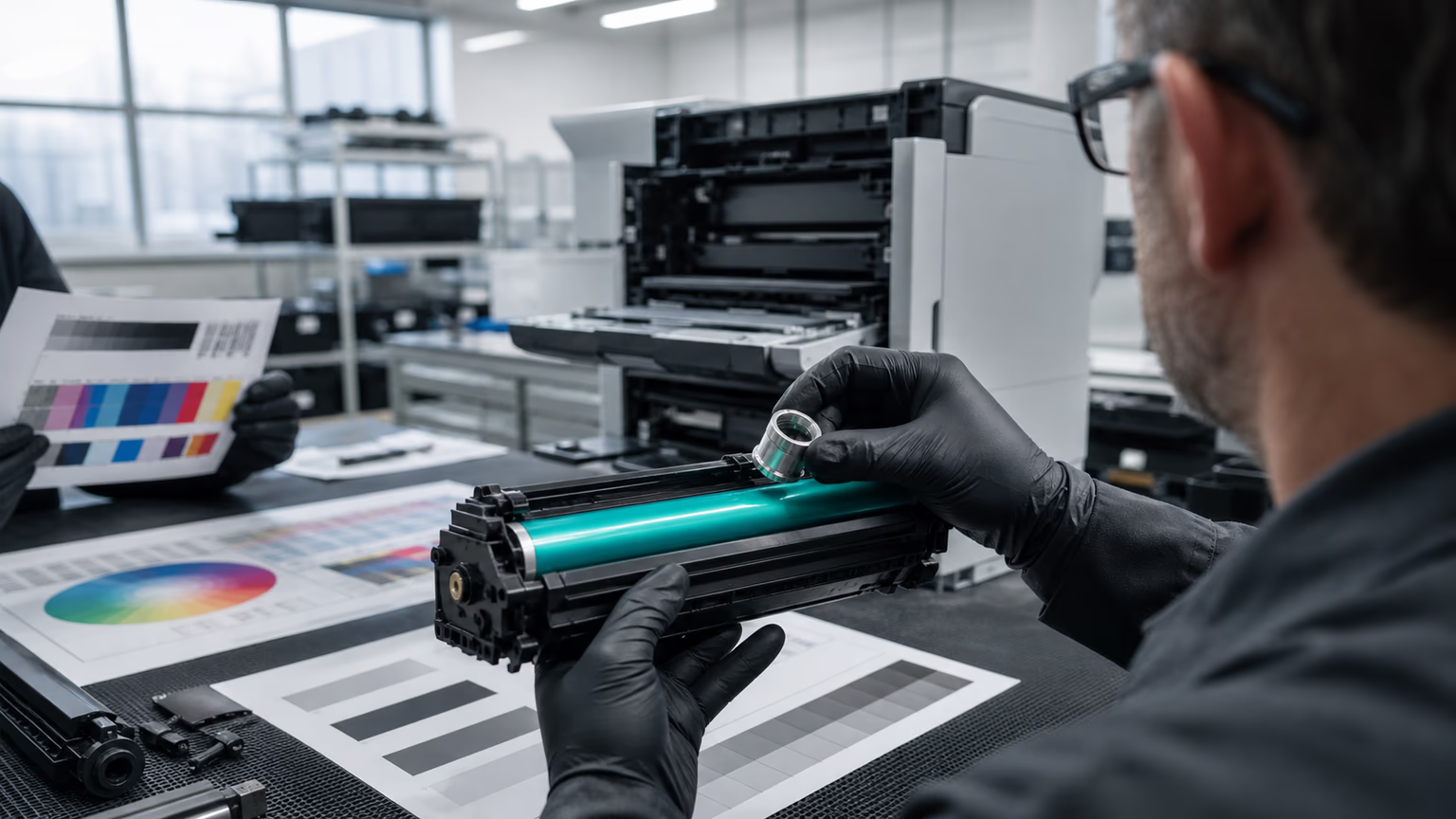
Day 20–35: Prepare and Test Samples
Samples are the first real test of the project.
But sample testing should be structured. Many buyers print a few pages, check whether the text looks dark, and approve the product. That is not enough for a private label toner launch.
Sample testing should include:
- installation experience;
- printer recognition;
- text sharpness;
- solid black density;
- grayscale areas;
- page coverage variation;
- initial page quality;
- longer print run;
- leakage check;
- gray background check;
- ghosting check;
- page yield expectations;
- packaging sample review;
- comparison with current supplier or OEM.
The buyer should also test samples in real customer conditions if possible. A product may perform well in a factory test room but face different conditions in a school, office, service fleet, warehouse, or humid environment.
Sample testing should answer two questions:
- Can this product perform well enough to carry our brand?
- Can this factory reproduce the same quality in mass production?
The second question is often more important than the first.
A perfect sample is useless if mass production changes materials, components, toner, chip, drum, blade, or packaging quality without control.
Day 30–45: Confirm Quality Standards
Before mass production, the buyer and factory should agree on quality expectations.
This should not be vague. “Good quality” means different things to different people.
The quality agreement should cover:
- print density expectations;
- page yield target;
- compatible printer models;
- chip requirements;
- leakage tolerance;
- packaging condition;
- carton strength;
- sample approval reference;
- inspection method;
- batch traceability;
- complaint handling process;
- replacement policy;
- documentation requirements.
For a private label brand, quality standards protect both sides. The buyer knows what to expect. The factory knows what must be controlled. If a complaint appears, both sides have a reference point.
This is especially important when launching a brand in a market where customers already compare products against OEM cartridges or established compatible brands.
Your first shipment sets the reputation. If the first batch creates complaints, the brand may struggle before it has a chance to grow.
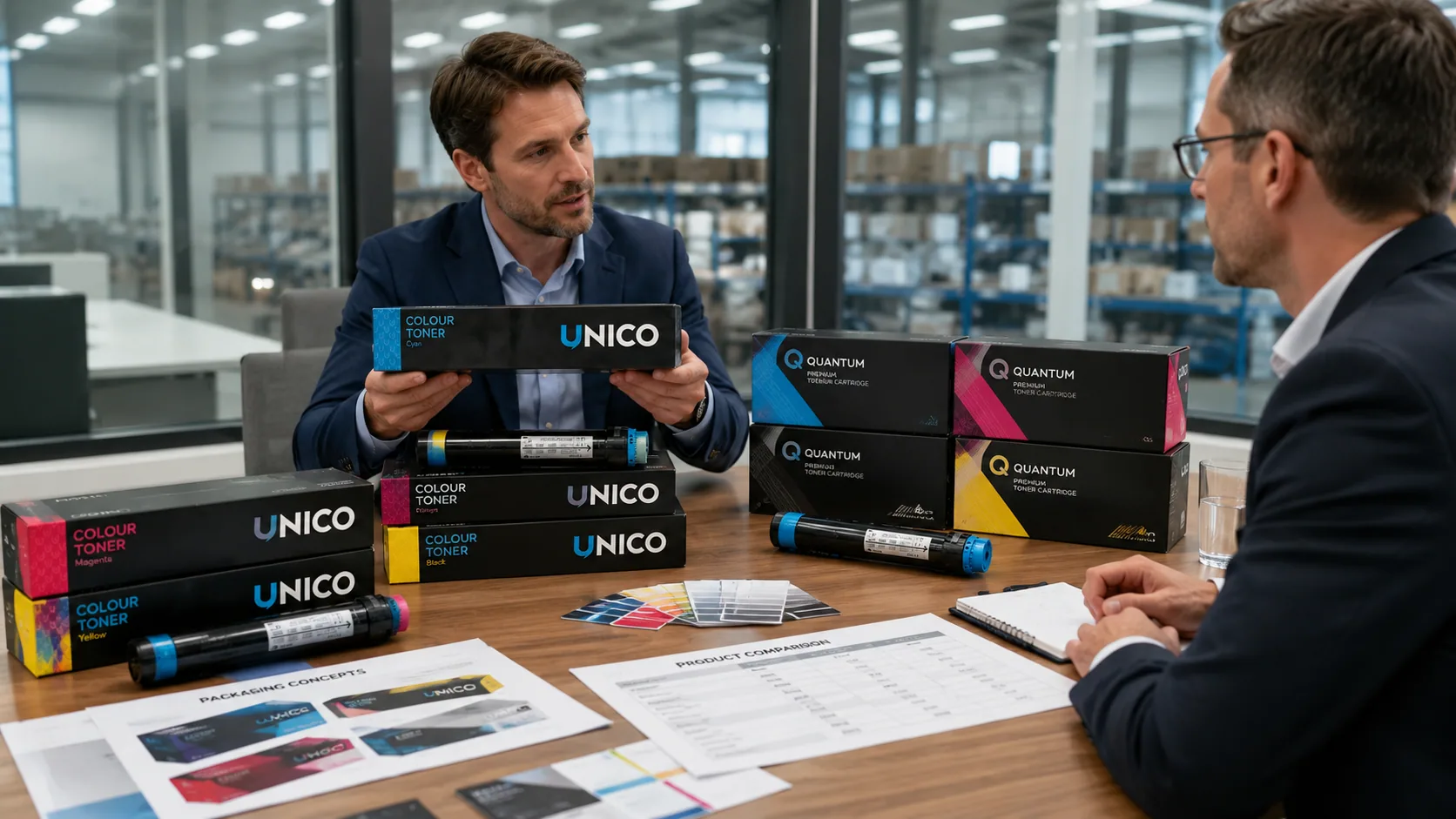
Day 35–55: Build the Packaging System
Packaging is one of the most visible parts of the launch.
A private label toner box should not look like a generic export carton with a logo pasted on it. It should look like a coherent product line.
A good packaging system includes:
- brand logo;
- product category;
- model number;
- compatible printer information;
- color coding if needed;
- yield information if applicable;
- barcode;
- SKU code;
- safety or handling icons;
- warranty/support note;
- language appropriate for the target market;
- carton marks;
- consistent visual style across SKUs.
The design should also support operations. Warehouse staff, sales teams, distributors, and customers must be able to identify the model quickly.
Good packaging reduces confusion and supports trust. Poor packaging creates hesitation.
This is why private label toner that looks premium matters. Premium appearance is not only about design taste. It helps the buyer defend pricing, build trust, and avoid looking like a temporary low-end product.
Day 45–60: Confirm Pricing and Margin
A toner brand must be profitable, not just attractive.
Before placing the first production order, the buyer should calculate:
- factory price;
- packaging cost;
- design cost;
- sample cost;
- shipping cost;
- duty and import tax;
- warehouse cost;
- local delivery;
- sales commission;
- expected return rate;
- warranty reserve;
- marketing cost;
- target wholesale price;
- target retail price;
- distributor margin.
Many buyers underestimate hidden costs. They compare factory price against selling price and assume the margin is high. But after logistics, customs, local handling, stock risk, and after-sales support, the actual margin may be smaller.
A good private label strategy considers both product cost and commercial structure.
The goal is not only to launch a toner brand. The goal is to launch a profitable toner brand.
This is why product range matters. Fast-moving models with stable demand may create better business than rare SKUs with high theoretical margin but slow turnover.
Day 55–70: Prepare Production
Once samples, packaging, and pricing are confirmed, the factory can prepare production.
Before production starts, the buyer should confirm:
- final artwork files;
- box dimensions;
- label information;
- SKU list;
- model compatibility;
- toner type;
- chip version;
- packaging quantity;
- carton marks;
- inspection requirements;
- delivery timeline;
- shipping method;
- required documents.
The factory should confirm material availability and production schedule. If some components have longer lead time, the buyer should know before the deadline becomes a problem.
For a 90-day launch, communication discipline is critical. Delays often happen because artwork is not approved, labels are incomplete, model information is unclear, or the buyer changes SKUs late in the process.
A private label project moves faster when both sides work from a clear checklist.
Day 65–80: Inspect and Prepare for Shipment
Before shipment, inspection should confirm that the product matches what was approved.
A basic inspection should include:
- correct SKU and model;
- correct packaging;
- barcode and label accuracy;
- carton marks;
- product appearance;
- seal condition;
- random print testing;
- leakage check;
- packaging strength;
- quantity verification;
- photo documentation.
For the first order, inspection is especially important. This is the first time the brand will appear as a finished product, not just as a sample or mockup.
If the first shipment goes to distributors or important customers, any packaging mistake can create confusion. A wrong model label, unclear compatibility statement, or weak carton can damage confidence before the cartridge is even used.
A serious factory should support pre-shipment inspection and provide clear records.
Day 80–90: Launch Preparation
While the products are being shipped or prepared for delivery, the buyer should prepare sales and marketing materials.
A basic launch kit may include:
- product photos;
- product list;
- compatibility chart;
- price list;
- brand introduction;
- warranty policy;
- sales presentation;
- FAQ;
- website product pages;
- distributor sheet;
- email announcement;
- sample offer;
- reorder process.
The launch is not complete when the goods arrive. The sales team must know how to present the product and answer customer questions.
Customers may ask:
- Is this compatible with my printer?
- How does it compare with OEM?
- What happens if it fails?
- Is there a warranty?
- What is the page yield?
- Can I reorder the same model later?
- Is the packaging ready for resale?
- Can you support bulk orders?
If the buyer cannot answer these questions confidently, even a good product may sell slowly.
What Should Be Ready by Day 90
By the end of a disciplined 90-day launch, the buyer should have:
- approved product range;
- tested samples;
- confirmed packaging;
- first production order;
- shipment plan;
- launch materials;
- product photos;
- sales documents;
- warranty policy;
- website or catalog listings;
- distributor communication;
- reorder plan.
This is not the end of brand development. It is the beginning of real market learning.
After the first shipment, the buyer should monitor:
- customer feedback;
- complaint rate;
- fast-moving SKUs;
- slow-moving SKUs;
- reorder behavior;
- packaging feedback;
- price resistance;
- sales team objections;
- distributor interest;
- technical issues.
The second order is often more important than the first. It shows what the market actually wants.
Why Factory Support Is Critical During Launch
A private label toner launch involves many moving parts. Without factory support, buyers can lose time on avoidable problems.
The right factory can help with:
- narrowing the SKU list;
- avoiding unstable models;
- preparing samples quickly;
- checking compatibility;
- designing packaging structure;
- confirming label details;
- adjusting carton information;
- planning production;
- preparing documentation;
- investigating early complaints.
This support reduces the buyer’s learning curve.
If you are trying to move from sample to shelf quickly, the factory must be more than a price source. It must be a launch partner.
That is why working with a manufacturer experienced in private label toner manufacturing can save time, money, and frustration.
Common Mistakes That Delay a 90-Day Launch
A 90-day launch is possible, but only if common mistakes are avoided.
Choosing too many SKUs
Too many models increase sample work, packaging complexity, MOQ pressure, and inventory risk.
Changing packaging too late
Late artwork changes can delay printing and production.
Testing samples too casually
Weak sample testing can lead to complaints after launch.
Ignoring chip compatibility
For many printer models, chip version and regional compatibility matter.
Using unclear model labels
If customers cannot identify compatibility, sales and returns suffer.
Focusing only on price
A low price cannot protect the brand if the product creates complaints.
Skipping pre-shipment inspection
Small mistakes become expensive once the goods arrive.
Launching without sales materials
The product may be ready, but the sales team may not be ready to sell it.
How UNICO Supports a 90-Day Toner Brand Launch
UNICO can support private label toner buyers through the full launch process: product selection, sample preparation, packaging customization, compatibility checks, production planning, quality control, and export preparation.
The goal is to help buyers move from idea to shelf-ready product without building their own factory or managing every technical detail themselves.
For distributors, resellers, service companies, and regional importers, this can shorten the path from market opportunity to sellable product.
A strong launch does not require doing everything at once. It requires choosing the right first products, presenting them professionally, and making sure the cartridge performance supports the brand promise.
That is also why a 90-day launch should connect with a broader plan to build a profitable compatible toner line over time.
FAQ
Can I really launch a toner brand in 90 days?
Yes, a focused private label toner brand can often be launched in about 90 days if the buyer uses existing factory models, confirms packaging quickly, tests samples efficiently, and starts with a controlled SKU range. A large, fully customized product line may take longer.
Do I need to design every cartridge from zero?
No. Most private label toner projects use proven compatible cartridge models from an existing manufacturer. The buyer customizes branding, packaging, product selection, and market positioning.
How many models should I start with?
Most buyers should start with a focused selection of fast-moving models. Depending on the market, 10–30 SKUs may be more practical than launching hundreds of models at once.
What is the biggest delay in launching a toner brand?
Common delays include late packaging approval, unclear SKU lists, slow sample testing, artwork changes, chip compatibility questions, and missing label information. A clear launch checklist prevents many delays.
Should I wait until every translation, catalog, and sales page is perfect?
No. The first launch should be professional, but it does not need to be perfect. It is better to launch a focused, stable product line and improve based on real market feedback.
What should I check before approving production?
Before production, confirm sample performance, packaging artwork, SKU list, compatibility information, barcode, carton marks, quality expectations, inspection process, and delivery schedule.
Final Thoughts
Launching a toner brand in 90 days is realistic when the project is focused, structured, and supported by the right factory.
The buyer does not need to build a factory. But the buyer does need to make clear decisions: target market, product range, packaging, quality expectations, pricing, and launch materials.
A successful private label toner launch is not about rushing. It is about removing unnecessary complexity and using an experienced manufacturing partner to move faster with lower risk.
From sample to shelf, the best 90-day projects are built on discipline: choose the right products, test properly, package professionally, inspect before shipment, and prepare the sales team before the goods arrive.
Related reading: profitable compatible toner line, private label toner manufacturing, create your own toner cartridge brand, private label toner, private label toner manufacturing, compatible toner manufacturer.