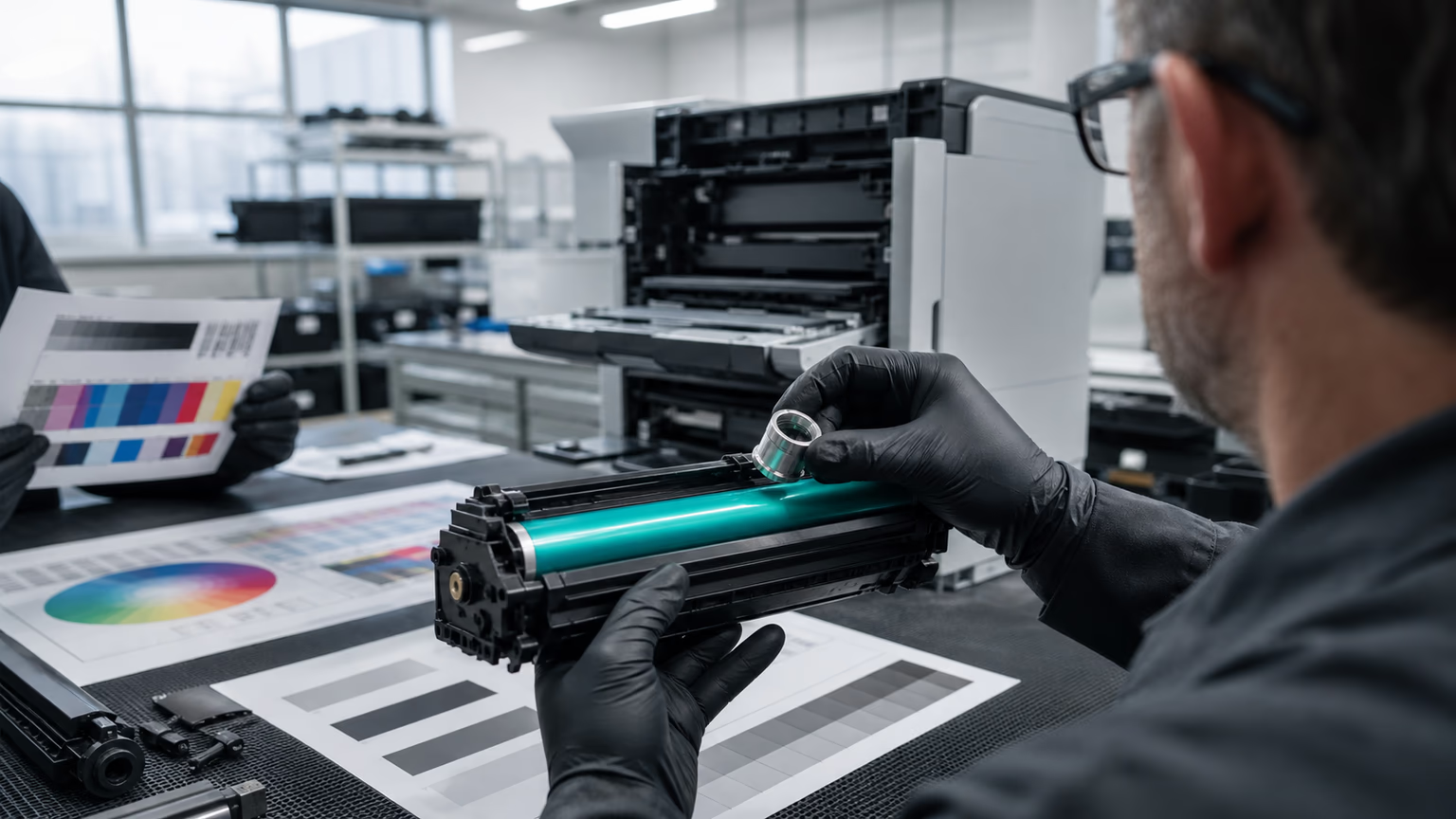
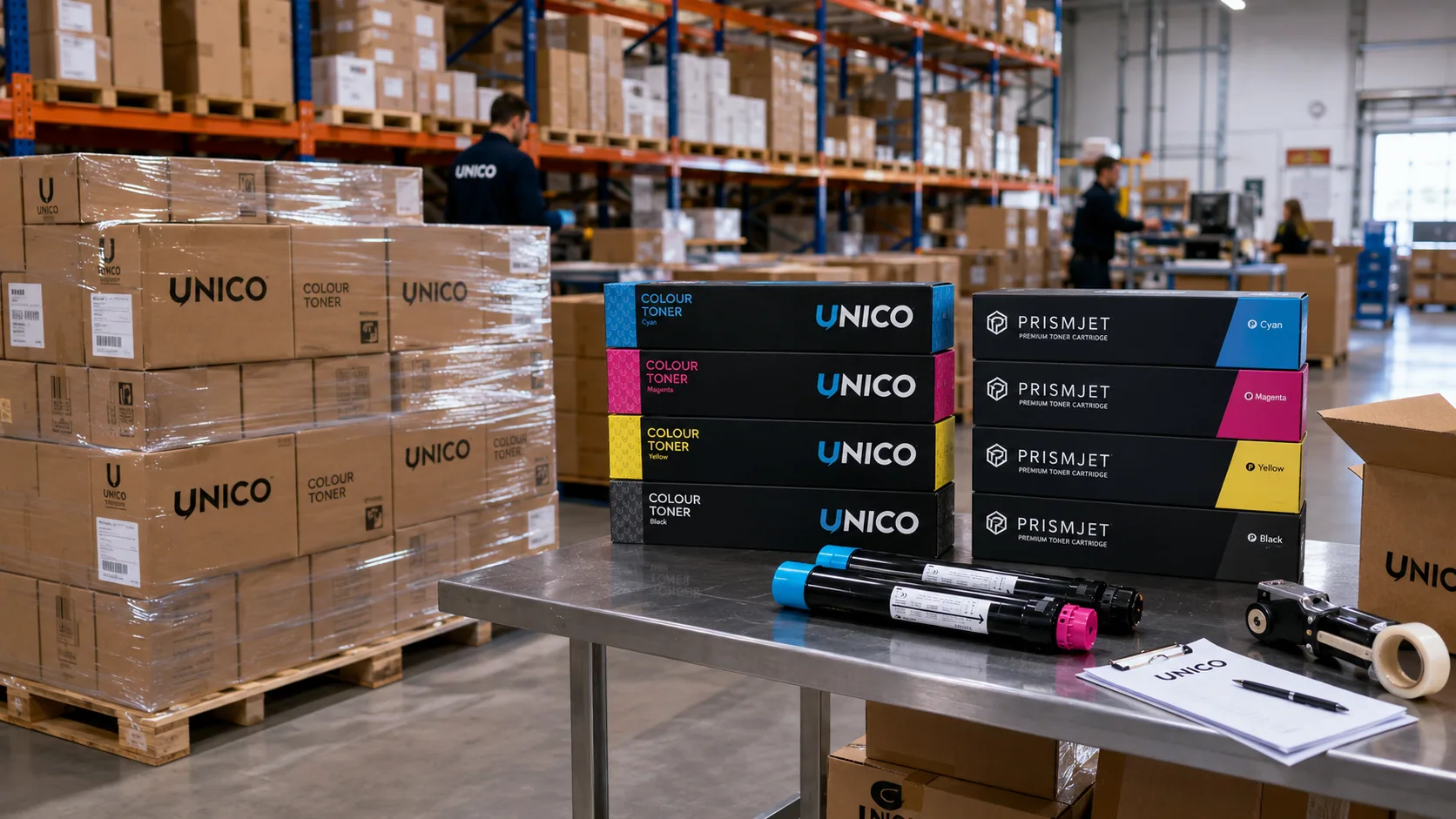
Creating your own toner cartridge brand is one of the most attractive ways to move beyond simple resale. Instead of selling another supplier’s name, you build a brand that customers recognize, reorder, and associate with your company.
For distributors, office supply companies, service providers, ecommerce sellers, and regional importers, this can create real commercial advantages: stronger margins, better customer retention, more control over presentation, and less dependence on generic products.
But a toner cartridge brand cannot be built with a logo alone.
In the printing consumables market, customers judge a brand by two things: how professional the product looks before installation and how reliably it performs after installation. If the box looks weak, buyers hesitate. If the cartridge performs poorly, they do not reorder. If the packaging looks premium but the print quality is unstable, the brand loses trust even faster.
That is why OEM-level presentation matters.
OEM-level presentation does not mean pretending to be an OEM product. It means building a compatible toner brand that looks organized, credible, consistent, and professional enough for B2B customers to trust.
What OEM-Level Presentation Really Means
OEM-level presentation is not about copying original brands. It is about matching the level of clarity, consistency, and confidence that professional buyers expect from established products.
For a toner cartridge brand, this includes:
- clean brand identity;
- consistent box design;
- clear model compatibility;
- professional product labels;
- accurate SKU structure;
- barcode readiness;
- proper carton marks;
- high-quality product photos;
- warranty or support statement;
- clear user information;
- reliable product documentation;
- consistent presentation across models.
The goal is simple: when a customer sees your product, it should not feel like an unknown low-end cartridge. It should feel like a serious compatible toner solution.
This matters because compatible toner still faces trust barriers in many markets. Buyers may worry about leakage, printer recognition, gray background, light print, page yield, chip issues, or customer complaints.
Professional presentation cannot solve these problems by itself, but it can reduce hesitation and create the right first impression.
If you want private label toner that looks premium, OEM-level presentation is the visual and operational foundation.
A Brand Is More Than a Box
Many buyers begin by asking for packaging. They want a logo, box design, color scheme, and labels. That is understandable, but it is only the visible part of the brand.
A real toner cartridge brand also needs:
- product positioning;
- target customer definition;
- model selection;
- compatibility data;
- quality standards;
- price structure;
- warranty policy;
- complaint process;
- reorder planning;
- sales materials;
- technical support information.
Without these elements, the brand is only decoration.
A customer may buy once because the box looks good. But they will reorder only if the product performs well, the model information is clear, the support process works, and the supplier can deliver the same quality again.
This is why creating a toner cartridge brand should be treated as a product-line project, not only a design project.
Why Distributors Build Their Own Toner Brands
Distributors and resellers often start by selling existing brands or generic compatible toner. This can work, but it has limits.
When you sell someone else’s product, you usually have less control over:
- pricing;
- packaging;
- customer loyalty;
- product positioning;
- market differentiation;
- reorder relationship;
- brand recognition;
- sales materials;
- product changes;
- long-term strategy.
With your own toner cartridge brand, the relationship changes. Customers begin to connect the product with your company. Your sales team can promote your own line. Your packaging can match your market. Your product range can fit your customer base. Your margin structure can become more stable.
This is why many B2B suppliers eventually consider private label toner manufacturing. They do not want to build a factory, but they do want to own the customer-facing brand.
Private label manufacturing allows them to do that without taking on the full cost and complexity of production.
The First Decision: What Kind of Brand Are You Building?
Before designing the box, you need to define the brand.
Different toner brands can have different positions.
Cost-effective OEM alternative
This brand focuses on reliable performance at a lower cost than OEM.
Premium compatible toner
This brand focuses on professional presentation, stable quality, and B2B trust.
Distributor-ready product line
This brand focuses on clear SKUs, model coverage, cartons, pricing, and repeat supply.
Service-company toner line
This brand focuses on fewer complaints, easy troubleshooting, stable page yield, and technical support.
Ecommerce toner brand
This brand focuses on product photos, clear compatibility, customer reviews, and low return rates.
Private label wholesale line
This brand focuses on scalability, packaging consistency, MOQ management, and reorder planning.
The brand type affects everything: packaging, copywriting, pricing, product selection, and sales strategy.
A brand that sells to service companies should not look or speak exactly like a brand that sells to home users. A brand built for distributors should not be designed only for online retail. A product line for corporate buyers needs a different trust structure than a low-cost marketplace listing.
Product Selection Defines the Brand Experience
Your brand will be judged by the first products customers use. That makes SKU selection critical.
It is better to launch with a focused, stable range than a large but risky catalog.
A good starting range should include models that:
- have real demand in your market;
- match your existing customer base;
- have stable compatible production;
- offer meaningful savings versus OEM;
- have manageable chip risk;
- have clear compatibility information;
- can be tested properly;
- can be reordered reliably;
- provide acceptable margin.
A weak first SKU can damage the entire brand. If the first cartridge leaks, prints poorly, or causes printer recognition problems, the customer may not give the brand a second chance.
This is why a brand launch should connect with a broader plan to build a profitable compatible toner line. Profitability depends on selecting models that sell well, perform consistently, and create repeat orders.
Packaging Must Be Designed as a System
OEM-level presentation requires system thinking.
Many private label projects design one box nicely, then struggle when the product range expands. The design may not work for different sizes, colors, models, languages, barcodes, or carton labels.
A good packaging system should answer:
- Where does the logo go?
- Where is the model number?
- Where is the compatible printer information?
- How are black and color cartridges identified?
- How are brands and series separated?
- Where does the barcode go?
- How are different languages handled?
- What information appears on the retail box?
- What information appears on the carton?
- How will the design scale from 10 SKUs to 100 SKUs?
This matters for warehouse operations, sales teams, distributors, and end customers. Good packaging reduces mistakes. Bad packaging creates confusion.
For a toner brand, packaging is not just marketing. It is also product information architecture.
Clear Compatibility Information Reduces Returns
One of the most common causes of toner cartridge returns is confusion about compatibility.
A customer buys the wrong model, installs it in the wrong printer, or misunderstands regional differences. Sometimes the cartridge itself is fine, but the information was not clear enough.
OEM-level presentation should make compatibility easy to understand.
The packaging and product listing should show:
- compatible printer models;
- cartridge model number;
- OEM reference number if appropriate;
- color;
- yield information where applicable;
- region or chip warnings if needed;
- clear SKU code;
- support contact or QR code.
For B2B buyers, clear compatibility is especially important because products move through multiple hands: importer, distributor, warehouse, reseller, technician, and end user.
Every unclear label increases the chance of a mistake.
A strong factory should help prepare accurate compatibility information before production.
Quality Must Match the Presentation
A professional box creates expectation. The cartridge must meet it.
If the product presentation suggests reliability but the cartridge creates defects, the brand loses credibility.
Key performance areas include:
- clean print;
- stable density;
- page yield consistency;
- low leakage risk;
- printer recognition;
- low gray background;
- low ghosting risk;
- stable chip behavior;
- acceptable fusing;
- batch repeatability.
This is where OEM-level presentation and manufacturing quality must work together.
A brand can survive a simple design. It cannot survive repeated performance problems.
The factory should support the buyer with sample testing, batch control, retained samples, component consistency, print testing, and complaint analysis.
If your product looks professional but the factory cannot control repeat quality, the brand is exposed.
Sales Materials Make the Brand Easier to Sell
A toner cartridge brand also needs sales tools.
At minimum, buyers should prepare:
- product catalog;
- SKU list;
- compatibility chart;
- product photos;
- packaging photos;
- brand introduction;
- warranty policy;
- FAQ;
- distributor price list;
- sales presentation;
- website pages;
- reorder sheet;
- technical support notes.
These materials help sales teams explain the brand and reduce repeated questions.
For distributors, sales materials are especially important. A sales representative needs to answer quickly: which model fits which printer, how the product compares with OEM, what the warranty is, and why the customer should trust the brand.
OEM-level presentation should continue beyond the box. It should appear in the catalog, website, product sheet, quotation, and after-sales support.
How a 90-Day Launch Can Work
Creating your own toner cartridge brand does not always need a long development cycle. If the first launch is focused and the factory has private label experience, the buyer can often move from sample to market in about 90 days.
A practical launch process may look like this:
- define the brand position;
- select first SKUs;
- test samples;
- confirm packaging direction;
- approve model labels and carton marks;
- finalize price and MOQ;
- place production order;
- inspect pre-shipment samples;
- prepare product photos and sales materials;
- ship first batch and begin market launch.
This is why a structured plan to launch a toner brand in 90 days is useful. It keeps the project focused and prevents delays caused by too many SKUs, unclear design, incomplete compatibility data, or late packaging changes.
The goal is not to launch everything at once. The goal is to launch professionally enough to begin selling and learning from the market.
Avoid Looking Like a Generic Export Product
Many compatible toner products look similar. Generic boxes, crowded labels, unclear model names, weak photos, and inconsistent product information make it difficult for buyers to trust the brand.
If your brand looks generic, customers will compare it mainly on price.
To avoid this, your brand should have:
- clear visual identity;
- consistent layout;
- professional product photography;
- structured SKU naming;
- strong compatibility information;
- clean English or localized copy;
- simple warranty message;
- stable packaging across the line.
The product should feel intentional. It should not feel like a factory template with a logo added at the last minute.
That difference affects how customers perceive value.
Do Not Overpromise OEM Equivalence
OEM-level presentation does not mean claiming that the product is identical to OEM in every possible way. That can create unrealistic expectations and legal or commercial risk.
A stronger message is:
- OEM-compatible;
- cost-effective alternative;
- tested for stable performance;
- designed for reliable everyday printing;
- built for B2B supply;
- supported by factory quality control.
This positioning is more credible.
Customers understand that compatible toner exists to reduce printing cost. What they need is confidence that the savings will not create unacceptable problems.
So the brand promise should be realistic: professional compatible toner with stable quality, clear support, and better cost efficiency than OEM.
Your Brand Needs a Complaint Process
Every toner brand needs a complaint process before the first shipment reaches customers.
That process should define:
- what evidence the customer should provide;
- how batch numbers are recorded;
- how photos and print samples are collected;
- when replacement is approved;
- how the factory investigates;
- how recurring issues are reported;
- how corrective action is handled;
- how the sales team communicates with customers.
Without this process, every problem becomes reactive. The customer complains, the sales team panics, and the factory receives incomplete information.
A professional brand handles complaints with structure. That does not mean there will be no defects. It means the buyer can respond like a serious supplier.
This is a major part of OEM-level presentation: not only how the product looks, but how the business behaves when something goes wrong.
Factory Support Behind the Brand
A private label toner brand needs factory support behind it.
The right manufacturer should help with:
- product selection;
- sample testing;
- packaging adaptation;
- model compatibility;
- chip confirmation;
- quality inspection;
- production planning;
- documentation;
- product photos;
- batch traceability;
- complaint analysis;
- reorder planning.
Without this support, the buyer must manage too many technical details alone.
This is where the factory becomes more than a producer. It becomes part of the brand infrastructure.
For a buyer who wants to create a toner cartridge brand, the factory’s role is not only to manufacture products. It helps make the brand practical, repeatable, and commercially safe.
How UNICO Supports Toner Cartridge Brand Creation
UNICO supports buyers who want to create their own toner cartridge brand with professional presentation and stable product support.
The process can include:
- selecting the first product range;
- preparing and testing samples;
- advising on packaging structure;
- supporting logo and label application;
- confirming compatibility information;
- preparing production;
- inspecting quality;
- supporting private label packaging;
- assisting with export requirements;
- helping buyers expand the line over time.
For distributors, resellers, service providers, and regional importers, this means they can develop their own branded toner line without building their own factory.
The buyer controls the market-facing brand. The factory supports the product behind it.
That combination is what makes private label toner practical.
FAQ
Can I create my own toner cartridge brand without owning a factory?
Yes. You can create your own toner cartridge brand through private label manufacturing. The factory produces the toner cartridges and supports packaging, testing, and production, while your company sells under its own brand.
What does OEM-level presentation mean for compatible toner?
OEM-level presentation means the product looks professional, consistent, organized, and trustworthy. It does not mean copying OEM brands. It means presenting your compatible toner brand with clear packaging, accurate information, and reliable support.
What should be included on toner cartridge packaging?
Packaging should include brand name, model number, compatible printer information, color, yield information if applicable, barcode, SKU, warranty/support statement, and clear product identification.
How many products should I launch under my toner brand?
Most buyers should start with a focused selection of high-demand, stable models. A smaller reliable range is usually better than a large catalog that is difficult to test, stock, and support.
How long does it take to launch a toner cartridge brand?
A focused private label toner brand can often be launched in about 90 days if the buyer uses proven factory models, confirms packaging quickly, tests samples properly, and keeps the first SKU range controlled.
What is the biggest mistake when creating a toner cartridge brand?
The biggest mistake is focusing only on packaging while ignoring product quality, compatibility, batch consistency, and after-sales support. A brand must look professional and perform reliably.
Final Thoughts
Creating your own toner cartridge brand is a serious opportunity for distributors and B2B suppliers. It can improve margin, strengthen customer loyalty, and give your company more control over market positioning.
But the brand must be built properly.
A logo and box are only the beginning. OEM-level presentation requires clear packaging, reliable compatibility information, professional sales materials, stable product quality, and factory support behind the scenes.
The goal is not to imitate OEM. The goal is to create a compatible toner brand that customers trust, reorder, and associate with professional value.
With the right manufacturing partner, your toner cartridge brand can become more than a product line. It can become a long-term asset for your business.
Related reading: profitable compatible toner line, private label toner manufacturing, launch a toner brand, private label toner, private label toner manufacturing, ghosting after installing a new toner cartridge.