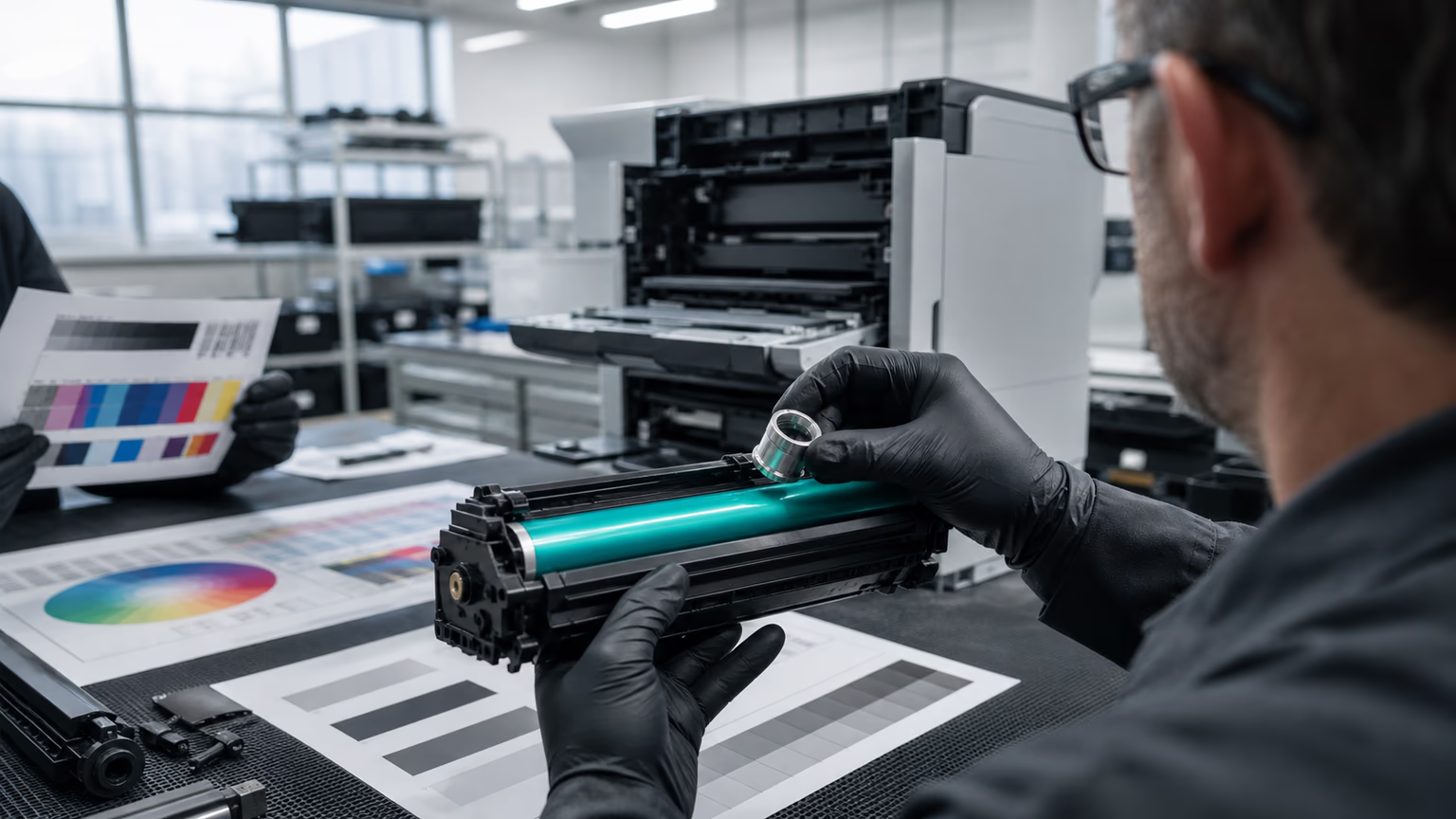
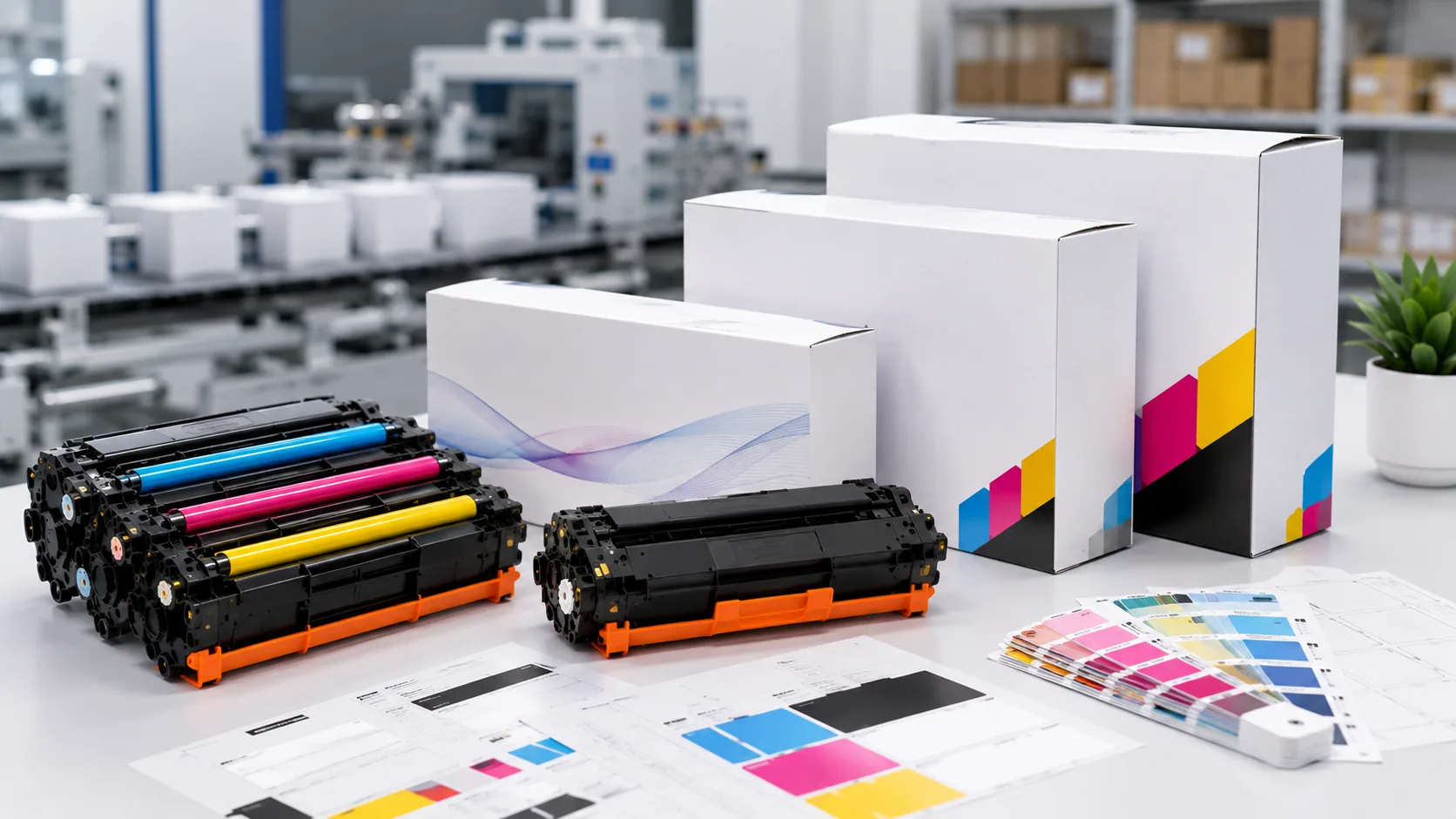
Distributors and office printing suppliers increasingly turn to private label toner manufacturing to differentiate themselves from competitors selling identical unbranded cartridges.
A private label (or white label) program transforms a generic compatible toner into your own product line with custom packaging, cartridge labeling, and marketing support.
However, moving from commodity reseller to brand owner introduces new responsibilities: quality assurance, batch consistency, chip compatibility, and customer support.
This guide outlines what private label toner manufacturing actually requires, how to avoid common pitfalls, and when to engage a manufacturing partner.
What Private Label Toner Manufacturing Includes – And What It Does Not
Private label toner manufacturing means a supplier produces compatible cartridges that carry your brand name, logo, and design elements.
The manufacturer handles component sourcing, assembly, testing, and packaging – but the final product appears as yours.
This differs from OEM white label (where a major brand sells cartridges made by another OEM) and from generic wholesale (no branding).
Key components of a private label program:
- Custom outer carton design (full-color printing with your branding)
- Custom cartridge labeling (tamper-evident seal, brand name, SKU code)
- Optional user insert or safety data sheet with your contact details
- Quality control that meets your specified tolerances
- Batch traceability linking your SKU to production records
What private label does not include: redesigning the internal mechanics of the cartridge. The toner powder, drum unit, wiper blade, and chip remain the supplier’s standard configuration unless you negotiate custom specifications (which typically requires much higher volumes).
Core Requirements for a Successful Private Label Toner Program
Before approaching any manufacturer, understand your own requirements. Private label is not merely slapping a sticker on a box. It demands operational discipline.
Minimum Order Quantities (MOQ) for Private Label
MOQ for private label toner is almost always higher than for generic wholesale. The supplier must stop their regular packaging line, switch to your custom boxes, and potentially reconfigure labeling machines. Typical MOQ ranges:
- Black cartridges: 1,000 – 3,000 pieces per SKU
- Color cartridges (each color separate): 500 – 1,500 pieces per SKU
- High-yield or extra-high-yield: 1,000 – 2,000 pieces
Trial run for new SKU: some suppliers offer 300–500 pieces with simpler labeling (e.g., adhesive sticker instead of direct printing)
If a supplier offers private label MOQ below 300 pieces, verify their process. They may be using generic boxes with stick-on labels rather than true custom packaging. That approach can work for testing but lacks the professional presentation for long-term branding.
Batch Consistency Under Your Brand
When you private label, customers associate every defect with your company, not the manufacturer. Batch consistency becomes critical. The supplier must demonstrate:
- Same chip firmware version across all cartridges in a batch and across reorders
- Same toner formulation (particle size, charge control, fusing characteristics)
- Same component suppliers for OPC drums, wiper blades, and magnetic rollers
- Documented change control – you are notified before any substitution
Request a batch consistency protocol from the supplier. Ask how they handle component end-of-life (e.g., when a chip supplier discontinues a model). The answer reveals their operational maturity.
Print Quality and Yield Expectations Under Private Label
Your branded cartridge must meet or exceed the performance of the supplier’s generic equivalent. Do not assume that private label automatically means higher quality. Establish quality benchmarks in writing:
- Optical density: minimum 1.3 for black text on 75 gsm paper
- Backgrounding: no visible toner dust outside character areas at 600 dpi
- Fusing test: no smearing after 5 seconds of firm rubbing
- Halftone uniformity: no banding or micro-streaks at 20% and 50% coverage
- Page yield: within +/- 5% of ISO/IEC 19752 or 19798 declared value
For private label, you should receive a quality certificate with every batch. The certificate should include actual test results, not a generic “passed”.
Chip and Firmware Compatibility Management
Chip compatibility is the most common failure point in private label toner. Printer manufacturers release firmware updates that can reject non-OEM chips. Under a private label program, the supplier must:
- Track OEM firmware release schedules for supported printer models
- Update chip programming accordingly (new revision)
- Clearly label chip version on each batch (e.g., rev 4.2)
- Provide a chip compatibility warranty covering at least 12 months from shipment
If you distribute in regions where auto-updates are common (corporate fleets with managed print services), require the supplier to maintain a firmware testing lab. Without this, your branded cartridges may suddenly fail in the field, damaging your reputation.
Packaging and Logistics for Private Label Toner
Custom packaging introduces additional logistics steps. Evaluate the supplier’s packaging capabilities:
Outer Carton Specifications
Printing method: offset or digital? Offset provides higher quality for runs above 5,000 units.
Material: corrugated board weight (minimum 3-layer B-flute for protection)
Information panel: must display cartridge model, compatible printers, page yield, batch number, expiration date, and your company address
Sustainability: recycled content percentage and recyclability symbols
Inner Cartridge Bag and Labeling
Anti-static bag with your brand name and a clear window (optional). Cartridge label should be oil-resistant and include a tamper-evident seal. Some suppliers offer direct printing on the cartridge body – this requires higher MOQ but looks more professional.
Logistics for Mixed SKU Pallets
Private label orders often include multiple SKUs (e.g., black, cyan, magenta, yellow). The supplier should provide pick-and-pack services with separate master cartons per SKU, clearly labeled with your SKU codes. Verify that they can handle drop-shipping to your customers if needed.
Evaluating a Private Label Toner Manufacturing Partner
Not every wholesale toner supplier is equipped for private label. Use these criteria to shortlist partners:
Technical Documentation
Request a private label capability statement. It should include:
- List of supported printer families (HP, Canon, Brother, Kyocera, etc.)
- Typical MOQ per technology (mono vs color, standard vs high yield)
- Design proof process – who creates packaging artwork? Do they have in-house graphic designers?
- Sample of previous private label work (anonymized)
Quality Testing Process
Ask to see their internal testing workflow. A competent supplier conducts:
- Incoming component inspection (chips, toner powder, OPC drums)
- In-line testing during assembly (electrical contact, gear alignment)
- Random sampling from each batch (1-2% of production) for print testing
- Environmental storage simulation (temperature and humidity cycling)
If they cannot describe their testing process in specific terms (not just “we have quality control”), consider it a risk.
Communication and Change Management
Private label requires proactive communication. Ask:
- How will you notify me of a component change (chip supplier, toner formula)?
- What is the lead time for artwork changes?
- Who handles customs documentation for my brand when shipping internationally?
Document the answers in your supply agreement.
Red Flags Specific to Private Label Toner
Avoid manufacturers who display these behaviors:
Offering private label on every SKU with no MOQ increase – likely using generic stock and applying stickers after order, leading to label peeling or incorrect information.
No sample of previous private label work – or refusing to provide references.
Unclear batch traceability – cartridges without unique batch codes linked to production date.
Pushing you to accept “almost identical” packaging to another client’s brand – this creates legal ambiguity.
No written quality guarantee or defect claim procedure.
When to Request a Sample or a Quote for Private Label
The process differs from generic wholesale. Follow this sequence:
Initial technical discussion – confirm the supplier supports your target printer models and can meet your MOQ.
Request generic samples – order 5–10 unbranded cartridges of the SKUs you intend to private label. Test print quality, yield, and chip compatibility thoroughly.
Request a second batch sample – order another 5–10 cartridges from a different production month to verify batch consistency.
Request private label sample run – if the generic samples pass, order a small private label run (minimum the supplier allows, often 100–300 pieces with simple labeling). Evaluate packaging durability and label adhesion after shipping.
Request a full quote – after approving the private label sample. The quote should itemize:
- Unit price (based on final MOQ)
- One-time artwork and tooling fees (plate making for boxes)
- Cost per custom box and label
- Freight terms (EXW, FOB, CIF) and estimated lead time
Do not request a quote before step 4. Without validated samples, you have no basis to compare pricing.
Pricing Structure for Private Label Toner Manufacturing
Private label adds 5–15% to the base wholesale cost, depending on packaging complexity and order volume. One-time fees typically range from 800 per SKU for printing plates and design setup. Some suppliers waive these fees for orders above 5,000 pieces. Ongoing costs include:
- Higher per-unit packaging material cost (custom boxes vs generic white boxes)
- Label application labor
- Quality assurance overhead for batch segregation
Negotiate these elements transparently. A low unit price with hidden setup fees can make private label uneconomical for small distributors.
Legal and Liability Considerations
When you private label, you assume product liability in most jurisdictions. Your supply agreement must include:
- Indemnification clause: the manufacturer holds you harmless for patent or trademark infringement related to their cartridge design.
- Defect warranty: typically 12–24 months from shipment, covering print defects and chip failures.
- Recourse for batch recalls: who pays for return shipping and replacement if a whole batch is defective?
- Compliance certificates: RoHS, REACH, CE marking, and any regional e-waste regulations.
Have a local legal advisor review the agreement before signing. Never rely on verbal promises about liability.
FAQ
What is the minimum order quantity for private label toner cartridges?
For true custom packaging (printed boxes and direct-labeled cartridges), MOQ typically starts at 1,000 pieces per SKU. Some suppliers offer low-volume private label (300–500 pieces) using adhesive stickers on generic boxes. Confirm what type of branding you are actually paying for.
Can I private label only part of my product range?
Yes. Many distributors start with their top 3–5 SKUs (e.g., HP 83A, CF283X, and Canon 045 black) while keeping low-volume SKUs as generic wholesale. The supplier should manage separate inventory for branded and unbranded units without cross-contamination.
How long does it take to set up a private label toner line?
From artwork approval to first shipment, expect 4–8 weeks. This includes plate making, test printing, packaging assembly, and initial batch production. Rush orders may add 15–20% to costs.
What happens if the printer manufacturer releases a firmware update that blocks my private label cartridges?
Your supplier should provide an updated chip revision and replace affected inventory under warranty. The supply agreement must specify response time (e.g., 15 days) and who bears the cost. Without this clause, you could be left with unsellable stock.
Can I request custom toner formulation (e.g., higher density or lower melt temperature)?
Yes, but only at very high volumes (10,000+ pieces per SKU). Custom toner formulation requires re-engineering the powder, adjusting charge control agents, and requalifying fusing properties. For most distributors, selecting a supplier with proven standard formulations is more practical.
Moving Forward with Private Label Toner Manufacturing
Private label toner gives you brand ownership, better margins, and customer loyalty – but only if the underlying cartridge quality and batch consistency are solid.
Start with rigorous sample testing, then scale gradually from a few SKUs.
A transparent manufacturing partner will provide test reports, batch traceability, and clear change management.
Avoid suppliers who treat private label as an afterthought.
If you are evaluating private label options for your compatible toner line, UNICO Imaging offers documented batch control, chip firmware monitoring, and custom packaging support. Request a private label capability pack and sample testing protocol for your target SKUs.
UNICO Imaging provides private label toner manufacturing services for distributors and printing suppliers worldwide. Focus areas include batch consistency, chip compatibility tracking, and logistics for custom-branded cartridges.