Introduction: The Hidden Cost of Cheap Compatible Toner
Many B2B toner distributors learn the same lesson the hard way: buying the cheapest compatible toner cartridges often leads to the most expensive problems.
The price per piece looks attractive on a spreadsheet, but when a cartridge fails in the field, it does not just cost you a return label.
It triggers a cascade of consequences: a service dispatch to a frustrated client, potential printer damage from a leaking or defective cartridge, and the slow erosion of trust that takes years to rebuild.
Suddenly, that initial saving evaporates against a backdrop of operational chaos and reputational harm.
This is the false economy that traps countless distributors.
The real opportunity lies in flipping the script—not competing on price, but building a premium compatible toner brand that stands for reliability, consistency, and real partnership.
A premium brand does not mean overpriced; it means a product engineered to perform, wrapped in a promise that protects the end user’s uptime and your own margins.
This guide breaks down every step you need to take to transform a commodity into a trusted brand, from understanding cartridge internals to auditing suppliers and integrating with managed print services.
The Anatomy of a Premium Compatible Toner Cartridge
To build a premium brand, you must first understand what makes a compatible toner cartridge truly premium—and what gets sacrificed when cost-cutting runs rampant.
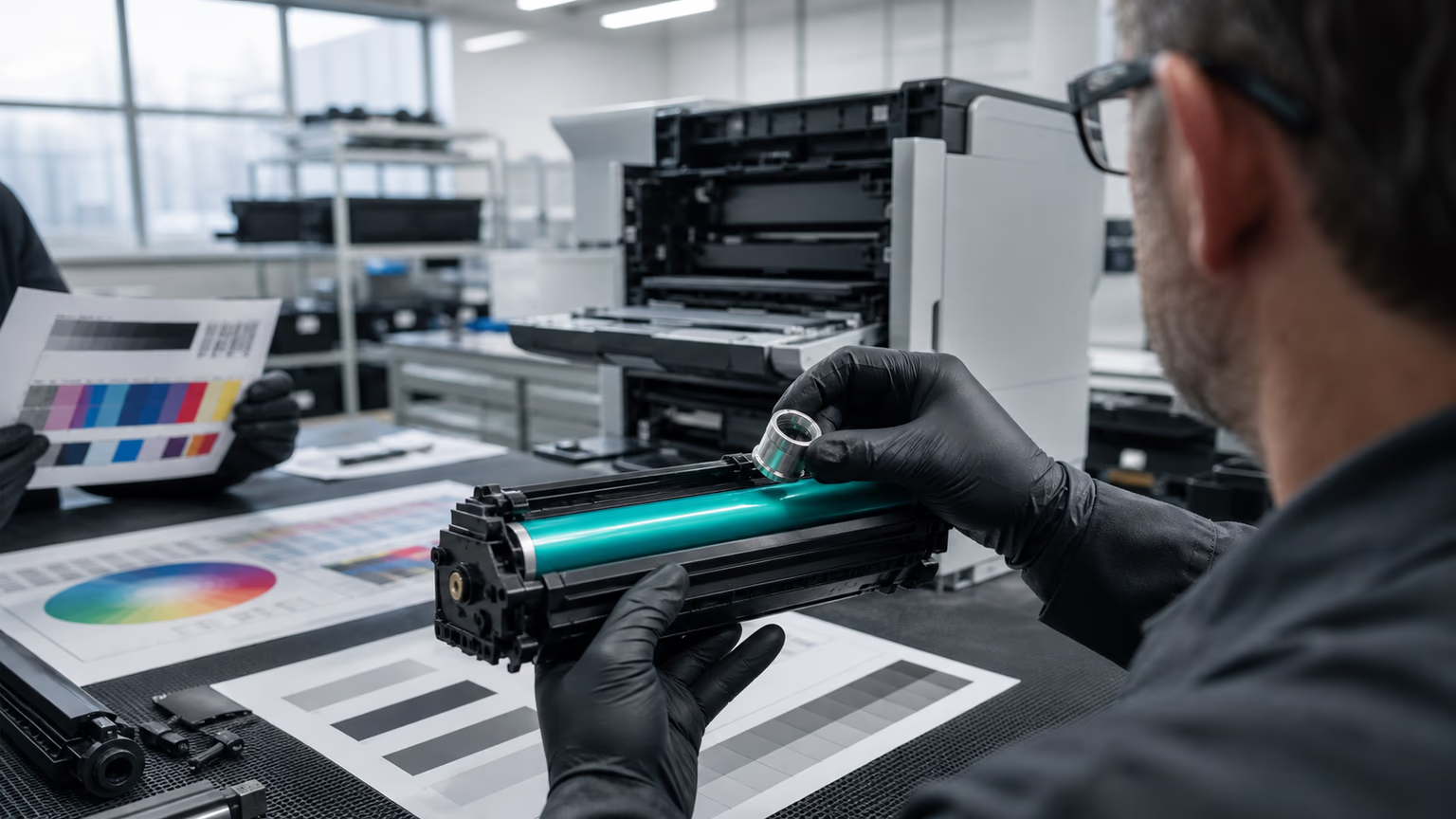
The heart of any laser printer toner cartridge is the organic photoconductor (OPC) drum, a light-sensitive cylinder that transfers the image to paper.
In a premium build, this drum features a thick, uniform coating that resists wear and maintains consistent electrical properties over tens of thousands of pages.
In cheap alternatives, a thin or uneven coating quickly develops pinpricks and surface flaws that manifest as ghosting, background scatter, or uneven density—all immediate triggers for user complaints.
Adjacent to the OPC drum, the magnetic roller and doctor blade work together to meter an exact layer of toner onto the developing roller.
Inferior blades warp under friction, causing toner dust to escape inside the printer and contaminate other components.
Over time, this leads to streaking, premature cartridge failure, and even printer damage.
The primary charge roller (PCR) is another critical piece; a low-cost PCR can arc and create electrical noise that degrades print quality and confuses the printer’s high-voltage circuits.
Then there is the chip.
Far more than a simple counter, the chip communicates with the printer to report toner levels, ensure regional compatibility, and sometimes even authenticate the cartridge.
Premium compatible toner cartridges use chips developed with a deep understanding of the printer’s firmware logic, capable of withstanding routine updates without bricking.
By contrast, cut-rate chips often trigger error messages or fail outright after the first firmware refresh, leaving end users stranded.
When you build a premium brand, every component—from the toner powder’s melt characteristics to the wiper blade’s edge geometry—must be selected for long-haul reliability, not short-term gain.
Compatibility in the Real World: Mixed Fleets and Firmware Landmines
Ask any fleet manager about the single biggest fear with compatible toner, and the answer is almost always the same: a surprise firmware update that overnight renders a warehouse of cartridges unrecognizable.
Printer manufacturers regularly release firmware that tightens the handshake between printer and cartridge, sometimes deliberately breaking aftermarket chips.
A premium approach to building a compatible toner brand means picking a supplier that treats firmware compatibility as an ongoing R&D investment, not a one-time fix.
They should have a dedicated team monitoring releases across all major models and providing chip revisions before customers ever see an error.
In real-world offices, the challenge is compounded by mixed fleets—a jumble of different printer models, often from different manufacturers, each with its own firmware history.
A cartridge that works flawlessly in one device may fail in another simply because of a subtle timing mismatch in the chip’s serial communication.
Premium compatible toner for mixed printer fleets requires exhaustive validation: testing across multiple generations, firmware versions, and regional coding scenarios.
It is not enough for a supplier to show you a single test print.
Demand evidence of cross-model compatibility matrices and ask how they handle field failures when a new firmware version catches everyone off guard.
A supplier’s responsiveness in these moments defines your brand’s reputation.
Supplier Due Diligence: A Step-by-Step Audit Framework
Selecting a manufacturing partner is the single most consequential decision in building a premium compatible toner brand.
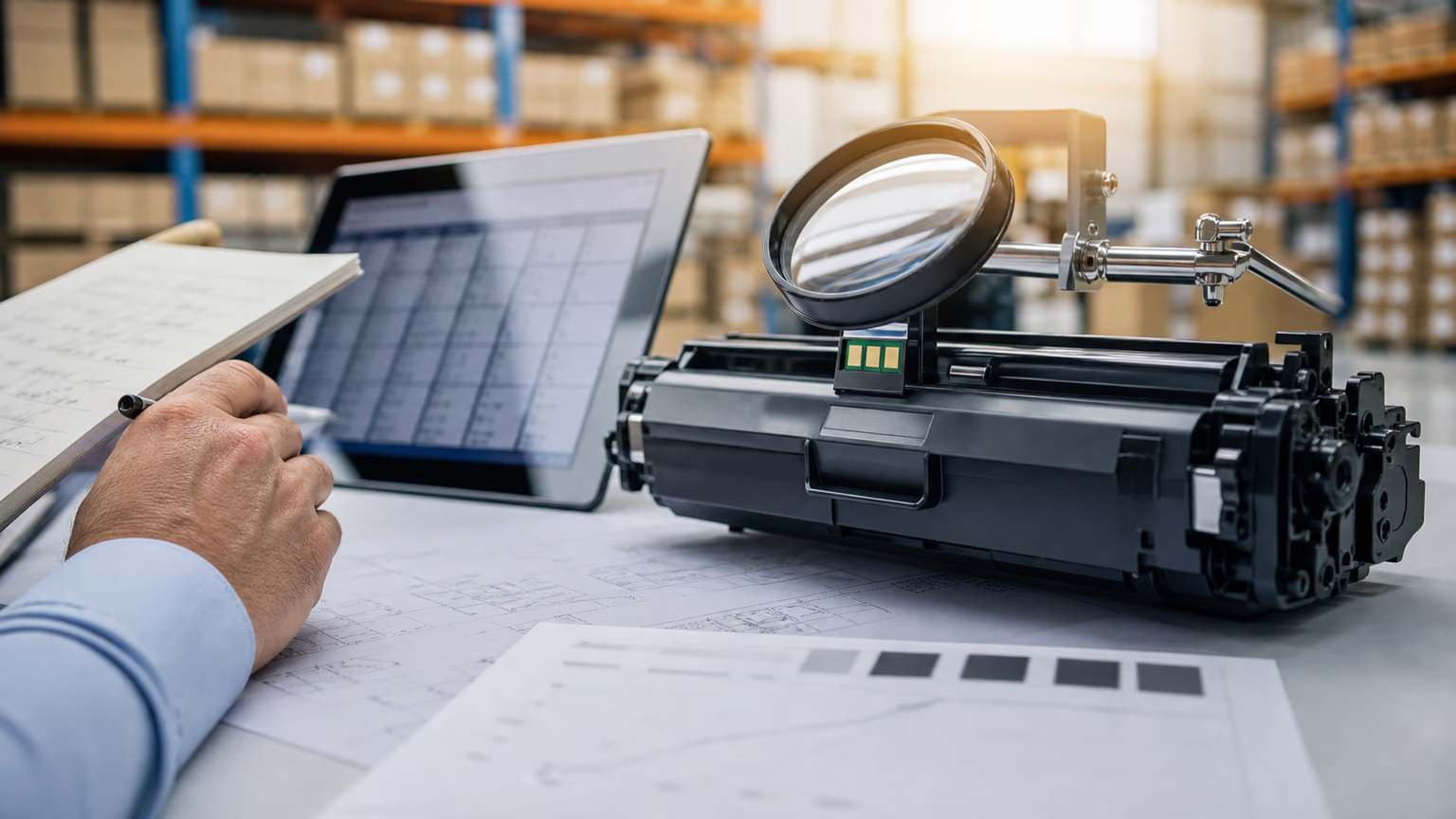
A supplier audit is not a one-day event but a structured, ongoing process that goes far beyond a factory tour and a sample box.
Start by requesting batch samples from three consecutive production runs.
A single high-performing sample is meaningless; you need to see that quality is repeatable when the production line is under real-world time and cost constraints.
Conduct your own yield tests in actual office environments, printing at 5% and 20% page coverage.
Compare the results against the supplier’s declared yield and note any drop-off near the cartridge’s end of life.
Equally important is chip validation: test the cartridges in printers with the latest firmware installed, and ask the supplier for a clear service-level agreement on chip update turnaround—including what happens if a critical firmware update breaks communication across your fleet.
An honest supplier will share their historical QA failure rate data and walk you through their corrective action procedures.
Here are the key checkpoints to cover in your audit:
- Yield consistency: Run side-by-side tests across multiple units and batches, measuring usable pages until print quality degrades beyond acceptable limits.
- Component transparency: Request documentation on OPC drum specifications, magnetic roller coating, and toner particle size distribution. A premium partner will be open about materials.
- Firmware and chip management: Assess how the supplier tracks printer firmware updates, what their chip versioning process looks like, and their track record for patch delivery.
- Customization capabilities: Evaluate whether they can provide custom packaging, chip branding, and even tailored fill levels to match your brand promise.
- Technical support depth: You need more than a sales contact. Look for an engineering team that can perform root cause analysis on field returns and help you preempt issues.
This framework transforms supplier selection from a gamble into a calculated business decision, giving you the confidence to scale your premium brand.
Building Your Brand: Packaging, Positioning, and Perception
A premium compatible toner cartridge in a plain white box is a contradiction.
B2B buyers are trained to read packaging as a quality signal.
Sturdy, thoughtfully designed packaging with clear, professional labelling immediately communicates that the product inside has been built to a high standard.
It also differentiates your offering from the sea of generic, low-cost cartridges that flood the market.
Invest in custom packaging that reflects your brand identity—consistent colors, typography, and a clean, modern layout that reinforces trust.
But a box is only the start.
Building a brand means shaping how your customers perceive your product before they even install it.
Position your toner not as a cheaper alternative, but as a risk-managed, engineered solution.
Create educational assets—one-pagers, comparison sheets, and simple explainer videos—that your customers can share with their own end users.
When an IT manager can confidently explain to a department head why this compatible toner delivers reliable results without the OEM price tag, your brand becomes an indispensable part of their operation.
This shift in perception is how you escape the price-only trap and earn loyalty.
Service-Centric Toner: Integrating with MPS and Extended Contracts
For managed print services (MPS) providers, toner failure is not just a product defect; it is a direct threat to service-level agreements and client retention.
Every time a cartridge streaks, leaks, or triggers a false low-toner warning, it generates a help-desk ticket that erodes the profitability of the MPS contract.
A premium compatible toner strategy directly aligns with MPS goals by driving down interventions and smoothing out print quality across the fleet.
Consistent toner performance allows you to predict cartridge replacements accurately, optimize delivery schedules, and reduce the emergency despatch costs that plague reactive service models.
Moreover, the data generated by a reliable toner program—page counts, coverage trends, cartridge lifespan—becomes a powerful tool for fleet optimisation.
You can identify which printers are over- or under-utilised and make data-driven recommendations that further cut your client’s costs.
When your toner supply becomes synonymous with hassle-free uptime, your MPS contracts become stickier and more valuable.
Future-Proofing: Supply Chain Resilience and the Next Generation of Print
Recent years have exposed the fragility of single-source supply chains.
Building a premium compatible toner brand demands resilience: you need contingency plans and, ideally, secondary suppliers that have passed the same rigorous audit.
This does not mean compromising on quality; it means identifying alternative sources that meet your specifications and can ramp up production if your primary partner faces disruption.
Technology is also evolving.
Chipless toner designs and universal cartridges promise to sidestep some firmware headaches, but they must be approached with caution.
Validate any emerging technology against the same compatibility and reliability benchmarks you set for conventional cartridges.
At the same time, keep an eye on sustainability: bulk packaging, recyclable materials, and cartridge take-back programmes are becoming differentiators that appeal to environmentally conscious businesses.
Staying ahead of these trends positions your brand as a forward-thinking partner, not just a commodity supplier.
FAQ
What is the difference between a premium compatible toner and a standard compatible toner?
A premium compatible toner uses higher-grade components—such as thicker OPC drums, precision doctor blades, and advanced chips—that are engineered to meet or exceed base performance. Standard compatible cartridges often cut costs on these materials, leading to lower page yields, inconsistent print quality, and a higher risk of printer damage.
How do I know if a compatible toner cartridge is truly high quality before placing a large order?
Request batch samples from consecutive production runs and conduct your own yield and print quality tests. Compare results across multiple printer models and firmware versions. A trustworthy supplier will also provide transparent QA data and references for their batch consistency.
What are the most common firmware issues with compatible toner and how can I prevent them?
Firmware updates can block cartridge communication if the chip is not updated. To prevent this, partner with a supplier that actively monitors OEM firmware releases and provides timely chip revisions. Validate new chips in a test fleet before deploying to customers.
Can a premium compatible toner match OEM performance in a mixed printer fleet?
In a well-managed program, yes. The key is rigorous pre-deployment testing across the exact printer models and firmware levels in your fleet. Premium compatible toner that has been validated for mixed environments can deliver consistent, OEM-comparable results without the premium price.
Is it worth investing in custom-branded toner cartridges for my distribution business?
Custom branding differentiates your product in a market flooded with generic alternatives. It builds recognition, signals quality, and helps customers associate reliable performance with your company name. Over time, a strong brand reduces price sensitivity and attracts long-term B2B partnerships.
Conclusion
Building a premium compatible toner brand is a strategic pivot away from the race to the bottom.
It requires a deep understanding of cartridge engineering, a disciplined supplier audit process, and a commitment to service-centric thinking.
When executed correctly, this approach turns a base commodity into a trusted product that commands loyalty, reduces operational friction, and protects your margins.
The B2B market is crowded with generic alternatives, but the distributors who solve the real problems—unpredictable quality, firmware anxiety, and hidden service costs—will define the next generation of the industry. Your customers are not just buying toner; they are buying confidence. Deliver that consistently, and you will not need to compete on price alone.