The Hidden Costs of Choosing the Wrong Toner Brand Model
When a printer service company loses a long-term contract because of repeated print quality complaints, the cause is rarely a single defective cartridge.
It is an accumulation of minor failures that erode trust: inconsistent image density, premature page yield drops, or fuser smearing that triggers service calls.
For B2B distributors and managed print services (MPS) providers, the choice between white label and private label toner is not a marketing checkbox.
It is a procurement decision that directly impacts field service costs, customer retention, and margin stability.
A seemingly small defect rate of two or three percent can wipe out the profit from the entire supply agreement once you factor in technician dispatches, replacement logistics, and SLA penalties.
The core tension is clear: speed to market versus sustainable differentiation.
Choosing the wrong model because of attractive unit pricing or rushed branding can set off a chain of operational disruptions that become visible only when helpdesk tickets start climbing.
White Label vs Private Label: A B2B Procurement Lens
From a sourcing manager’s perspective, the distinction between white label and private label toner is about ownership and control.
White label toner is a pre-manufactured product where the supplier produces a generic formulation and allows you to put your company’s logo on the box.
You have little to no influence over the chemical composition, the chip firmware, or the mechanical components.
The supplier’s priority is volume, and the same formulation may appear under dozens of other brand names.
In contrast, private label toner gives you a stake in the product definition.
You collaborate with the manufacturer to specify density curves, background levels, fuse grade, and even the design of the cartridge housing.
While you may not own the intellectual property outright, you typically negotiate exclusivity for the formulation within your market or customer segment.
Minimum order quantities (MOQs) are higher, lead times longer, and a non-disclosure agreement (NDA) is standard.
But in return, you gain a product that is uniquely yours—and a supply chain that can be tailored to your service standards.
Quality, Compatibility, and Print Performance: The Real Differentiators
Price-per-cartridge tables never capture what happens when toner hits the paper.
The key performance indicators that matter to a service team are image density, background, transfer efficiency, and page yield under real-world coverage conditions.
White label toner often meets baseline ISO standards, but batch-to-batch variation can introduce subtle drift in these parameters.
Without active R&D input, a supplier may switch a raw material source to reduce cost, unintentionally altering fuse characteristics or causing ghosting on certain printer models.
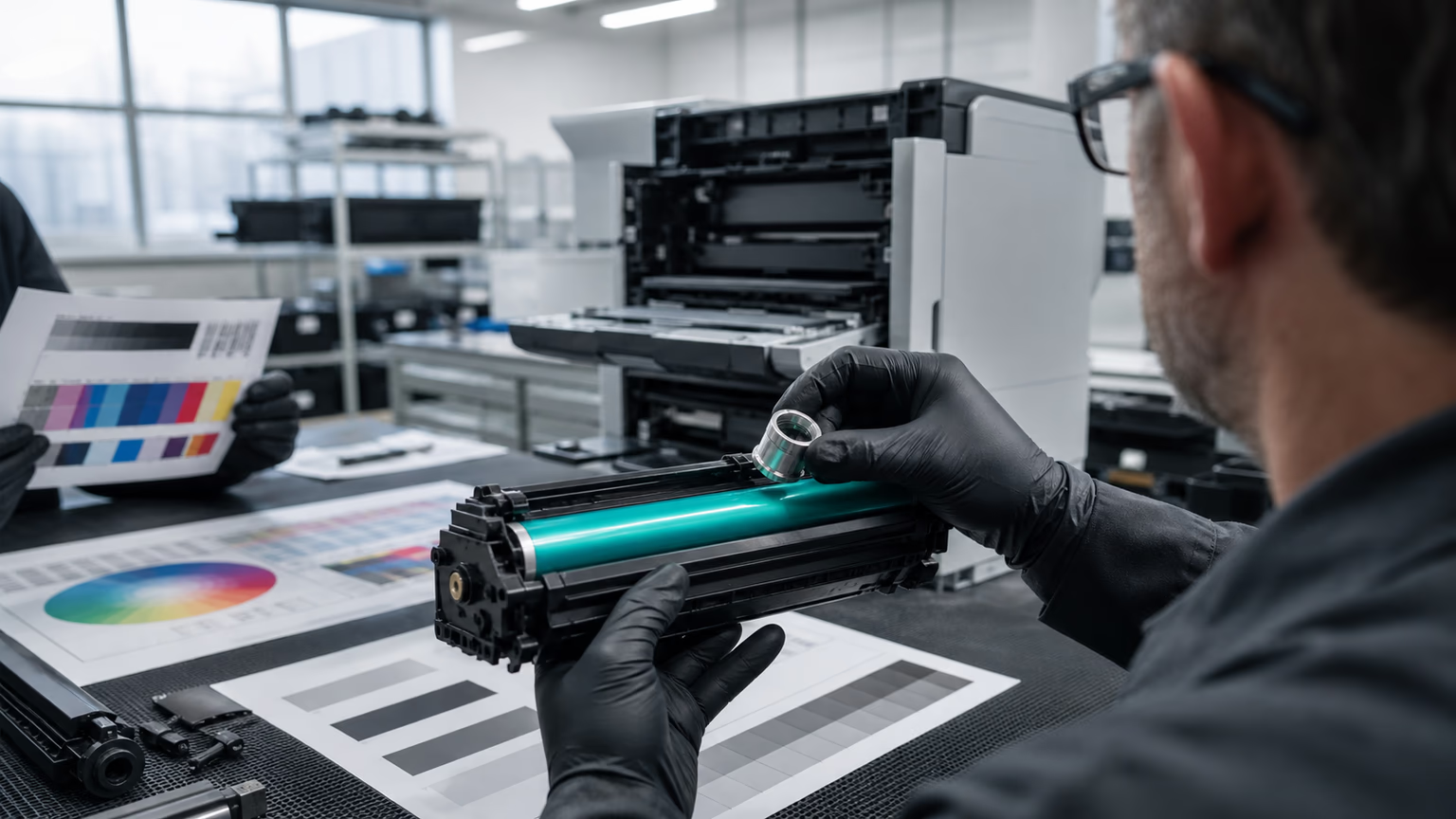
Private label arrangements often include co-developed quality gates: sealed pre-production samples, third-party lab reports, and ongoing stability testing across multiple printer families.
Hardware quality is equally critical.
The gear train, drum unit, wiper blade, and chipset must work seamlessly with the OEM device’s sensing and timing mechanisms.
A poorly molded gear can strip after a few thousand pages, and a chip that fails to handshake with a firmware update will stop the printer even when toner remains.
These are not hypothetical risks—they are the primary drivers of helpdesk call volume related to third-party toner.
When White Label Makes Strategic Sense for Your Business
Despite its limitations, white label toner remains a valid strategic choice under specific business conditions.
Cash-and-carry distributors serving price-sensitive small and medium businesses often operate on thin margins where the cost advantages of a generic product outweigh branding concerns.
MPS providers managing a uniform fleet of mid-range printers may find that a single, consistent white label source—with thorough incoming quality checks—delivers acceptable field performance.
Speed-to-market is another factor.
If you need to launch a toner line quickly to fill a gap in your catalog or to respond to a competitor’s move, white label can cut months off the go-to-market timeline.
In these scenarios, the purchasing decision should be framed as a tactical one: you are buying convenience and speed, and you must offset the quality risk with rigorous sample testing and a buffer stock to handle batch failures without disruption.
When Private Label Becomes a Competitive Asset, Not a Cost Center
For businesses that depend on long-term service contracts, private label toner transforms from a cost into a retention tool.
A house brand that consistently delivers clean prints and predictable page yields becomes part of the service promise.
Customers are less likely to churn when they trust the consumable as much as the printer itself.
Private label also opens the door to value-based pricing.
Instead of competing head-to-head with generic compatibles, you can position your brand around reliability, local support, and customized packaging that signals professional quality.
Packaging itself becomes a touchpoint: custom box design, clear multilingual instructions, and tamper-evident seals all reinforce the perception that the product is engineered, not just rebadged.
Moreover, by controlling the supply chain, you can synchronize toner availability with your MPS contracts, reducing emergency orders and logistics costs.
The higher upfront investment in private label is justified by higher margins, lower complaint rates, and the ability to capture replacement cartridge revenue that would otherwise flow to opportunistic competitors.
Supplier Evaluation Checklist: Questions Most Buyers Forget to Ask
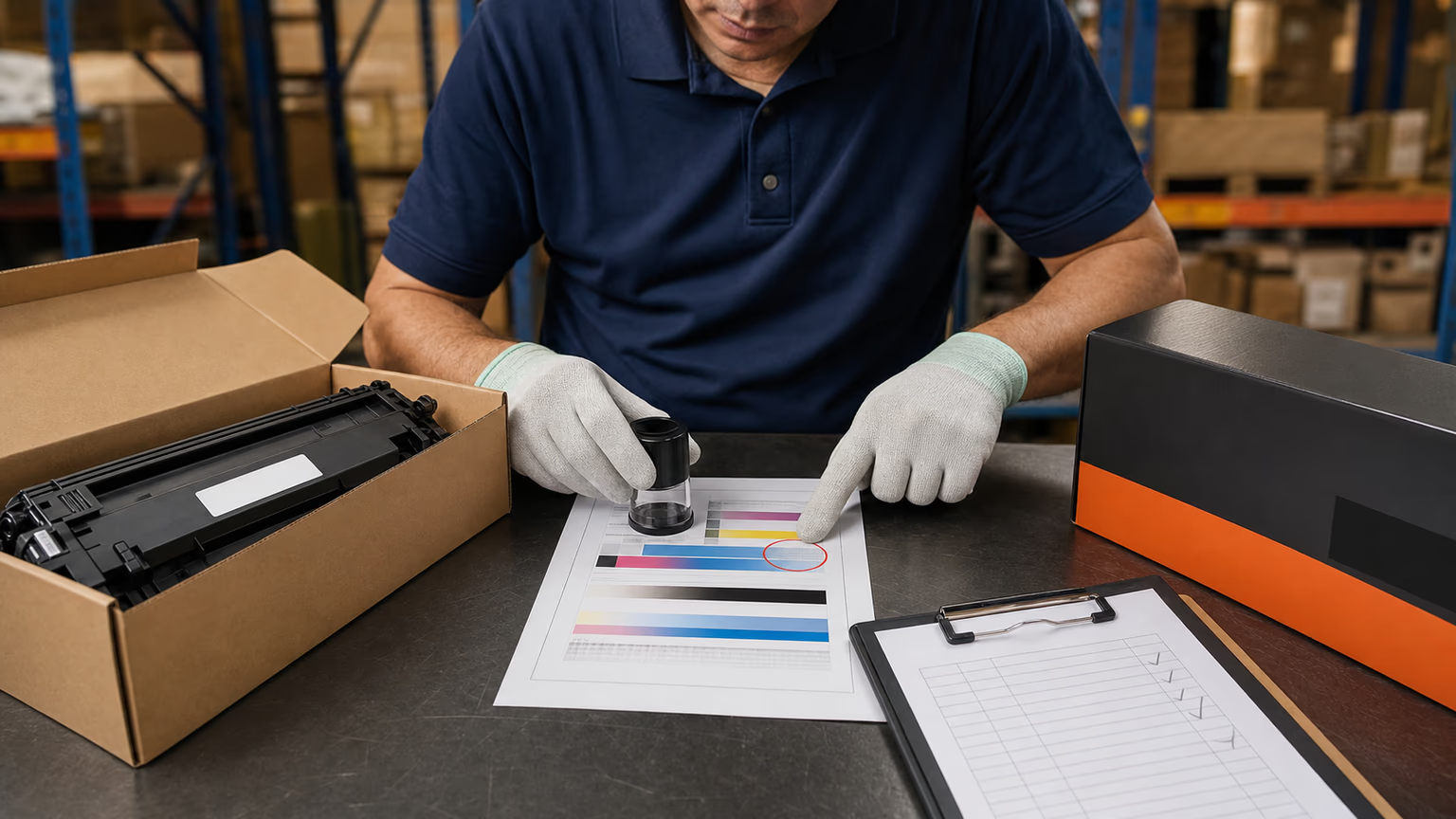
Do they provide batch retention samples and traceability records for every shipment?
This ensures you can isolate and investigate any quality drift without guesswork.
How do they handle firmware compatibility?
Ask for a documented policy on chip firmware updates and evidence of testing across the last three firmware versions of the target printer models.
Can they demonstrate ongoing third-party lab testing for density, background, and yield on your exact printer fleet mix?
Raw ISO certificates are not enough.
What is their business continuity plan for critical raw material shortages?
A credible supplier will have multi-source agreements or safety stock strategies for photoreceptor drums, toner powder, and chips.
Building a Future-Proof Toner Supply Strategy
A rigid commitment to either white label or private label rarely survives contact with a growing, diversifying customer base.
The most resilient approach is often a hybrid model.
Use white label toner to cover high-volume, low-margin segments where price competition dominates, and deploy private label toner for key accounts that value reliability and brand consistency.
Define clear trigger points for shifting a customer segment from one model to the other: a certain annual volume threshold, a pattern of helpdesk tickets, or a contract renewal cycle can all signal when the increased investment in private label will pay back through reduced service overhead.
Integrate your toner strategy into your broader MPS offering by tying consumable performance data to fleet management software.
This gives procurement and service teams a shared view of total cost of ownership, moving the conversation away from cartridge price and toward system-level reliability.
FAQ
What is the main operational difference between white label and private label toner?
White label toner is a ready-made product from a supplier that you brand as your own, with no control over the formulation or components. Private label toner involves joint development with the manufacturer, allowing you to influence quality specifications, cartridge design, and exclusivity terms, which directly affects field performance and customer experience.
How does private label toner affect my ability to win service contracts?
A strong private label brand signals commitment to quality and reduces the risk of print-related service calls. It can differentiate your proposal from competitors using generic white label products, making it easier to justify service-level agreements and higher contract values through demonstrable reliability.
Are there hidden quality risks with white label toner that I won’t see upfront?
Yes. The most common hidden risks include batch-to-batch formulation changes that cause inconsistent fusing or print density, chip recognition errors after firmware updates, and mechanical failures like gear stripping due to lower-grade plastics. These issues often only emerge after thousands of pages, increasing service interventions.
What minimum order quantities are typical for private label toner cartridges?
MOQs vary by cartridge complexity and supplier, but private label typically requires significantly larger commitments than white label—often starting in the thousands of units per SKU. This investment is necessary to cover custom tooling, packaging design, and dedicated production runs.
Can I switch from white label to private label without disrupting customer supply?
Transitioning is possible but requires careful phase-over planning. Run both product lines in parallel for a period, validate the private label samples thoroughly across your customer’s printer fleet, and communicate the change as an upgrade in quality. Gradual replacement during natural cartridge replacement cycles minimizes service turbulence.
Conclusion
The decision between white label and private label toner is ultimately a risk management exercise that must be tied to your service delivery model and growth trajectory.
There is no single correct choice.
White label offers a fast, low-barrier entry but exposes you to quality volatility that can silently erode margins through increased support costs.
Private label requires more upstream investment and supplier collaboration but builds a durable moat around your customer base, transforming toner from a commodity into a strategic asset.
Rather than searching for the perfect model, successful distributors and service providers evaluate their customer segments, audit suppliers against operational criteria, and build a supply strategy flexible enough to evolve as their business scales.
The real cost of toner is not the invoice price—it is the total burden of service events, customer dissatisfaction, and lost renewal opportunities hidden behind each cartridge sold.