The Margin Squeeze: Why Distributors Need a New Toner Sourcing Model
Regional B2B distributors face a structural problem: OEM toner prices keep rising while end customers demand lower cost per page.
In many commercial accounts, toner is the largest consumable expense after paper.
A distributor that resells OEM cartridges at standard channel margins often ends up with too little profit to cover local service, delivery, and account management.
That reality pushes many toward generic compatible toner, but that route often creates a different set of problems: inconsistent print quality, premature cartridge failure, and damage to hard-won customer trust.
Factory-direct private label toner offers a third path.
By sourcing cartridges directly from the factory that produces them, a distributor can eliminate intermediary markups, set its own pricing structure, and build a brand that customers recognize and reorder.
However, this path is only defensible when the toner itself meets strict quality and compatibility standards.
The goal is not to sell the cheapest possible cartridge but to create a private label line that reduces OEM dependency while protecting the distributor's reputation and the end customer's uptime.
What Factory-Direct Private Label Toner Actually Means for a Distributor
Factory-direct means the distributor contracts directly with the manufacturing facility that produces the toner cartridges, not with a trading company, broker, or multi-level importer.
In a true factory-direct arrangement, the distributor can specify toner formulation, component quality, chip behavior, and packaging design.
The distributor becomes the brand owner and quality gatekeeper, while the factory provides production capacity and technical expertise.
This model changes the commercial equation.
Instead of buying a finished product with a fixed brand, the distributor commissions cartridges under its own label.
Pricing is based on materials, components, labor, and packaging, which typically leaves more room for distributor margin than OEM resale.
Minimum order quantities are often higher than buying from a local wholesaler, but they are negotiated directly with the factory, allowing tiered pricing that matches regional cash flow.
The distributor also gains control over SKU creation, label design, and regional compliance markings, which is essential for building a recognizable B2B brand.
Quality Risks in Compatible Toner: How to Avoid the Hidden Failures
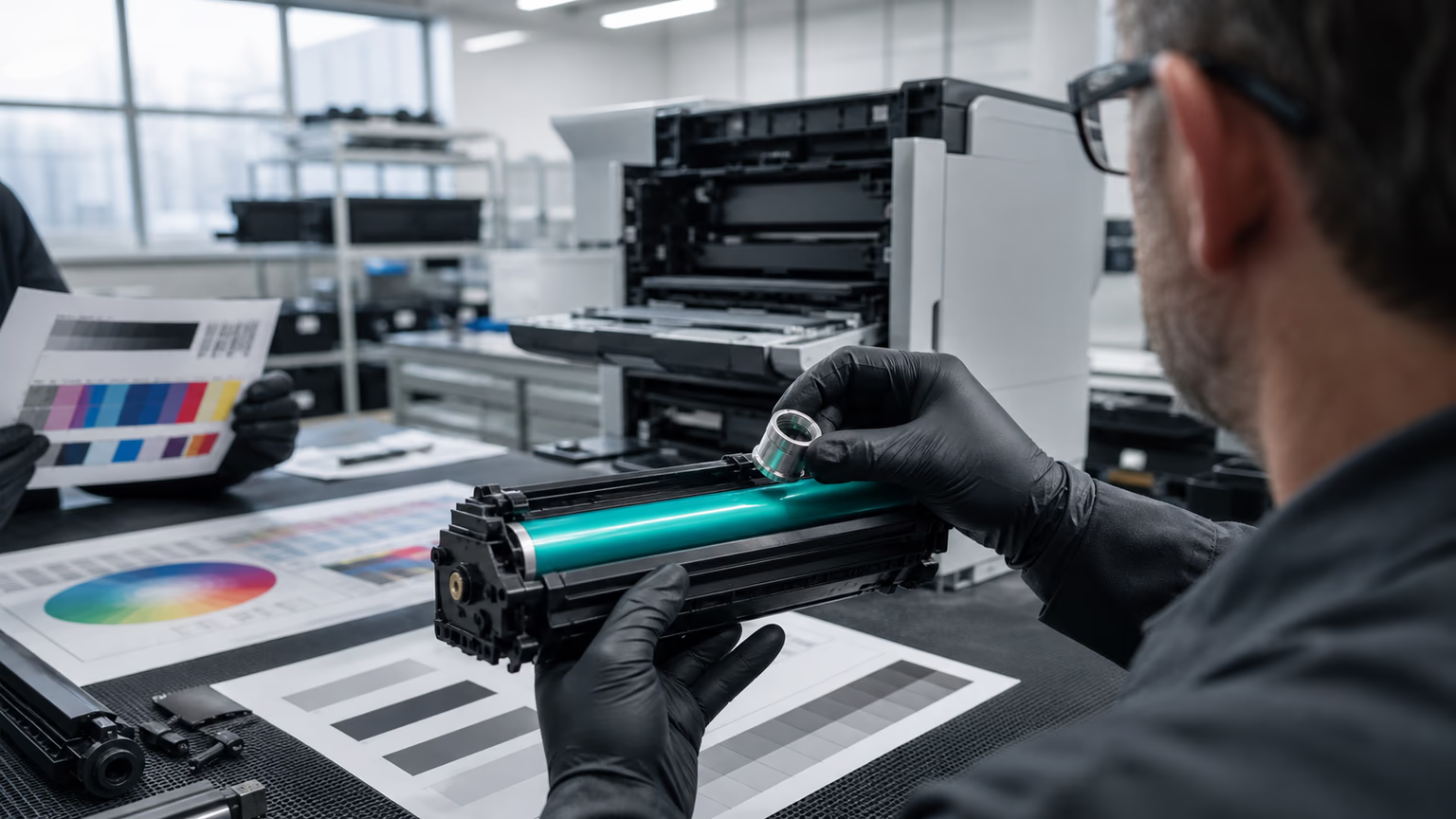
The most common complaint about compatible toner is not that it fails catastrophically but that it degrades gradually: background fog, streaking, uneven density, or lower page yield.
These symptoms usually trace back to toner formulation.
Particle size distribution, triboelectric charge, and melting point must match the printer's fusing system.
A factory that does not control these variables will produce cartridges that work sometimes and fail other times, depending on the batch.
Component quality is equally important.
The organic photoconductor drum, magnetic roller, wiper blade, and sealing materials all affect cartridge life and print consistency.
Inferior components may save cost but cause leakage, cartridge damage, or even printer contamination.
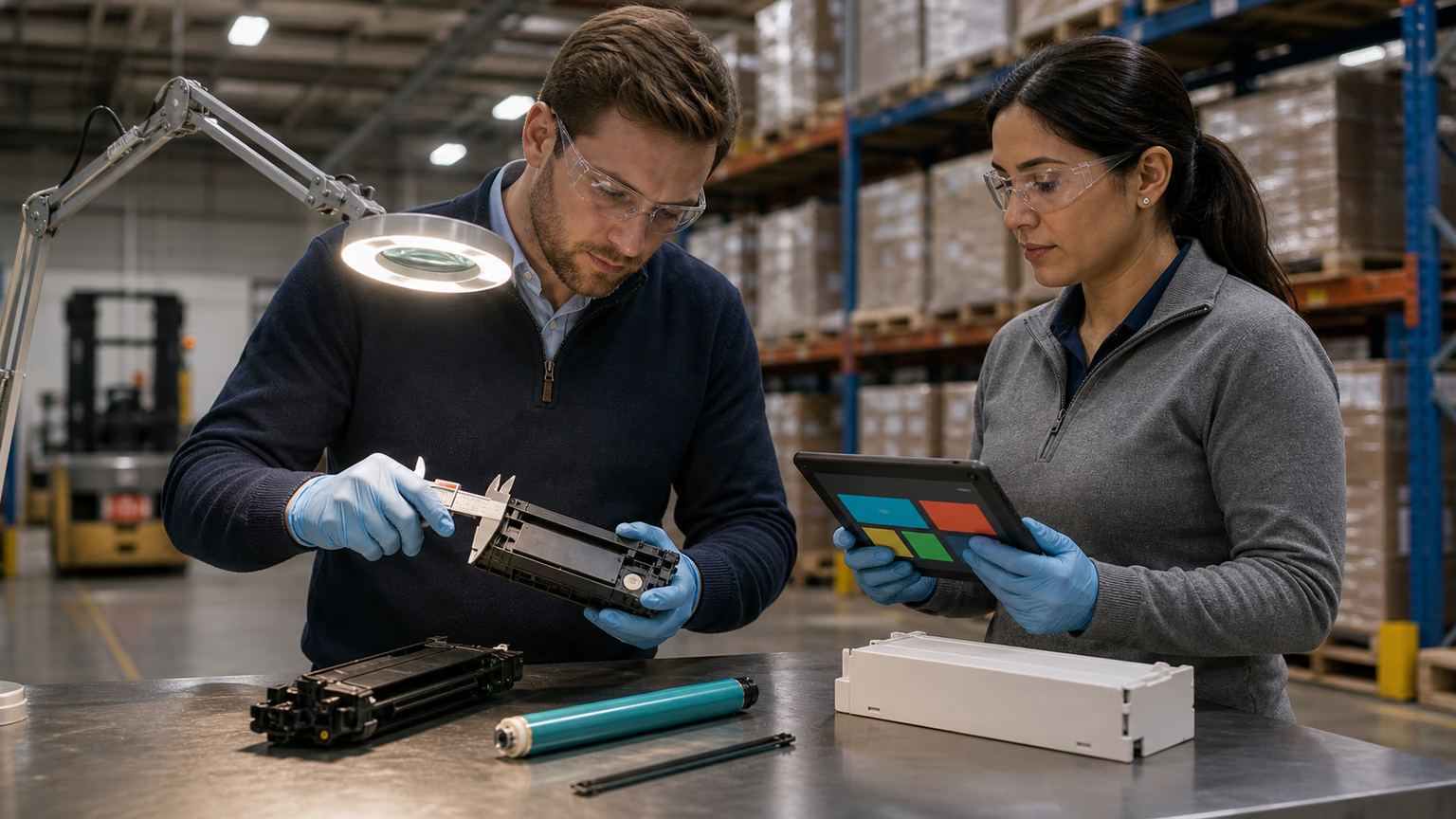
A responsible factory-direct partner should provide a full cartridge teardown report and batch traceability, so the distributor can audit what is inside each cartridge before it reaches a customer.
- Toner particle size and triboelectric properties must be stable across batches.
- OPC drums and magnetic rollers should match OEM-grade specifications for lifecycle and charge uniformity.
- Chip programming must be verified against the latest firmware versions from major printer manufacturers.
- Sealing and packaging must survive regional transport without leakage or impact damage.
- Batch-level QC records should include lot number, production date, and sign-off for outgoing inspection.
Compatibility for Mixed Printer Fleets: Chip Stability and Firmware Updates
For a B2B service company or MPS operator, the worst technical failure is a cartridge that stops being recognized after a routine printer firmware update. Printer manufacturers periodically release firmware that can block non-OEM chips. A sustainable private label toner program must address this risk up front, not after a customer calls with a dead printer.
The key is chip architecture.
Some factories use low-cost clone chips that emulate the original, but these chips are fragile when firmware changes.
Better programs use chips that are designed to survive common update cycles, often with over-the-air reprogramming or redundant communication protocols.
A distributor evaluating a factory should ask for a firmware update test matrix covering the most common business printer models across multiple brands.
The factory should be able to demonstrate that their cartridges continue to function after security and feature updates, at least within a defined compatibility window.
No factory can guarantee compatibility with every future firmware release, but a serious supplier will commit to monitoring updates and releasing revised chips quickly when a blocking issue appears.
Building Your Private Label Brand: Packaging, Positioning, and Customer Trust
Private label toner is not about slapping your logo on a white box.
It is a brand-building exercise.
The packaging, label, and cartridge marking should look professional and consistent across the entire SKU family.
For regional distributors, this means designing packaging that includes your company name, product code, page yield information if available, and any regional compliance markings required for the markets you serve.
The goal is to make the private label cartridge look like a first-tier product, not a budget alternative.
Positioning matters as much as packaging.
Avoid claiming to be identical to OEM or promising unrealistically high page yields.
Instead, focus on what the distributor can control: local availability, responsive replacement service, and consistency across orders.
A well-run private label program turns toner from a commodity into a service-led relationship.
Customers stay because they trust the distributor to stand behind the product, not because they believe the cartridge is exactly the same as the OEM unit.
- Create a consistent label design with clear product codes and brand identity.
- Include regional regulatory markings and safety information required by law.
- Develop a simple one-page product brief for each SKU that outlines compatibility and intended printer models.
- Train sales and service teams to explain the private label value proposition without making unverifiable claims.
- Use packaging that protects the cartridge and reinforces brand recognition in the warehouse and at the customer site.
Evaluating a Toner Factory: A Distributor's Due Diligence Checklist
Before signing a supply agreement, a distributor should treat the factory evaluation as a formal procurement project.
A site visit is ideal, but if that is not possible, request detailed documentation and conduct structured video audits.
The first area to examine is the production environment: clean room conditions, automated filling lines, component sourcing, and outgoing quality control.
A factory that is not transparent about its component suppliers or QC process is a red flag.
Ask for a sample batch and run a controlled test.
The test should include a representative set of printer models from the most common office brands.
Print a known document set at a controlled duty cycle and compare output quality, page yield, and cartridge behavior against a baseline.
Pay special attention to how the chip behaves after a firmware update.
Also evaluate packaging durability by drop testing a few cartridges in their final private label boxes.
- Review the factory's component sourcing list and request a teardown report for each SKU you plan to carry.
- Request batch traceability documentation that links each cartridge to its toner lot and production date.
- Test samples on at least ten different printer models across major business brands, focusing on high-volume network printers and MFPs.
- Run an accelerated firmware update test to see if cartridges survive security patches without error messages.
- Negotiate clear terms for minimum order quantities, price tiers, and performance clauses tied to defect rates.
- Ask for a written replacement or credit policy for dead-on-arrival cartridges and field failures, including return shipping responsibility.
Supply Chain and Inventory Planning for Consistent Availability
Once the private label program moves beyond a pilot, inventory planning becomes the difference between smooth fulfillment and constant firefighting.
Regional distributors often serve a mix of contract accounts and spot buyers, which makes demand lumpy.
A factory-direct relationship should include production planning support: the factory should be able to provide lead time forecasts, recommend safety stock based on your order history, and accommodate urgent partial shipments when a large end-customer order appears.
Start with a conservative SKU count.
Carry the most common cartridge models for the printer fleets you already service.
Use a simple reorder point based on average monthly consumption and supplier lead time, plus a buffer for variability.
As you gather order data, refine the SKU mix.
Avoid overcommitting to slow-moving models just because the factory offers a lower unit price at higher volume.
Cash tied up in slow-moving toner is capital that cannot be used for service expansion.
From First Order to Repeat Business: Scaling a Private Label Toner Program
A private label toner line is built in phases.
The first phase is a limited pilot with a small number of high-volume SKUs.
Use this phase to validate quality, compatibility, and packaging.
Collect field feedback from your own service team and a few trusted customers.
If a defect pattern appears, go back to the factory with documented failure analysis and require corrective action before expanding the line.
Once the pilot proves stable, expand SKU coverage based on actual customer demand data.
Build a service-friendly replacement process: a simple RMA form, a defined turnaround for credit or replacement, and clear communication to end customers.
The more predictable the service experience, the more likely customers are to accept private label toner as their default.
Over time, the distributor becomes less dependent on OEM price changes and more in control of its own margin and brand.
Scaling also means documenting everything. Keep a running log of batch performance, chip compatibility issues, packaging failures, and customer complaints. Share that data with the factory in a structured review meeting. A factory that welcomes this feedback loop is a partner; a factory that deflects or refuses to share root cause analysis is a risk.
FAQ
What is the minimum order quantity to start a factory-direct private label toner program?
Minimum order quantities vary by factory and SKU, but a reasonable starting point is a mixed container or a set number of cartridges per model.
How can I be confident the cartridges will work after firmware updates on my customers' printer fleets?
You cannot be absolutely certain about future firmware updates, but you can reduce risk by choosing a factory that maintains a chip testing lab and publishes a compatibility matrix.
Can the factory provide private label packaging with my company branding and regional compliance markings?
Yes, most factory-direct programs include custom packaging design.
What replacement or credit terms are typical if a batch has a high defect rate?
Common terms include a dead-on-arrival replacement policy and a negotiated defect rate threshold.
Can one factory support a mixed fleet of different printer brands with a single private label line?
Yes, a factory that specializes in compatible toner typically produces cartridges for multiple printer brands, but you must verify SKU coverage for the specific models your customers use.
Conclusion
Factory-direct private label toner is not a shortcut to higher margins; it is a repositioning of the distributor's role from reseller to quality-controlled brand owner.
The distributors who succeed are those who treat the factory relationship as a long-term engineering partnership, not a low-bid transaction.
They demand teardown reports, batch traceability, chip stability testing, and clear replacement terms.
They start with a limited pilot, collect field data, and scale only after the quality and compatibility risks are under control.
In a market where OEM price pressure and generic compatible failures squeeze both sides, a well-executed private label program gives regional distributors a defensible way to protect margin, stabilize supply, and keep mixed printer fleets running across their commercial accounts.