
Short answer: toner cartridges are generally classified under HS heading 8443.99 (parts and accessories of printers and copiers) and are commonly declared in India under 8443 99 59. Bulk toner powder falls under HS 3707.90. Both have commonly been taxed at 18% GST, applied as IGST on imports. Toner refilling is a service with its own service code. Always confirm the exact 8-digit line and current rate with your customs broker before you file.
HSN codes: toner cartridge, toner powder, drum, parts
India uses the Harmonized System (HS) for customs classification and the HSN code for GST. The first six digits are international; India adds two more digits for its own tariff lines. Getting the first six digits right matters most, because the national lines follow from them.
HS / HSN codes for toner products (common practice)
| Product | HS heading (6-digit) | Typical Indian HSN line | Notes |
|---|---|---|---|
| Toner cartridge (with toner) | 8443.99 | 8443 99 59 (other parts and accessories) | Treated as a part or accessory of printers and copiers |
| Ink cartridge with print head | 8443.99 | 8443 99 51 | For comparison; inkjet supply |
| Toner powder in bulk or bottles | 3707.90 | 3707 90 xx | Chemical preparations for photographic use, which include toners |
| Drum unit, developer unit, fuser | 8443.99 | 8443 99 xx | Parts of printers and copiers |
| Refilling service | Service (SAC 9987) | Maintenance and repair services | Taxed as a service, not goods |
Common practice as of October 2026. Classification can depend on the exact product and description. Confirm the 8-digit line and rate with your customs broker and the current CBIC tariff before filing.
Why toner cartridges are 8443 and not 3707
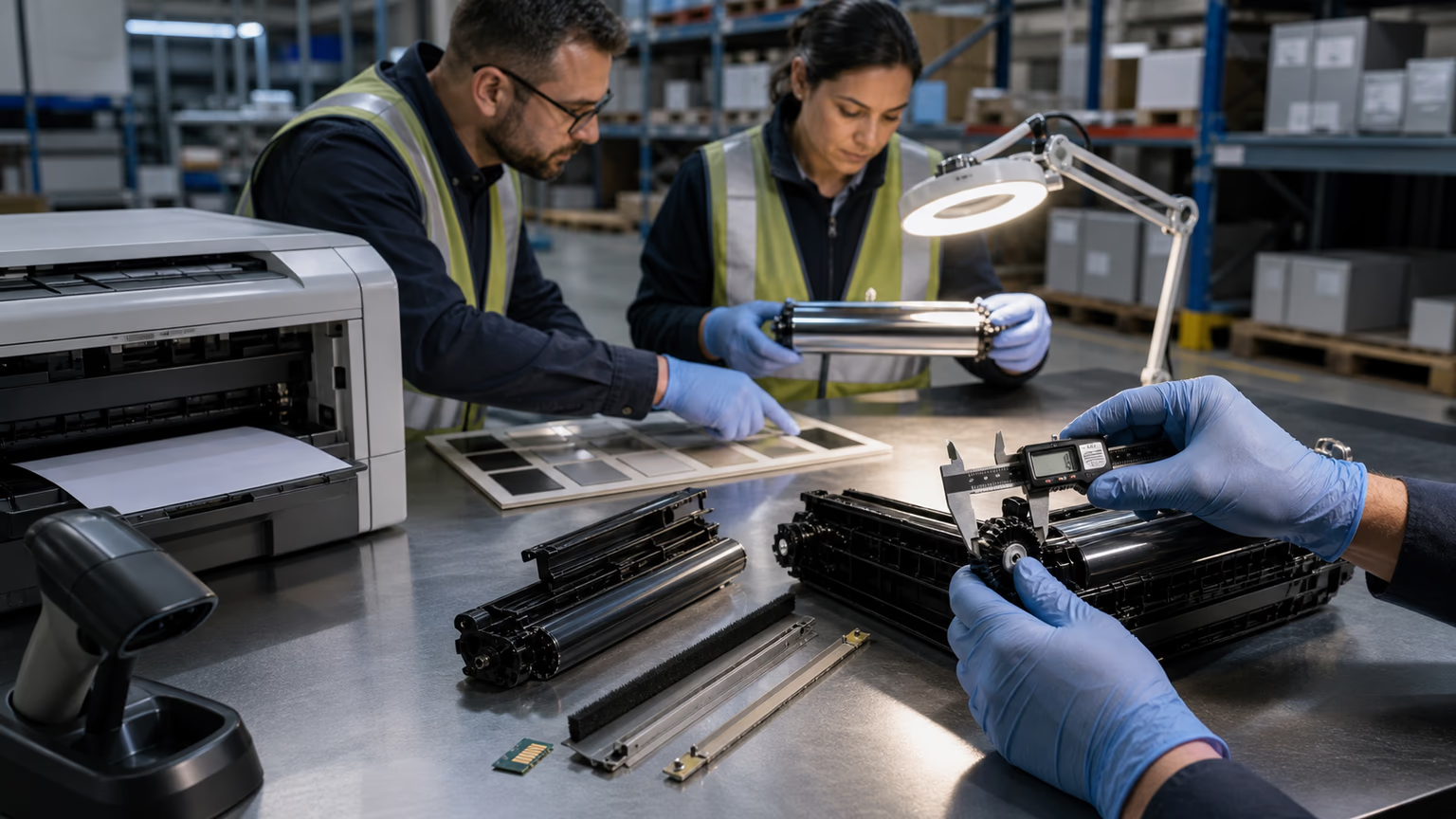
A toner cartridge is a mechanical unit with rollers, blades, seals and often a drum. Customs treat it as a part or accessory of the printer or copier it fits, under heading 8443.
Loose toner powder, sold in bulk or in bottles for refilling, is a chemical preparation and is classified under heading 3707, which covers preparations for photographic uses, including toners.
Describing a shipment clearly, for example “compatible toner cartridges for laser printers, model codes…” or “toner powder for laser printers, in 1 kg bottles”, helps customs apply the right heading.
Drums, developer and other parts
Drum units, developer units, fusers, transfer belts and similar components are also parts of printers and copiers and are generally classified under 8443.99. Waste toner containers follow the same logic.
GST rates and how to check them
For several years, toner cartridges and toner powder have commonly been taxed at 18% GST in India. On imports, IGST at the applicable rate is charged on the assessable value plus basic customs duty and any other duties. GST rates are set by notifications and were restructured in 2025, so treat any rate you read online, including here, as a starting point:
- check the current rate for your HSN line on the CBIC tax information portal (taxinformation.cbic.gov.in);
- ask your customs broker to confirm basic customs duty and any applicable exemptions or trade-agreement rates;
- keep a copy of the classification and rate decision with each shipment's file.
How customs duty is calculated
On an import, customs first determines the assessable value, usually the transaction value of the goods plus freight and insurance to the Indian port. Basic customs duty is applied to that value at the rate for the HSN line, and a social welfare surcharge may apply on the duty. IGST is then calculated on the assessable value plus these duties.
If a free trade agreement applies to the country of origin and you hold a valid certificate of origin, a lower basic duty may be available. Because these elements change with budgets and notifications, ask your customs broker for a current duty calculation for each HSN line before you price your products.
Customs documents for importing toner into India
A standard import of toner cartridges or powder needs the following documents:
Customs documents for importing toner into India
- Importer Exporter Code (IEC). The importing company needs an IEC from the DGFT, linked to its GST registration.
- Commercial invoice and packing list. Clear product descriptions with cartridge codes, quantities, unit values, weights and HS codes.
- Bill of lading or air waybill. Issued by the carrier; must match the invoice and packing list.
- Bill of entry. Filed electronically on ICEGATE by you or your customs broker; customs duty and IGST are assessed here.
- Product documents. Safety data sheet (SDS) for toner, certificate of origin where a trade agreement applies, and any test or compliance documents requested.
Clear, consistent descriptions are the most common cause of smooth or delayed clearance. The invoice, packing list and bill of entry should use the same product names, cartridge codes and HS codes. Our supplier documentation checklist lists what to request from a factory before shipment.
BIS and other compliance checks
- BIS: printers fall under India's compulsory registration scheme for electronic and IT goods. Toner cartridges are consumables and are generally not registered as a separate product, but the list of covered products changes; check the current BIS compulsory registration list before importing.
- Safety data sheets: keep an SDS for every toner product. It supports customs questions, warehouse handling and customer requests.
- Labeling: retail packages in India must carry the details required by the Legal Metrology (Packaged Commodities) rules, such as importer name and address, net quantity, country of origin and customer care details.
- Trademarks: compatible cartridges may name printer brands only to show compatibility. Packaging must not imitate the printer brand's trade dress.
- Environmental rules: plastic packaging and e-waste obligations may apply to your business depending on what you sell; check with your compliance adviser.
For a broader view of compliance documents, read our guide to the RoHS and REACH compliance trap in printer consumables.
Working with a factory: samples, labeling, shipping
Most compatible toner sold in India is made in China and other Asian manufacturing hubs. A good import process with a factory looks like this:
- Define the SKU list. Start with the cartridge codes your market buys most, including Indian regional versions such as Canon NPG and Kyocera TK-1178.
- Test samples. Print-test samples on the actual printer models used by your customers, including chip recognition.
- Agree on labeling. Provide the Legal Metrology label details and any private-label artwork before production.
- Confirm documents. Ask for commercial invoice, packing list, SDS and certificate of origin templates in advance.
- Choose shipping. Sea freight suits regular volumes; air freight suits urgent or small orders. Toner is not usually treated as dangerous goods, but carriers may ask for the SDS.
- Plan the first shipment small. Use it to test customs clearance, transit times and market response before scaling.
Our article on mapping regional toner SKUs before importing explains why choosing the right regional versions prevents dead stock, and MOQ, lead time and forecasting for toner distributors covers order planning.
Costs to include in your landed cost
- Factory price (FOB or EXW, depending on terms)
- International freight and insurance
- Basic customs duty and any surcharges
- IGST on imports (usually recoverable as input tax credit for GST-registered businesses)
- Customs broker, port and handling charges
- Inland transport and warehousing
- Returns allowance for defective or unrecognized cartridges
Comparing suppliers on landed cost per page, rather than factory price per cartridge, gives a much more accurate picture of profitability.
Common classification mistakes
- Declaring toner cartridges as ink. Ink headings apply to liquid inks and inkjet supplies, not to laser toner cartridges.
- Using one code for everything. A mixed shipment of cartridges, toner bottles and drums may need more than one HSN line.
- Vague descriptions. “Printer parts” or “consumables” invites questions. Describe the product and list cartridge codes.
- Inconsistent paperwork. Different codes on the invoice and the bill of entry cause delays and queries.
- Copying a competitor's code without checking. Classification depends on your product. Ask your broker to confirm, and keep the reasoning on file.
Checklist before your first shipment
- IEC and GST registration in place
- Customs broker appointed and briefed
- HSN lines and duty rates confirmed in writing
- Samples tested on Indian-market printer models
- Legal Metrology label content approved
- SDS and certificate of origin available
- Insurance and Incoterms agreed with the factory
- Returns and replacement process agreed with the supplier
Selling toner in India: market notes
India is one of the largest markets for compatible toner, with a few characteristics importers should plan for:
- Regional codes. Canon copier toner is sold under NPG codes and many Kyocera kits under India-specific numbers such as TK-1178. Stock the codes your customers actually search for. Our guide to Canon NPG and GPR toner codes explains the Canon naming.
- Refilling culture. Many small offices refill cartridges rather than replacing them. Bulk toner powder and refill-friendly cartridges sell alongside new cartridges.
- Copier-heavy offices. A3 copiers from Canon, Kyocera, Konica Minolta, Ricoh, Sharp and Toshiba are common, so copier toner is a large share of demand.
- Price sensitivity with quality expectations. Dealers compete on price, but repeat business depends on consistent quality and low return rates.
Importing toner from UNICO
UNICO manufactures and supplies compatible toner cartridges and copier toner for Canon, Ricoh, Kyocera, Konica Minolta, Sharp, Toshiba and Xerox devices, including regional versions used in India. Browse the UNICO catalog by model or OEM code, and request samples, documents and pricing through our wholesale toner supply page. Include your SKU list, monthly volumes and destination port.
FAQ
What is the HSN code for a toner cartridge?
Toner cartridges are generally classified under HS heading 8443.99 as parts and accessories of printers and copiers. In India's tariff they are commonly declared under 8443 99 59. Classification can depend on the exact product, so confirm the 8-digit line with your customs broker before filing.
What is the GST rate on toner?
Toner cartridges and toner powder have commonly been taxed at 18% GST in India, and imports attract IGST at the same rate on top of customs duty. Rates are set by GST notifications and can change, so check the current rate on the CBIC portal or with your tax adviser before invoicing.
What is the HSN code for toner refilling?
Toner refilling is a service, not goods, so it uses a service accounting code (SAC) rather than an HSN goods code. It is commonly treated as a maintenance and repair service under SAC group 9987. The toner powder bought for refilling is goods and is classified separately.
Do I need BIS for toner cartridges?
Printers are covered by India's BIS compulsory registration scheme for electronic and IT goods. Toner cartridges are consumables and, as of October 2026, are generally not treated as a separate BIS-registered product, but the list of covered products changes. Check the current BIS compulsory registration list before importing.