
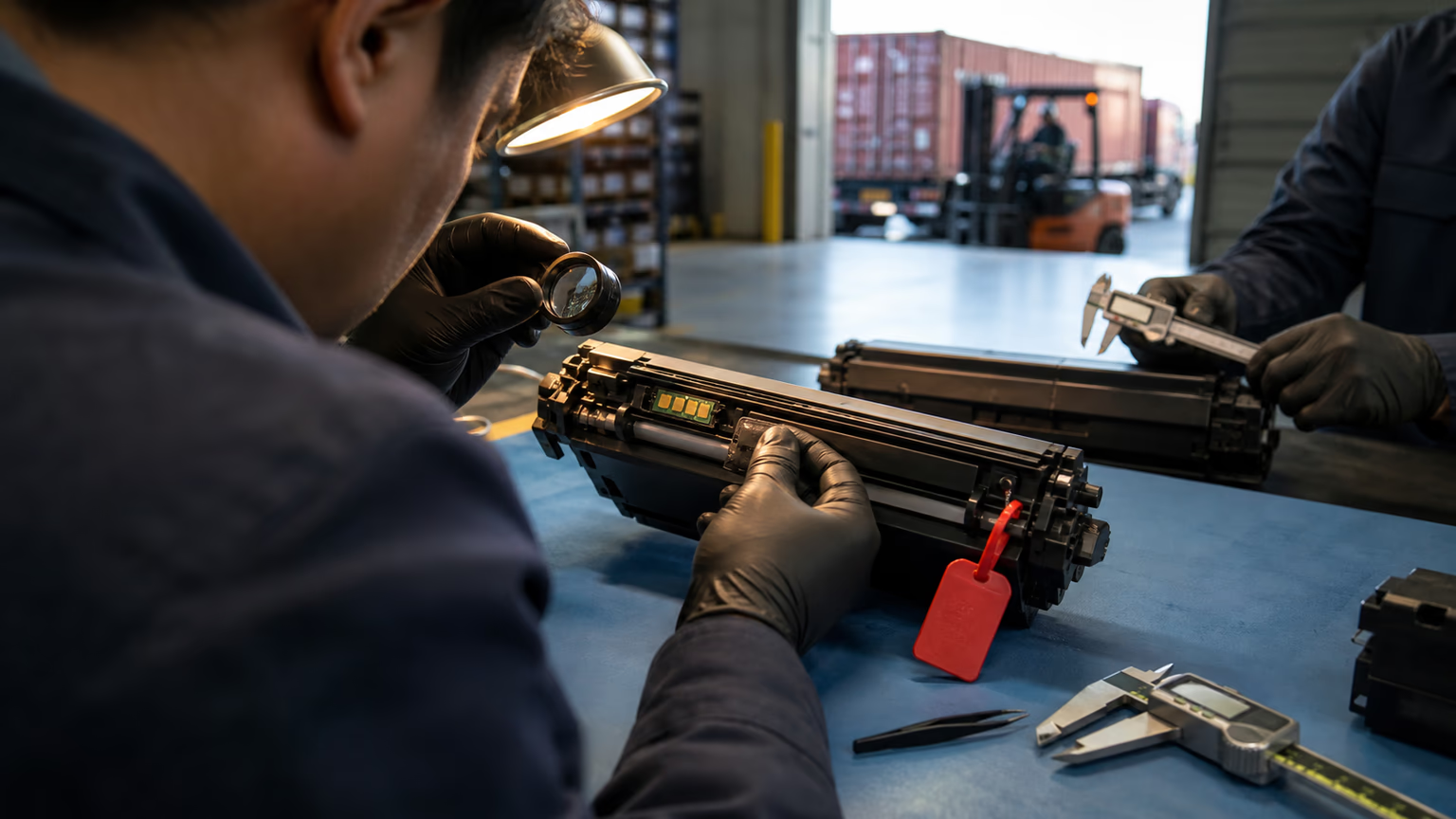
The Real Cost of Weak Toner Documentation at the Border and Beyond
Most B2B importers treat supplier documentation as an administrative checkbox.
That mindset becomes expensive when a shipment is held at customs because a safety data sheet is missing or a certificate of conformity does not match the commercial invoice.
The cost is not limited to demurrage and storage fees.
Every day a container sits at the port, downstream service commitments slip, end customers face downtime, and your team spends hours chasing paperwork instead of managing the business.
Weak documentation is also a leading indicator of deeper supplier quality problems.
A supplier that cannot produce a complete MSDS or consistent batch test reports is likely cutting corners in production, quality control, or compliance.
When documentation is missing before shipment, you are accepting unknown risk that will surface later as print defects, cartridge failures, or warranty disputes.
The real cost of weak documentation is not the missing paper; it is the predictable breakdown of your service promises and your margins.
Mapping Your Toner Import Risk: Where Documentation Fails First
To reduce toner import risk with better supplier documentation, you must first see where the paper trail breaks. Import risk is not a single event. It is a chain of failures that starts with incomplete documents and ends with a customer demanding a service credit. Break the chain into four risk areas.
- Operational risk: Held shipments cause stockouts, missed SLA windows, and higher expediting costs. If you do not have the right import documents, your inventory planning becomes guesswork.
- Quality risk: Without batch-specific test data, you cannot predict page yield, print density, or defect rates. Inconsistent quality drives service calls and returns.
- Compatibility risk: A toner cartridge may fit mechanically but fail electronically due to chip or firmware mismatches. Regional SKU variations make this worse. Documentation of compatibility testing is your only defense.
- Service risk: When a warranty claim is challenged, the supplier will ask for documents you do not have. If you cannot produce them, you eat the cost and lose the customer trust.
Every one of these risks can be reduced by demanding better documentation before the proforma is paid.
The Minimum Documentation Set Every Toner Importer Must Request
You cannot manage what you do not ask for. The following document set is the minimum requirement for any serious B2B toner purchase, whether you buy OEM-compatible cartridges or remanufactured units. Treat missing documents as a stop sign, not a negotiation point.
- Safety data sheets (MSDS): Required for chemical products in most jurisdictions. Verify the product name, hazard classification, and emergency response information. An MSDS that does not match the batch or SKU is worse than no MSDS.
- Regulatory certificates: CE marking, RoHS, REACH, and ISO 9001 or 14001 certificates should be current and verifiable. Do not accept a certificate from an unknown issuing body. Ask for the certificate number and verify it with the issuer.
- Certificate of conformity or compliance: This document ties the shipment to the declared specifications. It must reference the exact product codes, quantities, and batch numbers.
- Batch-specific test reports: Each production batch should have a test report showing page yield, print density, humidity resistance, and defect rate. Generic annual reports are not enough.
- Compatibility test evidence: If you are buying compatible toner, demand test data for the specific printer models and firmware versions your customers use. A supplier that cannot provide this is guessing.
These documents are not optional extras. They are the evidence that the supplier understands its own product and its own obligations.
How to Read a Toner Supplier’s Test Report Without Being an Engineer
You do not need a chemistry degree to spot a weak test report.
The first thing to check is whether the report is batch-specific.
A report that references a production date more than six months old or a different SKU is a red flag.
The second check is the parameters.
A credible report will list specific test methods and acceptance criteria for page yield at 5% coverage, print density in black and color, and defect thresholds for streaking, ghosting, or leakage.
Look for pass/fail criteria that are quantitative.
A phrase like 'meets all quality standards' without numbers is meaningless.
Ask for the actual test results, not just a certificate.
If the report shows a defect rate of 0.02% but does not explain how defects were measured, challenge it.
A professional supplier will be able to explain how samples were selected, how many cartridges were tested, and what happens when a batch fails.
Finally, compare the report against the contractual specifications. If the supplier promised a page yield of 3,000 pages but the report shows an average of 2,800, that gap will become your customer complaint. Documentation is only useful when it matches the negotiated spec.
Compatibility Documentation: The Hidden Trap in Regional Toner SKUs
Compatible toner is not a commodity.
The same cartridge model can have different chip versions, firmware requirements, and regional lockout behavior depending on where the printer was sold.
A toner that works in a fleet in one country may fail in another because the OEM pushed a firmware update that blocks non-OEM chips.
If your supplier does not document compatibility testing, you are the one who discovers the failure.
Demand compatibility test evidence that lists the exact printer model, regional variant, firmware version, and test date.
The report should confirm successful printing, chip recognition, and page count reporting.
If the supplier cannot provide this, ask how they guarantee compatibility across different regions.
Many low-cost suppliers skip this testing because it is expensive.
That is exactly why you need the documentation.
For B2B importers with mixed fleets, request a compatibility matrix covering the top printer models in your customer base. This becomes part of your supplier scorecard and reduces the chance of compatibility-related service calls.
Turning Documentation into a Supplier Scorecard: A Practical Audit Checklist
Documentation should not be viewed in isolation. Use it to compare suppliers systematically. Create a simple scorecard where each critical document receives a weight based on its importance to your operation. For example:
- MSDS completeness and batch match: 20%
- Regulatory certificates valid and verifiable: 15%
- Batch test report with quantitative data: 25%
- Compatibility test evidence for your fleet: 25%
- Warranty and returns policy in writing: 10%
- Responsiveness to documentation requests: 5%
Score each supplier from 0 to 5 on each criterion. A supplier that misses a document scores zero on that criterion. The total score becomes a defensible procurement decision. A low-cost supplier with a score of 2.5 is often more expensive than a mid-tier supplier with a score of 4.5 once you factor in customs delays, quality failures, and service risk.
Red flags that should immediately lower the score include documents that appear to be templates with no company letterhead, certificates from unrecognized bodies, test reports that lack dates or signatures, and a supplier that takes more than a few days to provide standard documents.
These signs indicate a supplier that does not control its own documentation, which usually means it does not control its production either.
Sample approval is part of the scorecard. Before a bulk order, request a pre-production sample with a documented acceptance test plan. The sample results must match the documented specs. If they do not, the bulk order is at risk.
Negotiating Better Supplier Documentation Before You Pay the Proforma
The best time to set documentation requirements is before money changes hands.
Once the proforma is paid, your leverage disappears.
Make documentation a binding part of the purchase order.
Specify that the supplier must submit a complete documentation package for pre-shipment review.
Define what happens if documents are missing or falsified: either the shipment is cancelled at the supplier's expense, or the buyer has the right to withhold payment until the documents are corrected.
Use staged payments to create compliance incentives.
For example, pay 30% as deposit, 50% after the pre-shipment documentation package is approved, and 20% after the goods arrive and pass incoming inspection.
This structure protects you from paying for non-compliant inventory.
Also require that the final documents accompany the shipment and are not sent later by email.
Physical copies should be in the courier pouch, and digital copies should be uploaded to a shared folder before the vessel departs.
In a competitive sourcing environment, some suppliers will resist extra documentation demands. That resistance is information. If a supplier cannot provide basic compliance documents before a PO, how will they respond when there is a quality problem after delivery? Walk away and find a supplier that treats documentation as a normal part of business.
Building a Repeatable Import Documentation Process for Your Team
Documentation risk is not a one-time fix.
It requires a standard operating procedure that every procurement and logistics team member follows for every order.
Start with a pre-shipment document checklist that is identical for all suppliers.
The checklist should include every document from the minimum set, with fields for batch numbers, issue dates, and verification status.
Review the checklist before the supplier is allowed to ship.
Integrate the checklist into your customs submission workflow.
Create a digital repository where each shipment folder contains the commercial invoice, packing list, MSDS, certificates, and test reports.
Use version control so you always know which document version was submitted to customs.
After delivery, reconcile the incoming QC results with the batch test report.
If there is a deviation, open a non-conformance report and discuss with the supplier immediately.
Over time, this data will show you which suppliers consistently meet their documented promises and which ones do not.
Finally, train your team to spot red flags without needing an engineer. A missing signature, an expired certificate, or a test report that does not include the batch number should trigger a hold. The goal is to make documentation verification as routine as checking the container seal.
What to Do When Documentation Is Missing: Escalation and Alternatives
No matter how good your process is, there will be times when a supplier cannot produce a required document. Maybe the safety data sheet is outdated, the compatibility test was done by a third party that cannot be verified, or the supplier simply does not respond. You need an escalation path that protects your business.
First, try to resolve the gap.
Request the missing document with a clear deadline.
If the supplier provides it after the deadline, assess whether the delay affects your shipment window.
If the document is falsified or cannot be verified, treat it as a material breach.
You have the right to cancel the order and demand a refund of the deposit.
If the goods have already shipped, conditionally accept them only after a third-party inspection at the supplier's expense.
The third-party lab should test a sample from the actual shipment for the parameters in the missing document.
If a supplier repeatedly fails to provide documentation, it is time to find an alternative.
There are many B2B toner cartridge suppliers who understand that documentation is part of the product.
Do not let a low unit price blind you to the total landed cost of a non-compliant shipment.
A slightly higher unit price with complete documentation is usually cheaper than a discount cartridge that gets stuck at customs or causes a service call storm.
FAQ
What documents should a toner supplier provide before shipment?
A complete documentation package includes safety data sheets, regulatory certificates like CE, RoHS, and REACH, a certificate of conformity, batch-specific test reports, and compatibility test evidence for your printer models. All documents must reference the exact SKU and batch number.
How can I verify the authenticity of toner supplier certificates?
Check the issuing body's identity and contact them directly if possible. Ask for the certificate number and look for signs of template fraud such as missing dates, no company address, or inconsistent logos. A legitimate supplier will welcome verification.
What are the most common reasons toner shipments are held at customs?
Customs holds often stem from missing or incorrect safety data sheets, a certificate of conformity that does not match the commercial invoice, or incomplete chemical declarations. These gaps are preventable with a pre-shipment document review.
How do I check if compatible toner will work with specific printer models?
Request compatibility test evidence from the supplier. The report should list the printer model, regional variant, firmware version, and test date. It should confirm successful chip recognition, printing, and page count reporting. If the supplier cannot provide this, do not assume compatibility.
Is cheaper toner more likely to have documentation gaps?
Often yes, because documentation and testing cost money. A supplier offering an unusually low price may be cutting corners on compliance documents, batch testing, or compatibility trials. Always compare total landed cost including documentation verification, not just unit price.
Conclusion
Reducing toner import risk is not about finding a supplier with the lowest unit price.
It is about building a documentation-driven procurement process that exposes risk before shipment, not after a customs hold or a customer complaint.
By demanding a complete documentation set, reading test reports critically, scoring suppliers on their paper trail, and making documentation a binding part of the deal, you transform supplier paperwork from a bureaucratic formality into a strategic risk control.
The next step for any B2B toner importer is to review your current supplier files against the checklist in this guide. If any document is missing, outdated, or unverifiable, start the conversation today. Your service reputation and your margin depend on it.