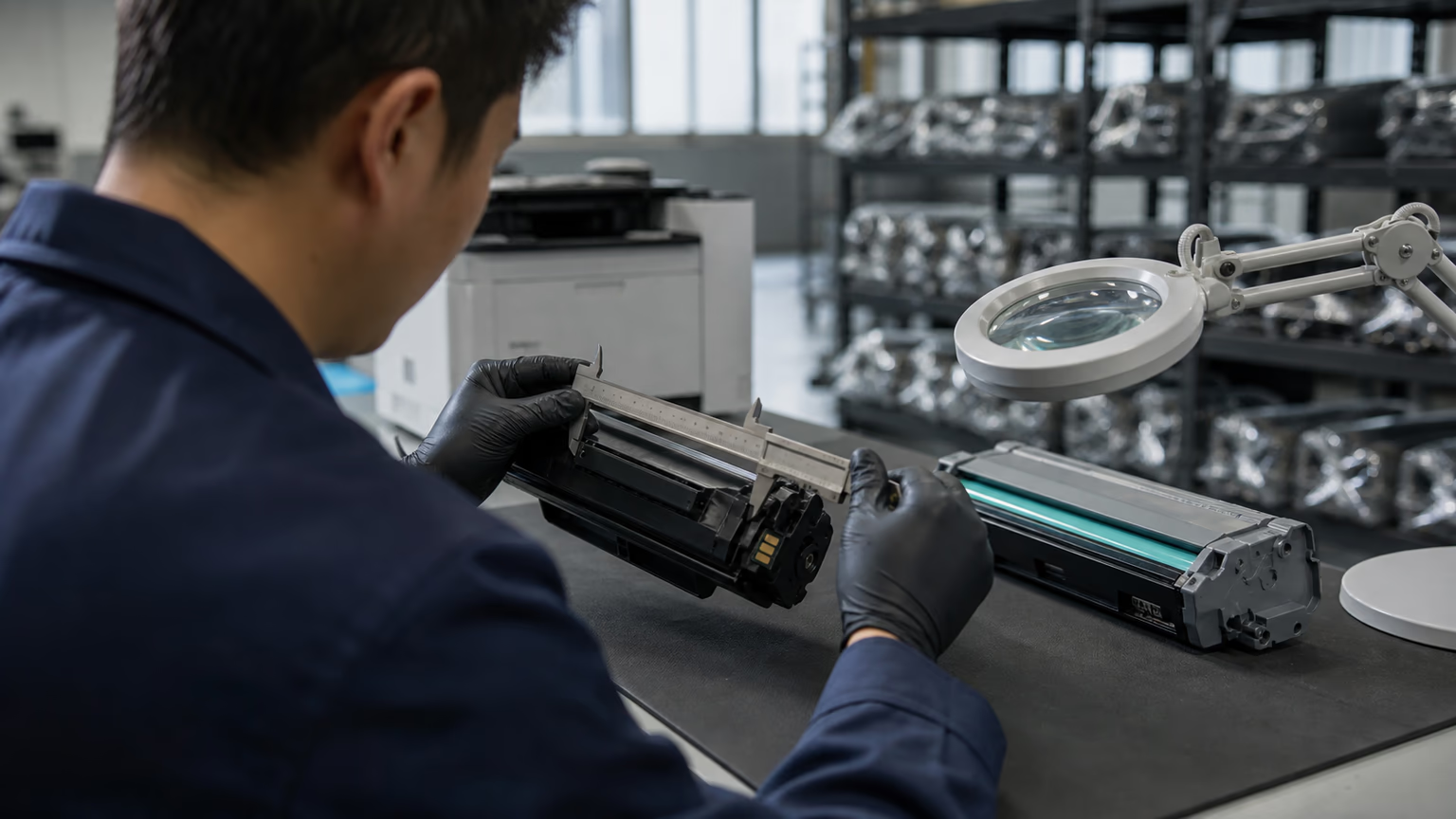

Why Mixed Toner Fleets Undermine Procurement and Service Margins
Large office printer fleets rarely grow according to a single plan.
Acquisitions, departmental purchases, and lease transitions introduce printers from multiple manufacturers, each with its own cartridge family, chip version, and part number.
For procurement teams and managed print services (MPS) operators, this fragmentation creates an invisible tax: dozens or even hundreds of unique toner SKUs that must be sourced, stocked, tracked, and replenished.
That SKU sprawl directly inflates inventory carrying costs and administrative overhead.
Each unique cartridge requires a separate forecast, a separate shelf location, and a separate reorder trigger.
Stockouts become more likely because demand for low-volume SKUs is hard to predict, and emergency orders often carry premium freight and rush fees.
Meanwhile, the same printer fleet may be pulling toner from five or six different suppliers, each with its own lead time, minimum order quantity, and return policy.
Service margins suffer as well.
When technicians are dispatched for a print quality issue, they may face a cartridge they have never seen before.
Troubleshooting becomes slower, first-time fix rates drop, and customers begin to doubt the provider's competence.
In MPS contracts, every extra service call erodes profitability.
Standardization is not a convenience; it is a structural fix for the hidden costs of fragmentation.
- Dozens of toner SKUs increase warehouse space and labor for picking and counting.
- Low-volume SKUs tie up working capital in slow-moving inventory.
- Multiple suppliers mean inconsistent pricing, lead times, and defect policies.
- Print quality complaints rise when many different cartridge batches enter the fleet.
- MPS contract margins shrink as toner-related service calls multiply.
Mapping Your Printer Fleet: The First Step to Toner Standardization
Before changing a single cartridge, you need a complete and accurate inventory of your printer fleet. This is not a one-time spreadsheet exercise; it is a living document that will guide every procurement decision. Start by recording each printer's make, model, engine platform, current cartridge part number, and average monthly print volume.
Conduct the audit site by site, because printer deployments often differ by building, department, or floor. Use barcode scanning or asset management software to reduce manual errors. Flag any printer that is rarely used, has high maintenance costs, or is scheduled for retirement. Retiring legacy devices before standardization can eliminate a significant number of low-volume cartridge SKUs.
Once the inventory is complete, sort printers by cartridge family or engine platform rather than by brand name.
You will often discover that several different printer models use the same or a very similar cartridge design.
For example, some office printers from different manufacturers share the same print engine produced by a third-party supplier.
Grouping these models together reveals immediate opportunities for SKU consolidation.
Document current consumables spend by model and department. This baseline is essential for proving the return on investment later. Without a clear picture of what you are spending today, it is impossible to demonstrate how standardization reduces total cost of ownership.
Grouping Printers by Cartridge Platform, Not by Brand
The common mistake in toner standardization is to think in terms of printer brands. A procurement team may try to buy all compatible toner from one supplier, but still maintain a separate SKU for every printer model. That approach fails to capture the real opportunity. The goal is to identify shared cartridge platforms across multiple models and brands.
Many office printers use engines manufactured by a small number of original design manufacturers.
A single compatible toner cartridge, designed and tested for a specific engine platform, can often work in printers from several different brands and model series.
For example, a cartridge built for a particular 35-page-per-minute engine may fit three or four distinct printer models sold under different brand names.
Cross-reference databases and supplier engineering teams are critical for accurate grouping. A reputable compatible toner supplier will have detailed compatibility lists that go beyond simple model mapping. They will know which cartridge casing, chip version, and gear configuration are required for each printer variant, including regional differences and model suffixes.
In a typical multi-brand fleet, grouping by cartridge platform can reduce the number of active SKUs by 30 to 60 percent without sacrificing printer coverage. This consolidation directly lowers inventory complexity, frees up warehouse space, and reduces the chance of ordering errors. The discipline of platform mapping becomes the backbone of the entire standardization strategy.
Evaluating Compatible Toner Options for Multi-Brand Fleets
Not all compatible toner cartridges are created equal. For a fleet of hundreds of printers, the cost of a single bad batch is not just a few reprints; it can trigger dozens of service calls, damage printer components, and erode customer trust. Therefore, supplier evaluation must be rigorous and evidence-based.
Request batch test reports and compatibility certificates for the specific printer models in your fleet. Ask how the supplier verifies that each production run meets page yield, density, and transfer efficiency standards. Some suppliers provide independent test results from laboratories or customer reference fleets. Use that data to shortlist candidates.
Before committing to a full rollout, test compatible cartridges on a representative sample of high-volume printers.
Run the test for at least one full cartridge cycle, monitoring print quality, page yield, and any error messages.
Pay attention to how the cartridge behaves after the printer enters sleep mode or after a firmware update.
A short test on a few printers is far cheaper than a fleet-wide failure.
Assess the supplier's ability to provide a consolidated catalog that covers the majority of your required SKUs. If a supplier can only offer cartridges for a narrow range of printer models, you may end up managing two supply chains instead of one. Look for a partner with engineering depth in multi-brand compatible toner development, not just a trading company with a large list of part numbers.
Building a Procurement Framework for Standardized Toner Supply
Once you have mapped your fleet and selected a qualified compatible toner supplier, the next step is to structure the commercial relationship for long-term success. The goal is to move from transactional buying to a strategic supply agreement that rewards volume across the entire fleet, not volume per SKU.
Consolidate to one or two primary suppliers that can cover at least 90 percent of your toner needs. A limited supplier base simplifies ordering, invoicing, and contract management. It also gives you more negotiating leverage because the supplier sees the total annual volume rather than dozens of small orders for individual cartridge models.
Negotiate tiered pricing based on total fleet volume. Instead of asking for a discount on each cartridge line, propose a pricing table that lowers your per-unit cost as your total quarterly or annual spend increases. Include a clause for long-term price stability, so that a sudden raw material cost increase does not wipe out your standardization savings.
Define clear service-level agreements for delivery, fill rates, and defective cartridge replacement.
For a fleet of hundreds of printers, a 95 percent fill rate on a slow-moving SKU may still mean several stockouts per year.
Specify how quickly replacement cartridges will be shipped for quality defects, and who pays for return freight.
Integration with electronic ordering and inventory management systems can further reduce administrative overhead and manual data entry.
Managing Service and Support Risks After Standardization
Standardizing toner changes the service environment. Technicians who previously had to recognize dozens of different cartridge types now work with a much smaller approved list. But that benefit only appears if you invest in training and documentation.
Train service technicians on the approved compatible cartridge list, including the specific printer models each cartridge supports.
Create a reference guide that maps printer model to consolidated cartridge SKU, and make it available on mobile devices or printed in the service van.
When a technician encounters a printer that is not on the list, they should know the escalation path for a compatibility issue.
Establish a clear escalation path with the supplier for quality or compatibility issues. If a cartridge is suspected of causing print defects or printer damage, your supplier should have a technical support team that can help diagnose the problem and provide root cause analysis. Without this support, every cartridge issue becomes a guessing game.
Monitor service call rates before and after standardization.
A well-executed toner consolidation should reduce the number of toner-related service calls.
If call rates increase, investigate whether the compatible cartridge is underperforming in specific printer models or whether a firmware update has introduced a incompatibility.
Create a fast feedback loop from end users and service technicians to procurement, so that cartridge performance data flows back into supplier evaluation.
Measuring TCO and Adjusting Your Toner Strategy Over Time
Standardization is not a one-time project; it is an ongoing discipline. To prove its value and refine the approach, you need to measure total cost of ownership (TCO) at the printer level, not just the purchase price per cartridge. True TCO includes the cost of the cartridge, the page yield, the cost of any service calls triggered by toner issues, and the labor cost of managing inventory.
Track inventory turnover rates before and after standardization. A reduction in SKU count should lead to higher turnover for the remaining SKUs, which means less cash tied up in slow-moving toner. If some consolidated cartridges are still turning slowly, consider whether the fleet composition has changed or whether the printer model is a candidate for retirement.
Review supplier performance metrics quarterly: fill rate, defect rate, response time to technical inquiries, and accuracy of compatibility claims.
Use this data to hold the supplier accountable and to renegotiate terms if necessary.
The standardization framework should also include an annual fleet reassessment.
Printers that are no longer cost-effective to support should be retired or replaced, further simplifying the toner supply chain.
Finally, report the hard numbers to management. Show the reduction in active SKUs, the improvement in inventory turns, the drop in emergency orders, and the change in service call rates. These metrics transform toner standardization from a tactical purchasing decision into a strategic contribution to the company's bottom line.
Common Standardization Pitfalls to Avoid
Even with a solid framework, standardization projects can go off track. The most common pitfall is treating toner standardization as a price-reduction exercise rather than an operational improvement. Chasing the lowest compatible cartridge price without validating quality and compatibility leads to print defects, service calls, and ultimately higher total costs.
Another frequent mistake is ignoring firmware update policies. Some printer manufacturers release firmware updates that block non-OEM cartridges. Before standardizing, ask your supplier how they handle chip updates and whether they have a process for providing updated chips when firmware changes. Negotiate a firmware support clause in your supply agreement.
Under-training service staff is also risky. If technicians do not know the approved cartridge list, they may install the wrong cartridge out of habit, causing print quality issues and warranty disputes. Similarly, failing to maintain accurate mapping data as new printer models are added to the fleet will erode the benefits of consolidation over time.
Finally, avoid single-source dependency without a contingency plan. While consolidating to one supplier is efficient, that supplier may face production delays or quality problems. Maintain a secondary supplier for critical high-volume SKUs, or negotiate a buffer stock arrangement that protects you from supply disruptions.
FAQ
Is it safe to use compatible toner in hundreds of different printer models from different brands?
Yes, if you choose a compatible toner supplier that documents compatibility testing on actual printer models within your fleet. Safety depends on the quality of the cartridge's chip, casing, and toner formulation. Test on a sample of high-volume printers before rolling out to the entire fleet. A reputable supplier will provide batch test reports and a clear replacement policy for defects.
How do I map my current printer fleet to compatible cartridge SKUs without risking compatibility issues?
Start with a complete audit of every printer's make, model, engine platform, current cartridge part number, and monthly volume.
What are the most common risks when standardizing on one compatible toner brand for multiple printer brands?
The main risks are inconsistent print quality, page yield variation, firmware blocking, and poor technical support from the supplier. To mitigate these, evaluate the supplier's batch-level quality control, test cartridges on high-volume printers, negotiate a firmware update support clause, and establish a clear escalation path for quality issues. Avoid selecting a supplier based on price alone.
How do I handle firmware updates that may block compatible cartridges after standardization?
Work with your compatible toner supplier to understand how their cartridge chips respond to printer firmware updates.
What should I look for in a compatible toner supplier when managing a large multi-brand fleet?
Look for a supplier with documented compatibility testing, batch-level quality control, and technical engineering support for printer-specific issues.
Conclusion
Standardizing toner across hundreds of office printers is not about finding a single universal cartridge.
It is about consolidating around shared engine platforms, reducing SKU sprawl, and building a supplier relationship that supports multi-brand compatibility and consistent quality.
The process requires a detailed fleet audit, rigorous supplier evaluation, and a procurement framework that rewards total volume rather than individual SKU volume.
For procurement teams, MPS operators, and printer service companies, toner standardization is a strategic lever for improving margins, reducing service calls, and regaining control over a fragmented consumables category. By following the framework outlined in this guide, you can move from reactive toner purchasing to a disciplined, data-driven supply chain that supports your entire printer fleet.