
For procurement professionals managing office printer fleets, selecting a toner supplier often begins with a spreadsheet comparison of unit prices.
However, the real drivers of total cost — print quality, device reliability, and ongoing technical support — rarely appear on those initial price lists.
Without a structured evaluation, too many B2B buyers end up with toner cartridges that look identical on paper but cause endless service calls, customer complaints, and hidden operational waste.
A 30-point toner supplier audit checklist transforms this high-risk guessing game into a disciplined, evidence-based process.
When you depend on consistent laser printer toner performance across hundreds or thousands of devices, every cartridge failure has a domino effect.
A single batch of subpar office printer toner can lead to reprints, wasted technician time, and even permanent damage to a printer's imaging components.
The challenge is that most supplier promises around yield, compatibility, and batch consistency are not independently verified before contracts are signed.
This is where an audit framework becomes your first line of defense.
It forces suppliers to demonstrate their claims with documentation, test data, and process transparency — not just sales collateral.
Procurement teams that adopt a formal checklist report a significant shift in how they negotiate and manage supplier relationships.
Instead of reacting to quality issues after they impact end-customers, they proactively eliminate risky vendors during the evaluation phase.
The checklist serves as a common language between technical teams, finance, and service operations, aligning everyone around what truly matters: reliable print output, minimal downtime, and predictable total cost of ownership.
Over time, this approach builds a roster of approved suppliers whose performance is continuously measured against clear benchmarks.
This article outlines a comprehensive 30-point audit divided into five critical pillars: quality and manufacturing, compatibility and fleet coverage, service and support, logistics and supply chain, and financial and contractual safeguards.
Each section provides actionable checks that can be immediately integrated into your existing vendor qualification workflow.
By the end, you will have a repeatable blueprint for turning supplier evaluation from a subjective chore into a strategic procurement advantage.
The Real Cost of Choosing the Wrong Toner Supplier
The unit price of a toner cartridge is the most visible number, but it is rarely the largest cost.
The true financial burden of a poorly chosen supplier materializes in higher failure rates, unplanned service interventions, and the slow erosion of customer trust.
For a B2B toner cartridge supplier that cannot maintain consistent quality, the real price tag includes everything from wasted prints and increased help-desk tickets to the overtime labor required to replace defective cartridges in the field.
These hidden costs can easily double or triple the effective spend on printer cartridges over a contract term.
Operational risks are particularly acute in managed print services (MPS) or printer service company environments, where service-level agreements (SLAs) tie compensation to uptime and print quality.
If a bulk printer toner supplier provides cartridges with inconsistent fill or poor fusing characteristics, the resulting jams and image defects trigger repeated technician dispatches.
Each dispatch eats into margins and damages the service provider's reputation.
Moreover, when end-customers experience frequent printer toner issues, they question the competence of the entire service offering, not just the cartridge brand.
Indirect costs further compound the problem.
Consider the administrative burden of processing returns and credits for defective toner cartridges.
Without a streamlined return process, procurement departments waste hours on documentation, shipping, and reconciliation.
In severe cases, leaking cartridges can contaminate printer internals, leading to expensive repairs and device downtime that interrupts core business operations.
A supplier audit that prioritizes quality metrics and defect tracking upfront can prevent these scenarios from ever developing.
For distributors and importers that supply compatible toner for mixed printer fleets, a single failure can sour a long-standing relationship, making the 30-point checklist a transparent, defensible tool for protecting the organization from known risks.
How to Use This Checklist: A Procurement Tool for Due Diligence
Before diving into the checklist items, it is important to establish a proper evaluation framework.
Begin with a thorough fleet analysis: document every printer model in your environment, its average monthly print volume, and any known issues with toner compatibility.
This baseline allows you to target the audit to your specific needs rather than applying generic questions.
For instance, if your fleet includes many high-speed laser devices, the thermal fusing performance of compatible toner becomes non-negotiable.
The audit should proceed in stages.
Start with a desktop assessment, requesting documentation on manufacturing processes, quality certifications, and batch testing protocols.
Follow this with a site visit or a detailed review of the supplier's production and warehousing facilities if possible.
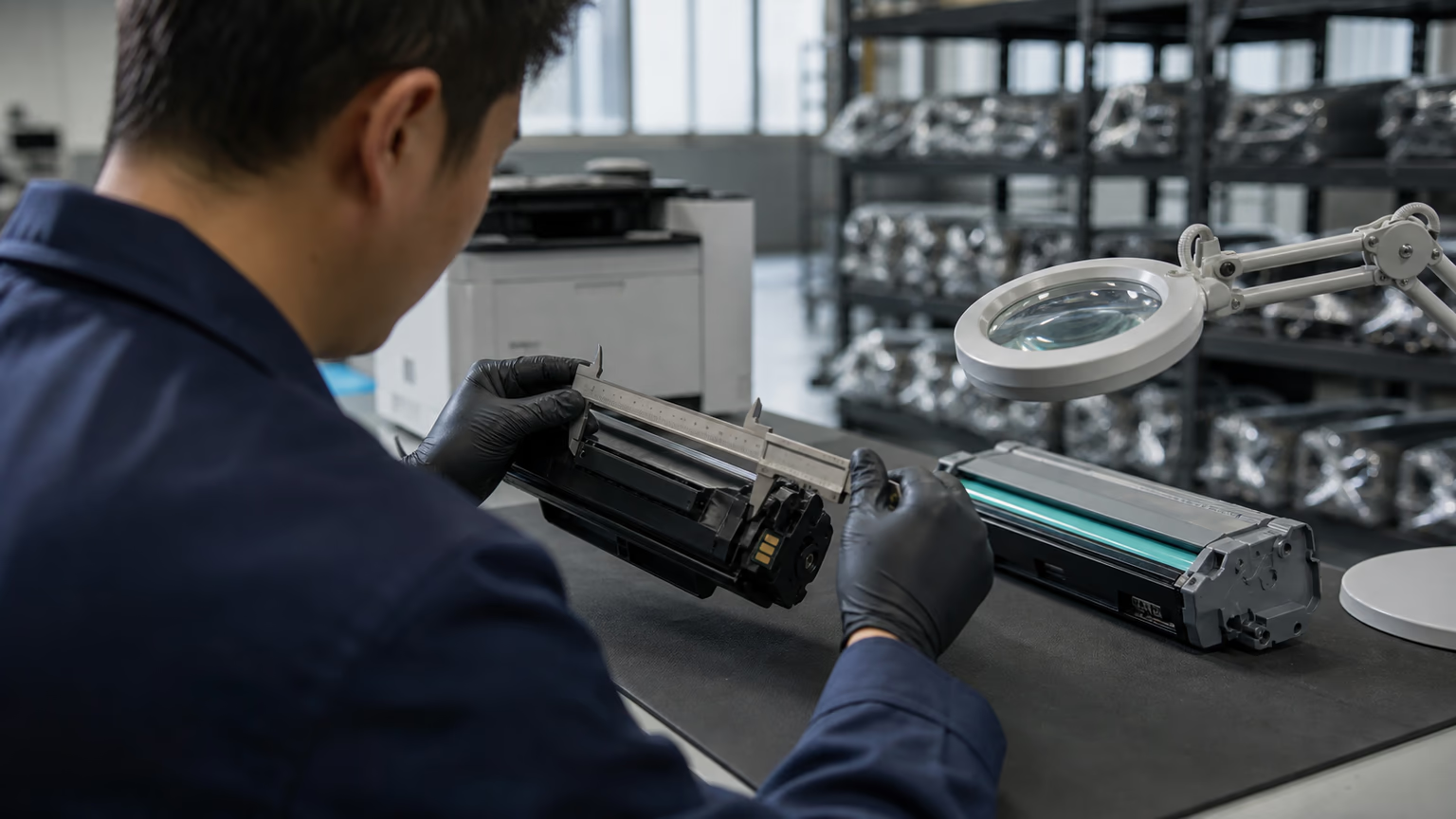
Concurrently, obtain cartridge samples for the most critical printer models in your fleet and run them through a standardized print test that checks density, backgrounding, page yield, and physical integrity.
The results should be compared against OEM reference cartridges and documented with objective measurements, not just visual impressions.
Scoring each checkpoint is critical for objective comparison.
Assign a weight to each of the five audit pillars based on your organization's risk tolerance.
A high-volume transactional printer fleet might prioritize logistics and failure rates, while a color-intensive marketing department will place quality at the top.
Score each item on a simple 0–3 scale and calculate a weighted total.
This numeric output allows you to rank suppliers dispassionately and provide clear justification to the procurement committee.
Re-audit annually or whenever a major fleet change or firmware update wave occurs to keep the evaluation current.
Quality & Manufacturing Audit (Points 1–8): Ensuring Consistent Output
The quality pillar examines whether the supplier has a documented, repeatable manufacturing process that delivers consistent laser printer toner cartridges.
First, verify the existence of incoming material inspection: the best bulk printer toner suppliers test each lot of raw toner, OPC drums, and other components before production.
Ask for evidence of statistical process control charts that map defect rates over time.
A supplier that cannot produce these records is operating reactively and will inevitably ship inconsistent product.
Points 1 through 8 also probe yield testing methodologies.
Reliable suppliers conduct life testing in accordance with recognized standards, such as ISO/IEC 19752 for monochrome and ISO/IEC 24712 for color, and share the results openly.
Page yield is not a marketing number; it is a performance specification that must be validated on devices representative of your fleet.
Request data from the supplier's internal lab for the exact printer models you operate, including mean yield, standard deviation, and the number of cartridges tested.
This transparency separates commodity resellers from true manufacturing partners.
Beyond yield, batch consistency is the hallmark of a professional B2B toner cartridge supplier.
Inquire about the acceptance criteria for each production run: what are the defined limits for density variation, background levels, and defect rates?
How does the supplier quarantine and rework non-conforming lots?
A supplier that blends down out-of-spec batches by mixing them with good product is a major red flag.
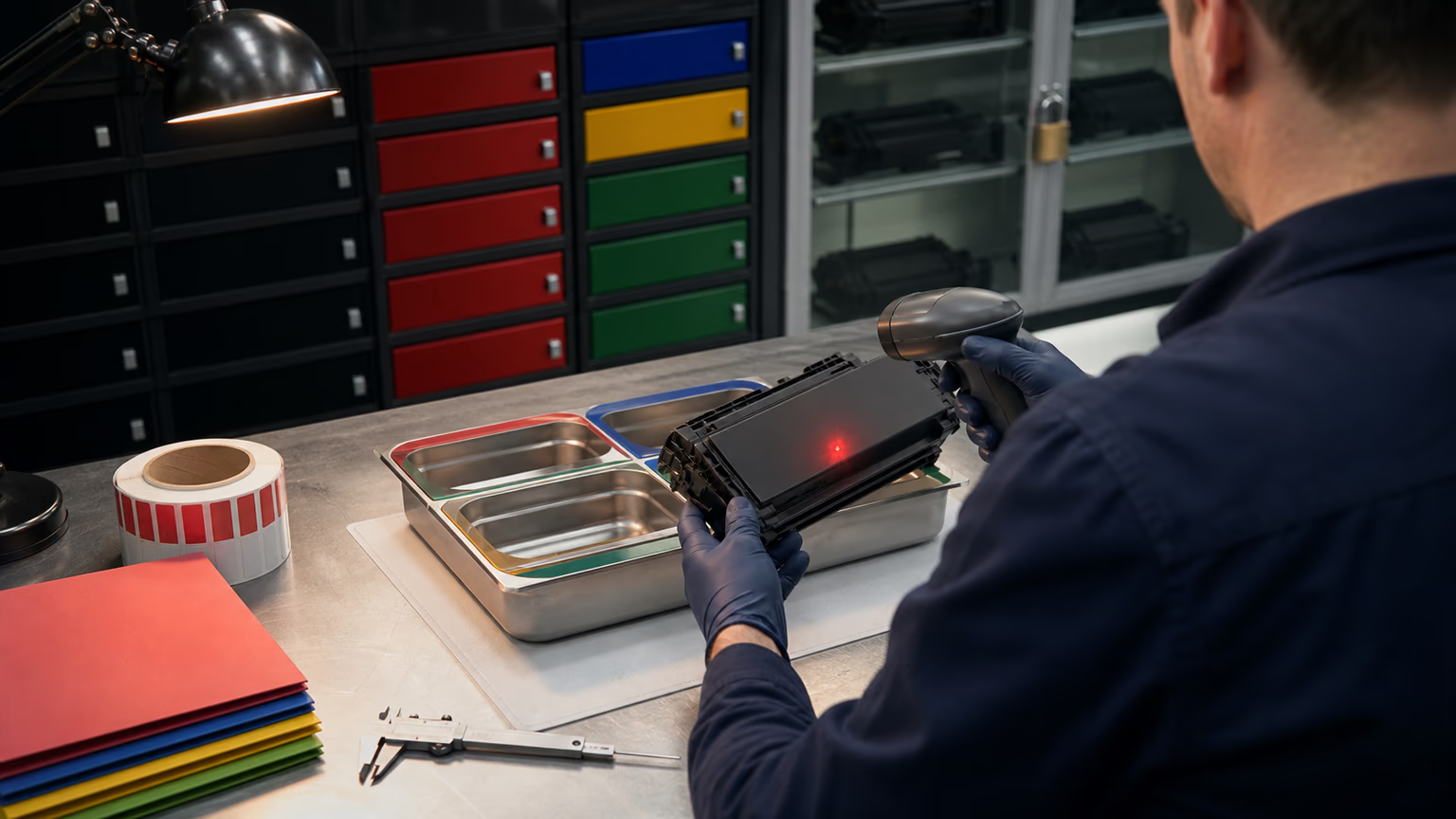
Look for a clear traceability system where every cartridge can be tracked back to its production lot and incoming material certificates, enabling root cause analysis if field failures occur.
Environmental stress testing — for temperature extremes, vibration, and shipping simulation — should also be part of the audit to explain why some toner cartridges fail after sitting on a shelf for months.
Compatibility & Fleet Coverage Audit (Points 9–15): Mitigating Firmware Risks
Compatibility is the most dynamic and risky dimension of the toner cartridge supplier audit checklist.
Modern printers regularly receive firmware updates that can render previously working compatible cartridges inoperable.
Therefore, points 9 through 15 focus on the supplier's chip technology and its ability to respond quickly to firmware changes.
A responsible printer toner supplier invests in a dedicated engineering team that monitors firmware releases across all supported brands and re-chips cartridges before clients are impacted.
Ask for a timeline of recent firmware events and the supplier's time-to-solution; any supplier that claims they never have chip issues is being less than transparent.
The audit should map the supplier's coverage to your exact fleet.
For each printer model, confirm the availability and version status of cartridges.
Beware of suppliers who offer only the most popular cartridges and leave you scrambling for the less common models in your environment.
A genuine compatible toner for mixed printer fleets provider demonstrates deep catalog support, including high-yield options, and validates each cartridge mechanically and electrically in-house.
Request a compatibility list that has been tested within the last six months and verify through sampling.
Points 9–15 also evaluate how the supplier handles mechanical tolerances.
Some cartridges may fit physically but cause excess waste toner buildup, errors with the registration sensors, or accelerated component wear.
A thorough supplier will have test beds with multiple printer units of each model to measure not just initial error rates but also performance over the full life cycle of the cartridge.
Additionally, confirm that the supplier has a proactive communication plan for firmware updates.
If a major printer manufacturer releases a security update that blocks aftermarket chips, your supplier should notify you in advance, provide a temporary workaround if needed, and ship updated cartridges before the old ones run out.
This level of service distinguishes a stable toner cartridge supplier for office fleets from a mere box-mover.
Service & Support Audit (Points 16–22): Evaluating Response and Issue Resolution
Even the best quality toner cartridges will occasionally have issues.
What separates a strategic partner from a transactional vendor is how quickly and effectively problems are resolved.
Points 16 through 22 dissect the supplier's technical support infrastructure.
Start by mapping the support structure: do you have a named account manager and access to level-2 engineers who understand the intricacies of laser print technology?
A supplier should provide multiple channels—phone, email, and a portal—with clear escalation paths and committed response times.
Importantly, the audit must specify performance SLAs with concrete penalties.
For example, if your service desk reports a batch defect, the supplier should acknowledge the issue within four hours and provide a root cause analysis within 48 hours.
Credits for dead-on-arrival cartridges should be processed upon return notification, not after lengthy back-and-forth.
Probe whether the supplier offers advanced replacement and covers shipping costs both ways; these logistical details heavily influence the actual cost of a failure.
Proactive monitoring is another differentiator.
Leading compatible toner cartridge suppliers for importers and service companies implement batch tracking systems that can flag issues before they spiral.
If a particular production run shows a higher-than-normal return rate, the supplier should withdraw remaining stock from inventory and inform customers.
During the audit, request a real example of a batch issue that was caught and managed through this process.
Technical training and documentation also matter: evaluate the supplier's installation guides, diagnostics, and field technician training to ensure your team can resolve problems quickly with the supplier's direct engineering support.
Logistics & Supply Chain Audit (Points 23–26): Guaranteeing Steady Supply
A reliable toner cartridge supply chain is the backbone of any service operation.
Points 23 through 26 verify that the supplier can deliver the right cartridges, in full, on time, every time.
Begin with inventory inquiry: what safety stock levels does the supplier maintain for your top-moving SKUs?
How do they forecast demand, and what lead times apply for replenishment orders?
A supplier with a single distribution point may struggle to meet tight delivery windows across a geographically dispersed fleet, so ask about the distribution network and whether regional hubs are part of the model.
Delivery reliability should be backed by historical performance data, not promises.
Request on-time delivery statistics for the past 12 months, along with any instances of stockouts.
For critical accounts, some toner cartridge suppliers for distributors commit to vendor-managed inventory programs where they monitor your stock levels and trigger shipments automatically.
Supply chain continuity has become a critical concern: ask about the supplier's manufacturing locations, alternative sourcing for key raw materials, and contingency plans for production interruptions.
A robust supplier will have at least secondary sources for chips, OPC drums, and toner powder, and will share a high-level continuity plan without revealing competitive secrets.
Finally, packaging and condition upon arrival can affect cartridge reliability.
Audit the packaging standards: are cartridges individually sealed with desiccant?
Is the packaging designed to withstand stacking and rough handling during transit?
During sample evaluation, note any signs of leakage or damage; these are often systemic issues with the supplier's packing process rather than isolated incidents.
Financial & Contractual Audit (Points 27–30): Uncovering Hidden Costs
The final four points of the audit address the commercial terms that can undermine otherwise excellent supplier performance.
Price stability is paramount.
Request a clear pricing structure and understand how prices may change over time.
A supplier that offers an attractive introductory rate only to increase prices after six months creates budget unpredictability.
Define price lock periods and any indexation formulas that tie adjustments to raw material costs or currency fluctuations.
These should be transparent and capped.
Scrutinize the return and credit policy next.
A low failure rate is meaningless if the process for returning defective cartridges is burdensome.
Audit the time from return request to credit memo, whether the supplier covers return shipping, and how they handle disposal of non-functional units.
Some suppliers charge restocking fees or require high thresholds before credits are issued—these terms add hidden costs that directly impact your TCO.
Contractual flexibility is especially important for growing fleets.
Can you adjust volumes without penalty?
What are the termination clauses if quality deteriorates or a major firmware event breaks compatibility?
The checklist should verify that contract terms include explicit quality and service KPIs with measurable targets and remedies.
Lastly, evaluate the supplier's financial health and compliance posture.
While you cannot ask for a balance sheet in most cases, you can look for external validations such as membership in industry associations, recognized environmental compliance, and adherence to regulations like REACH or RoHS.
These indicate a level of maturity and stability that reduces your risk of a sudden supplier failure that leaves your fleet stranded.
Red Flags: When to Walk Away
Even a partially conducted audit can reveal patterns that make a supplier untenable.
Several universal deal-breakers should prompt immediate disqualification.
A supplier that cannot provide any documented quality control process or batch records is operating on hope rather than engineering.
Similarly, an inability or unwillingness to share third-party test reports or customer references signals that they have something to hide.
Evasive answers about firmware update handling, chip sourcing, or the origin of components suggest that compatibility will become a recurring nightmare.
Watch for financial red flags as well.
If a supplier demands large upfront payments without performance guarantees, or offers pricing far below the market average without a credible explanation, the risk of bait-and-switch or sudden failure is high.
Also, beware of suppliers that push you to purchase exclusively one category of cartridges while remaining silent on other models in your fleet; this often preludes compatibility gaps that will become your problem.
Finally, a complicated or customer-unfriendly return process—including restocking fees, denial of credits for legitimate defects, or lack of return labels—indicates that the supplier does not stand behind its product.
FAQ
What are the most critical areas to evaluate in a toner supplier audit?
The pillars with the highest operational impact are quality (including batch consistency and yield validation), firmware compatibility readiness, and service support responsiveness.
How many suppliers should we audit before making a decision?
A shortlist of three to five suppliers is typical for a thorough evaluation. This provides enough variety to compare approaches across all five checklist pillars without overwhelming the procurement team. Conduct the same structured scoring for each, and be prepared to invest time in site visits or deep technical discussions with the top two.
What is the difference between auditing an OEM supplier and a compatible toner supplier?
OEM audits primarily focus on contractual terms, pricing stability, and logistics, as the cartridges are designed by the printer manufacturer and carry a performance baseline.
How can we test toner cartridge quality without a full-fledged lab?
You can perform practical field testing using a representative sample of your fleet printers.
What are the common red flags when auditing a new toner supplier?
Absence of batch traceability, inability to reference recent firmware updates they have successfully navigated, refusal to provide sample cartridges before contract signing, and vague answers about chip technology are all serious warnings.
Conclusion
A 30-point toner supplier audit checklist may seem like a heavy-handed procurement tool, but the cost of not using one is far heavier.
Every unchecked assumption about quality, compatibility, or service translates into field failures, customer dissatisfaction, and hidden operational expenses that erode margins and destroy trust.
By institutionalizing a structured audit, procurement teams turn supplier selection from a gamble into a calculated, defensible, and repeatable process.
The five pillars described here—quality and manufacturing, compatibility and fleet coverage, service and support, logistics and supply chain, and financial and contractual safeguards—cover the full spectrum of risk that any B2B toner cartridge supplier represents.
Adapt the checklist to your specific printer fleet, weight the criteria according to your business priorities, and re-audit annually.
Only then can you achieve a supply chain that supports your operations rather than constantly threatening them.
In commercial print environments, reliable office printer toner is not a commodity; it is a critical enabler.
Treat supplier evaluation with the seriousness it deserves, and your entire service operation will become more resilient.