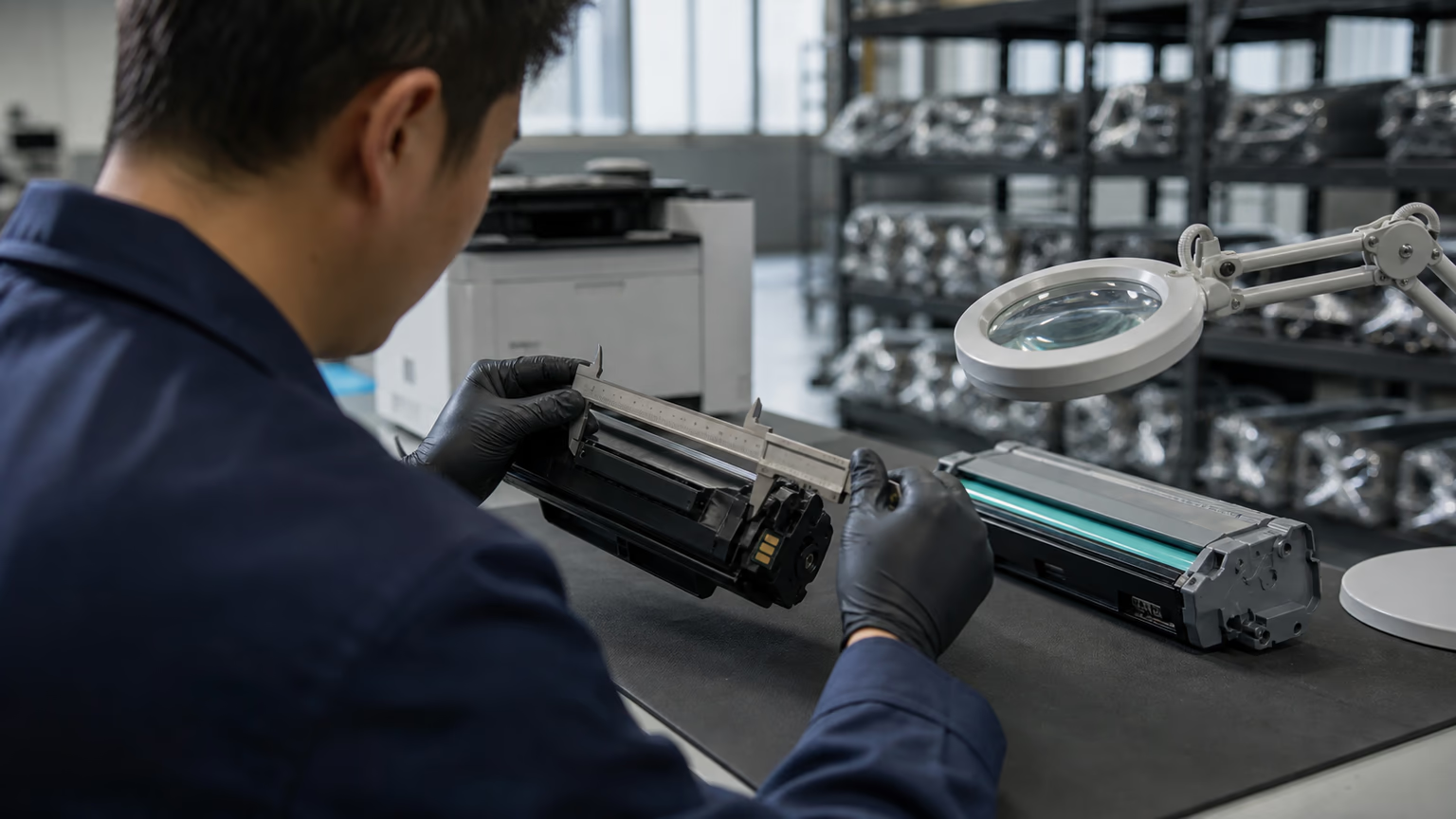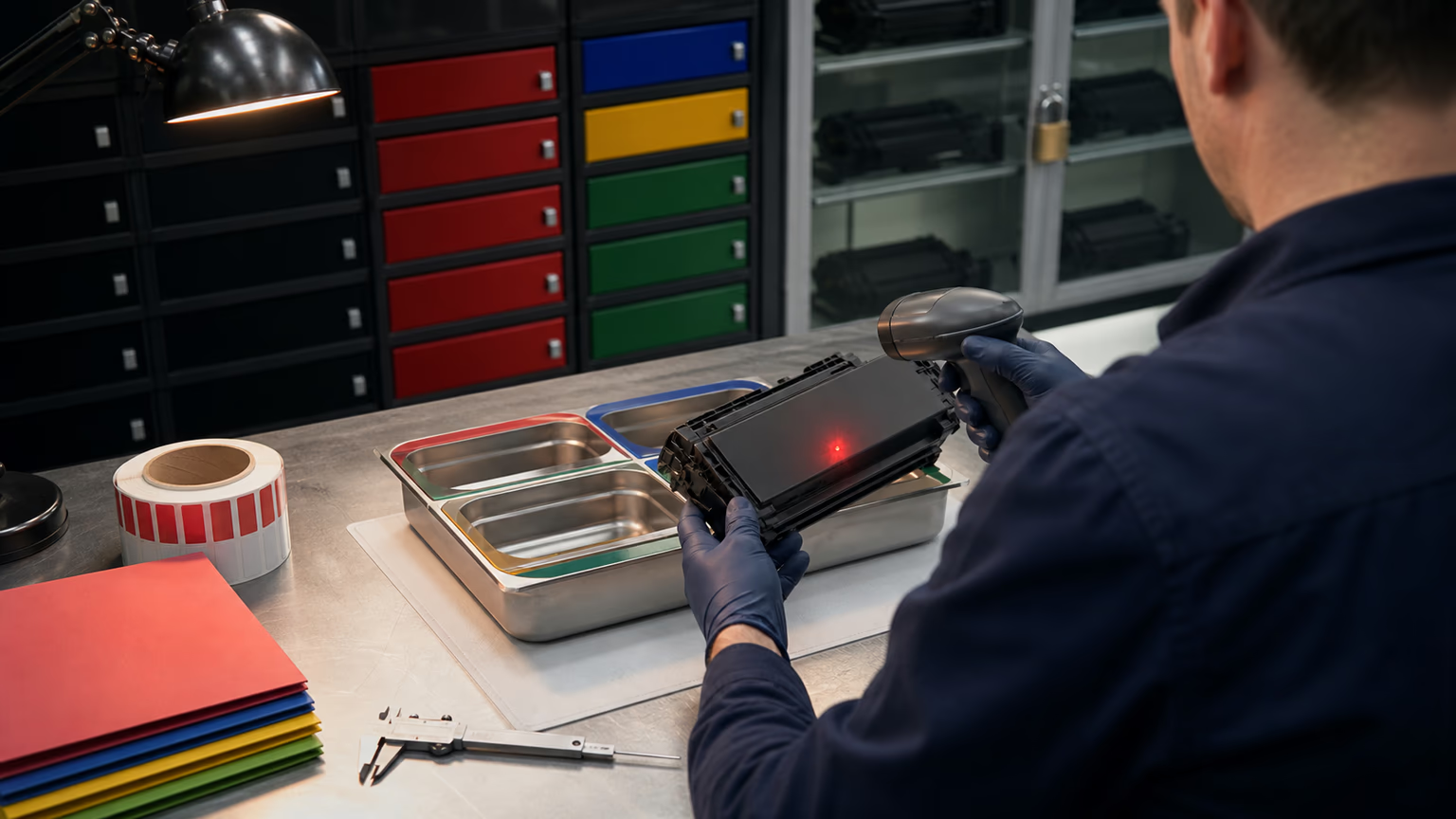
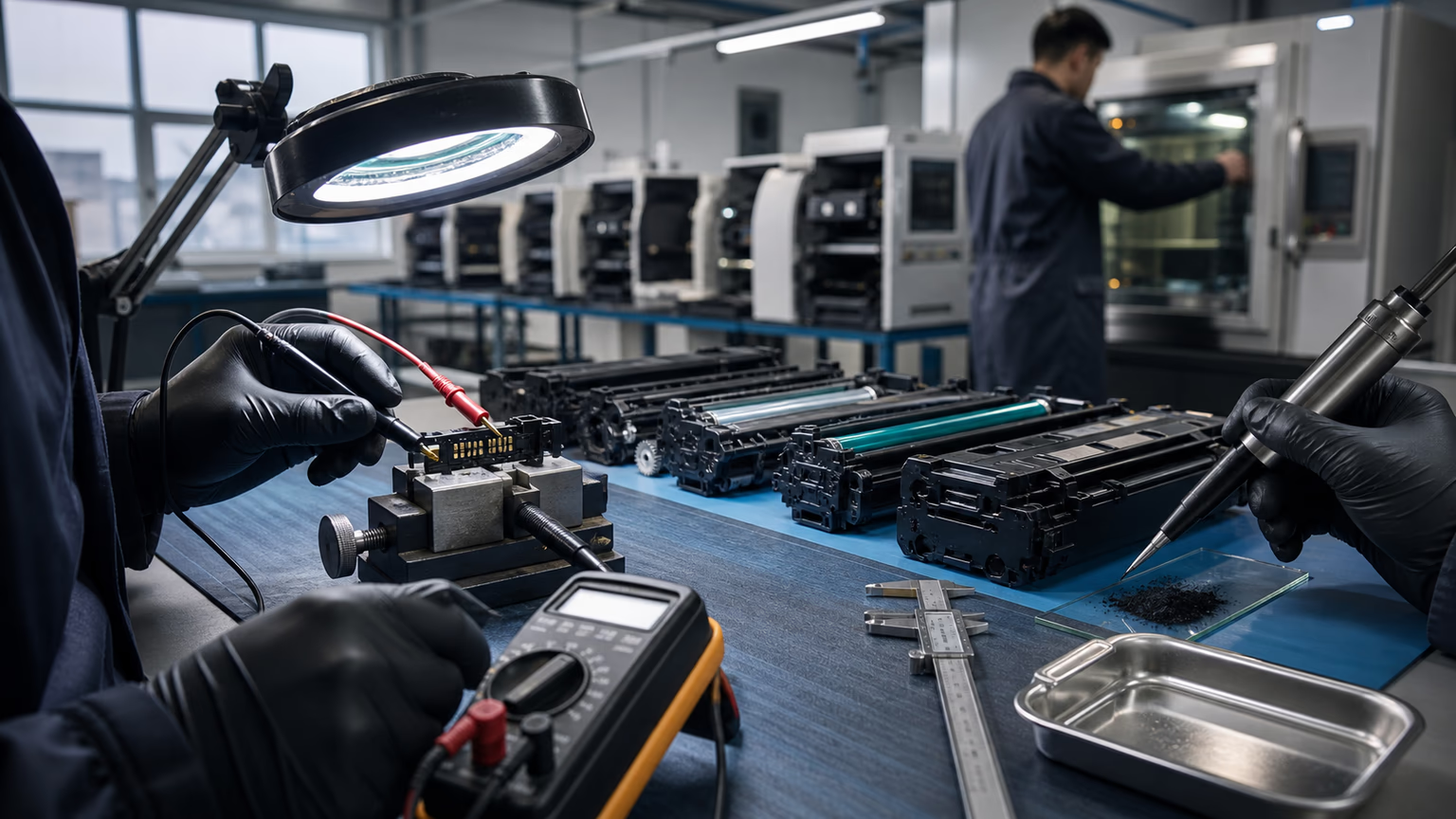
Toner Is an Engineering Component, Not a Commodity
In B2B toner procurement, it is tempting to treat toner cartridges as simple replaceable boxes.
But toner is a precision-engineered consumable: chemical formulation, particle size distribution, melt temperature, and charge characteristics directly affect how it interacts with drums, fusers, and developer units.
Two cartridges that look identical from the outside can perform very differently inside a laser printer.
When buyers compare only price per cartridge, they ignore the mechanical and electronic interfaces that determine whether a cartridge works reliably across a fleet.
A compatible cartridge must replicate not just the toner powder but also the chip communication and physical fit.
Printer firmware continuously monitors cartridge status, page count, and remaining toner.
A chip that fails to handshake correctly triggers error messages, premature replacement warnings, or even printer lockdown.
These failures are not visible on a sales sheet; they appear only after installation.
For mixed fleets with multiple printer models, treating toner as a commodity multiplies the risk because each engine has its own tolerance for chemical and electrical variables.
- Toner particle size and shape influence image density and drum wear.
- Chip authentication protocol must match printer firmware for every model in the fleet.
- Batch-to-batch consistency affects performance stability over time.
- A single cartridge design cannot guarantee identical results across different printer engines.
What Sales Promises Hide in Fleet Toner Procurement
Vendor sales collateral leans on phrases like OEM-equivalent quality, premium compatible, and high yield.
These terms have no universally accepted technical definition.
Without an agreed test method, sample size, and failure threshold, the words are marketing adjectives, not engineering specifications.
A sales promise that a cartridge delivers a certain page yield often assumes a 5% page coverage on standard A4 or letter paper in a controlled environment.
Real office printing frequently involves higher coverage, mixed document types, and different environmental conditions, so actual yield may be significantly lower.
Sales data rarely includes defect rate per thousand cartridges, batch-to-batch variance, or long-term wear on printer components.
Yet these hidden variables determine whether a fleet manager will face repeated service calls.
A supplier can advertise an attractive upfront price while passing on the cost through premature drum replacements, more frequent cartridge swaps, and increased helpdesk tickets.
Procurement teams need objective data that survives scrutiny, not bullet points designed to close a deal.
The Real Cost of a Toner Failure in a Managed Fleet
When a toner cartridge fails in a contracted fleet, the cost extends far beyond replacing the cartridge.
A technician must be dispatched or the customer must troubleshoot over the phone.
This labor is real money, and every incident erodes the margin of the managed print agreement.
Printer downtime means employees cannot print invoices, contracts, or reports; for a service provider, downtime is a breach of service level expectations that can trigger credits or even contract termination.
Beyond labor, a failed cartridge can contaminate or damage other printer components.
Leaking toner can coat the paper path, contaminate the charge roller, or degrade the fuser.
A low-quality formulation may produce excessive dust that shortens drum life.
Even if the cartridge itself is replaced under warranty, the labor and parts to clean the printer are often not covered.
The result is hidden cost per page that far exceeds the difference between a cheap cartridge and a lab-verified alternative.
- Service call labor and technician travel time.
- Printer downtime that breaks service level agreements.
- Damage to drums, fusers, and other internal components.
- Administrative overhead for returns, reorders, and customer complaints.
What Lab Data Actually Tells You (and Why It Matters)
The most credible toner suppliers publish third-party lab test reports.
These reports follow standardized methods such as ISO/IEC 19752 for monochrome yield and ISO/IEC 19798 for color yield.
Under these standards, a defined number of cartridges are tested on reference printer models under controlled temperature, humidity, and page coverage.
The results give a statistically valid average yield, along with standard deviation that reveals batch consistency.
A buyer can compare yield claims across suppliers on the same basis, rather than relying on manufacturer's self-published numbers.
Lab data should also include print quality measurements like optical density, background, and uniformity.
A cartridge may produce enough pages but with unacceptable streaks or fading after a few hundred prints.
Defect rate testing measures how many cartridges fail out of the box or prematurely in a sample lot.
Third-party reports indicate the sample size and test conditions, allowing procurement teams to gauge confidence.
Without these details, any claimed page yield is just a guess.
- ISO/IEC 19752 tested yield for monochrome cartridges.
- ISO/IEC 19798 tested yield for color cartridges.
- Standard deviation of yield across multiple production lots.
- Defect rate per 1,000 cartridges with defined failure criteria.
- Optical density and background measurements for print quality.
Compatibility Testing Across a Mixed Printer Fleet
Many distributors support fleets that include printers from multiple manufacturers and several model generations.
Each printer engine has its own drum geometry, fuser temperature curve, and chip protocol.
A compatible cartridge that works perfectly in one model may cause error messages, poor image quality, or even physical fit problems in another.
Firmware updates from the printer OEM can change chip authentication overnight, turning a previously working cartridge into a rejected one.
This is why a compatibility matrix is essential.
For every cartridge SKU, the supplier should provide the list of printer models it has been tested against, along with the firmware version at the time of testing.
The matrix should be updated regularly as new firmware is released.
Regional variants of the same printer model can use different chips or cartridge shapes, so testing in one geography does not guarantee performance in another.
A prudent buyer asks for a signed compatibility statement covering the specific models in their fleet, and then runs a pilot test before rolling out in volume.
How to Build a Toner Procurement Scorecard with Lab Data
To compare suppliers objectively, procurement teams should build a simple scorecard that assigns weights to the criteria that drive total cost.
Price per page is important, but it must be calculated from lab-tested yield, not vendor claims.
Defect rate and batch consistency should carry significant weight because they predict service call frequency.
Compatibility testing coverage across your fleet models is a gate-check: without a verified compatibility matrix, the supplier cannot advance to the next round.
The scorecard can include supply reliability, lead time stability, and the supplier's willingness to provide ongoing batch traceability data.
Before committing to a full contract, run a pilot test on a representative sample of printers in your own environment.
Measure actual yield, failure rate, and print quality over several weeks.
Compare these results with the submitted lab reports.
A supplier that refuses to provide pilot samples or lab data is signaling that its performance claims cannot withstand independent verification.
- Tested yield under ISO/IEC 19752 or 19798 with sample size.
- Defect rate per 1,000 cartridges from QC data.
- Coverage of compatibility matrix against your fleet list.
- Batch consistency data across multiple production lots.
- Price per page calculated from tested yield, not claimed yield.
- Supply traceability and willingness to support pilot testing.
Questions to Ask Before You Sign a Toner Supply Contract
A toner supply agreement is a long-term commitment with operational consequences.
Before signing, demand written answers to a set of technical questions.
Ask which test standards were used and what sample size was tested for each cartridge SKU quoted.
Request the defect rate per 1,000 cartridges from the supplier's quality control records, along with the time period covered.
Find out how the supplier handles firmware update incompatibility: do they provide replacement chips or updated cartridges, and how quickly?
Ask about batch traceability: can the supplier identify the production lot for each cartridge and provide QC data from that lot?
Clarify the return and replacement process for a cartridge that fails or damages a printer.
Understand whether the supplier will compensate for printer repairs if their cartridge is proven to cause damage.
These answers reveal whether the supplier has a quality system or just a marketing department.
A serious supplier will be able to provide this data without hesitation.
- What test standards and sample sizes were used for yield and quality claims?
- What is the defect rate per 1,000 cartridges for the specific SKUs quoted?
- How do you handle compatibility failures and firmware update issues?
- Can you provide batch traceability and quality control documentation?
- What is your return and replacement policy for defective or incompatible cartridges?
From Sales Promises to Lab-Backed Procurement: A Practical Shift
Shifting from brochure-driven buying to data-driven procurement does not require a massive overhaul.
Start with an internal fleet audit: document every printer model, current cartridge SKU, reported failure rates, and service call frequency.
This baseline highlights where toner quality is already causing pain.
Then define minimum data requirements for any new supplier: third-party lab reports, compatibility matrix, defect rate, and batch data.
Send these requirements as part of your request for quotation so suppliers know that unsubstantiated claims will not be considered.
Run a controlled pilot with a limited number of printers and a defined evaluation period.
Collect objective measurements: pages printed per cartridge, image quality scores, failure events, and technician time.
Compare these against the supplier's submitted lab data and your current baseline.
After rollout, monitor defect rates and yield monthly, not just at contract signing.
Use this ongoing data in future negotiations to demand better terms or to switch suppliers if performance degrades.
Over time, the organization builds a knowledge base that makes procurement decisions defensible to senior management and end customers.
FAQ
What does OEM-equivalent toner actually mean?
The term OEM-equivalent has no standardized technical definition.
Which lab tests are relevant for laser printer toner quality?
The two most relevant standards for laser toner are ISO/IEC 19752 for monochrome yield and ISO/IEC 19798 for color yield.
How can I verify a compatible toner works with my mixed printer fleet?
Request a compatibility matrix from the supplier that maps each cartridge SKU to the specific printer models in your fleet, including firmware versions tested. Then run a pilot test on a representative subset of your printers before full rollout. Monitor for error messages, print quality, chip recognition, and physical seating. Update the matrix whenever printer firmware changes.
What is a realistic defect rate for compatible toner cartridges?
There is no single universal number for a realistic defect rate because it depends on cartridge design, quality control, and printer interaction.
How does toner quality affect printer maintenance and service costs?
Toner quality directly influences drum and fuser life, image quality, and the frequency of paper jams and error messages.
Conclusion
For B2B distributors and printer service companies, fleet toner procurement is not a decision to be made on sales promises alone.
Toner quality affects equipment reliability, service costs, and customer relationships.
By demanding third-party lab data, compatibility matrices, and batch traceability, procurement teams can shift from reactive troubleshooting to proactive cost control.
The process is disciplined but straightforward: audit the fleet, define data requirements, run a pilot, and monitor performance.
Those who adopt this approach will make defensible decisions that protect margins and reputation.