Why Gloss Difference Matters in B2B Printing
In professional and office printing, gloss is not a minor aesthetic detail.
It is a measurable attribute that directly reflects the performance of the toner and the fusing system.
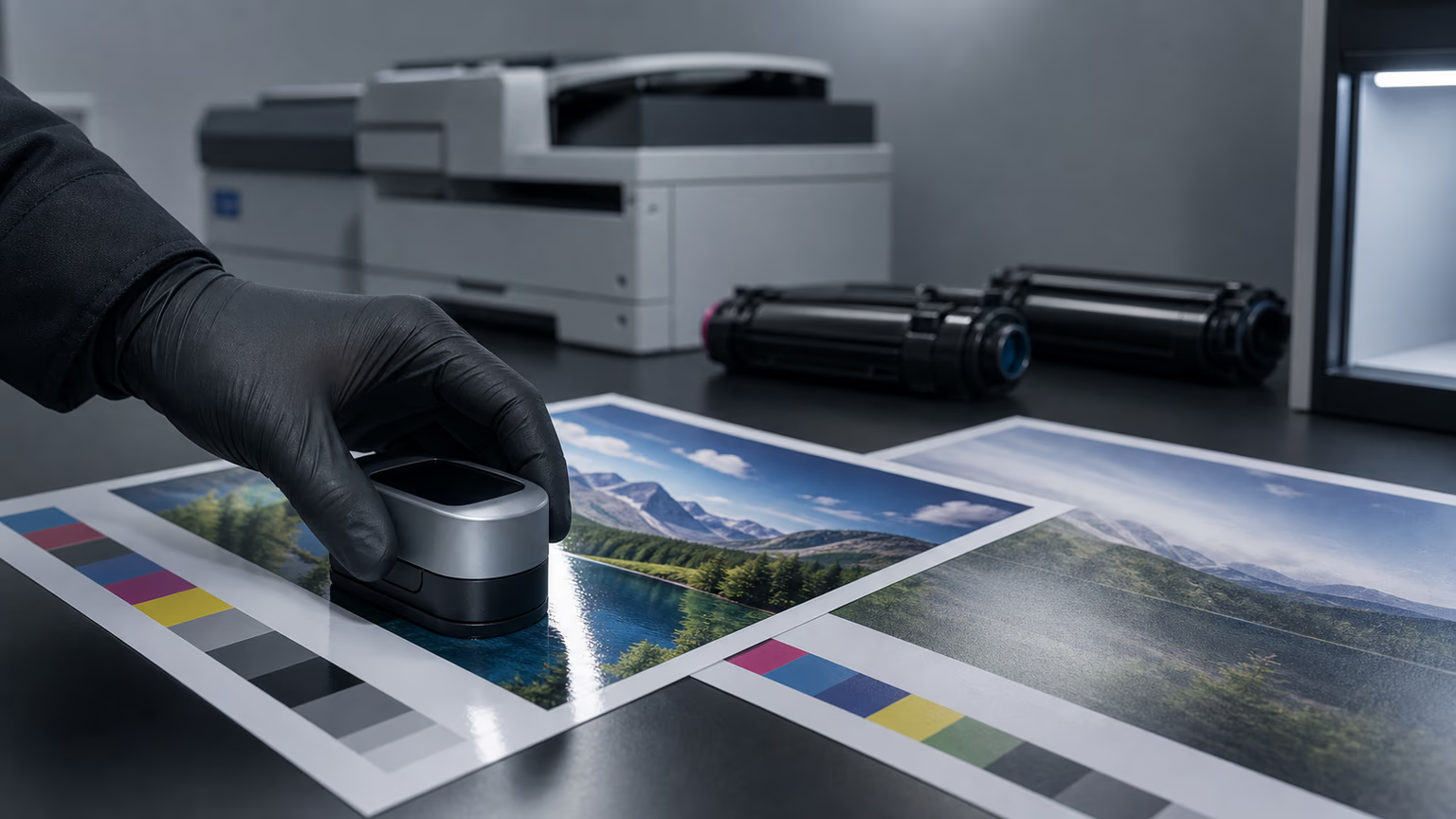
Gloss is typically assessed using a 60-degree gloss meter, which quantifies the reflectivity of a printed surface.
Higher values indicate a shinier finish, while lower values suggest a more matte appearance.
For B2B buyers, consistent gloss across prints is critical because end users often perceive a dull or uneven finish as a quality defect, even if the text and graphics remain legible.
OEM toner cartridges are engineered to produce a specific gloss level on compatible printer models.
This is achieved through precise control over the toner polymer, particle size distribution, and fusing characteristics.
Compatible toner cartridges, which are manufactured by third parties, may use alternative formulations that deviate from the original.
While many compatible toners perform acceptably in everyday applications, the gloss difference between OEM and compatible toner can become noticeable in solid color areas, photographs, or marketing materials.
For managed print service providers and toner distributors, ignoring this variation can lead to increased customer complaints and operational friction.
Gloss consistency is therefore a key procurement criterion. It should be evaluated with the same rigor as page yield, defect rates, and color accuracy. By understanding what causes gloss variation and how to measure it, B2B buyers can make informed decisions that balance cost savings with the need for reliable print output.
What Causes Gloss Differences Between OEM and Compatible Toner
The gloss level of a printed page depends on how the toner particles melt and flow during the fusing process.
OEM toners are formulated with specific polymer resins that have well-defined melting temperatures and flow characteristics.
These resins are matched to the fuser temperature, pressure, and dwell time of the intended printer model.
When the toner melts, it forms a smooth, uniform film that reflects light consistently, producing a predictable gloss.
Compatible toner manufacturers often face a more challenging task.
They must reverse-engineer a formulation that works across multiple printer platforms while keeping costs competitive.
As a result, they may use polymers with different melt viscosities or lower-quality pigments.
This can lead to incomplete melting, uneven surface texture, or reduced reflectivity.
Even small deviations in toner particle size or shape can affect how the toner transfers and fuses, altering the final gloss.
Another significant factor is batch-to-batch variation.
OEM production lines maintain extremely tight tolerances, but compatible toner suppliers vary widely in their quality control.
A batch that produces acceptable gloss in one production run may show a visible difference in the next due to slight changes in raw materials or manufacturing conditions.
This inconsistency is one of the most common sources of frustration for B2B buyers who place large orders and later discover that print quality is not stable over time.
Fusing temperature compatibility is also critical.
If a compatible toner requires a higher fusing temperature than the printer provides, it may not fully melt, resulting in a matte, rough finish.
Conversely, if the toner melts too easily, it can cause offsetting or gloss mottling.
Since compatible toners are often designed to work across a range of models, they may not be optimized for any single device, leading to less controlled gloss behavior.
The Business Impact of Gloss Inconsistency
For B2B service providers, gloss inconsistency translates directly into operational costs and reputational risk.
When a customer switches from OEM to compatible toner and notices a duller or uneven finish, the first reaction is often a complaint.
This can lead to helpdesk tickets, on-site technician visits, and sometimes the return of entire cartridge batches.
Each of these events consumes time and resources that erode the margin gained from the lower cartridge price.
In managed print environments, end users expect consistent output.
A legal firm printing client documents, a real estate agency producing brochures, or a school printing marketing materials will all reject pages that look visibly different from previous runs.
Reprints waste paper and toner, and they delay project delivery.
Over time, repeated quality issues can damage the service provider's reputation and lead to contract termination.
Even if the compatible toner is cheaper per page, the total cost of ownership can be higher when reprints, service calls, and lost business are factored in.
Moreover, gloss mismatch can be a signal of deeper toner quality problems.
If the toner does not fuse properly, it may also exhibit poor adhesion, leading to smudging, dusting, or premature fading.
This can cause additional service claims and even potential printer damage if the toner accumulates on internal components.
Buyers must therefore treat gloss as an early warning indicator rather than a standalone cosmetic issue.
How to Measure and Compare Gloss Performance
Before committing to a large volume of compatible toner, B2B buyers should establish a baseline for gloss performance.
The most practical approach is to conduct a controlled comparison using a 60-degree gloss meter.
This handheld device provides a numeric reading that can be recorded and compared across samples.
It is essential to use the same paper type, printer model, and printer settings for both OEM and compatible toner tests.
Begin by printing identical test pages that include solid black, solid color, and a mix of text and graphics.
Place the gloss meter on the solid areas and take multiple readings to account for any local variation.
Compare the average gloss value of the OEM print with that of the compatible toner.
While some difference is acceptable, a significant drop—typically more than a few gloss units—indicates a potential quality issue.
The specific tolerance will depend on the application; for example, marketing materials may require closer matching than internal documents.
It is also important to evaluate gloss stability over a longer print run.
After printing several hundred pages, check whether the gloss level has drifted.
Some compatible toners perform well initially but degrade as the cartridge ages.
Ordering sample cartridges from different production batches is a practical way to assess batch-to-batch consistency.
If the supplier cannot guarantee consistency, that is a red flag.
Procurement Strategy: Qualifying Compatible Toner Suppliers
Selecting a compatible toner supplier should never be based on price alone.
B2B buyers must adopt a structured qualification process that includes gloss performance as a weighted criterion.
Start by asking potential suppliers for technical datasheets that include gloss measurements.
A reputable supplier should be able to provide 60-degree gloss data for their toner when used on specific printer models.
If they cannot or will not share this information, it suggests a lack of quality control.
Request sample cartridges for pilot testing.
Run the tests described earlier and compare results against OEM benchmarks.
Also check for other print quality attributes such as density, background, and fusing adhesion.
Ask the supplier about their manufacturing process and quality assurance procedures.
Do they perform batch testing?
How do they handle variations in raw materials?
What is their return policy if a batch fails to meet your standards?
Building a scoring matrix can help compare suppliers objectively. Assign weights to criteria such as price, gloss consistency, page yield, defect rate, and customer support. Then rate each supplier based on your testing and documentation. This method reduces the influence of sales pitches and ensures that long-term quality is prioritized.
Risk Management: Operational and Service Considerations
Even after a supplier is qualified, ongoing risk management is necessary.
Implement a periodic incoming inspection protocol for each toner shipment.
This can be as simple as printing a standard test page and measuring gloss with a handheld meter.
Record the results and compare them to the baseline.
If a shipment falls outside the acceptable range, quarantine it and contact the supplier before distributing to customers.
Service technicians should be trained to recognize gloss-related complaints during routine maintenance.
They should know how to check fuser condition, paper type, and printer settings before assuming the toner is at fault.
Sometimes a worn fuser roller can reduce gloss even with OEM toner, so technicians must be able to isolate the variable.
Clear escalation procedures should be in place for handling customer complaints about print finish.
Consider a dual-source strategy for compatible toner. Relying on a single supplier exposes your business to supply chain disruptions or quality failures. By qualifying two suppliers, you can switch orders if one begins to show gloss deviations. This also gives you leverage in negotiations and ensures continuity for your customers.
Practical Checklist for B2B Buyers
To summarize the key actions, use the following checklist before switching to or expanding the use of compatible toner:
- Define an acceptable gloss tolerance based on your customers' expectations and applications.
- Obtain OEM baseline gloss measurements for the printer models you service.
- Request test samples and gloss data from at least three compatible toner suppliers.
- Run side-by-side pilot tests on a representative sample of printers and paper types.
- Evaluate batch-to-batch consistency by ordering samples from different production runs.
- Implement periodic incoming inspection with a gloss meter for each shipment.
- Document all test results and supplier communications for future reference.
Following this checklist will significantly reduce the risk of gloss-related issues and help you maintain a reliable print service for your clients.
FAQ
What is the main reason compatible toner often has lower gloss than OEM?
Compatible toner frequently uses different polymer resins that do not melt and flow the same way as OEM toner at the printer's fusing temperature. This leads to a rougher surface and lower reflectivity. Additionally, batch-to-batch variation in compatible toner manufacturing can cause inconsistent gloss even within the same brand.
Can gloss difference affect print durability or only appearance?
Gloss difference is primarily an appearance issue, but it often correlates with fusing quality. Poorly fused toner may have lower adhesion, leading to smudging, flaking, or premature wear. Therefore, significant gloss deviation can be a warning sign of reduced durability and potential printer contamination.
How can I measure gloss consistency of a compatible toner before buying in bulk?
Use a 60-degree gloss meter on solid printed areas. Print identical test pages with OEM and compatible toner on the same printer and paper, then compare average readings. Also test multiple batches and after long print runs to assess stability. Request gloss data from the supplier and verify with your own measurements.
Are there compatible toners that match OEM gloss levels?
Yes, some compatible toner manufacturers invest in high-quality polymers and rigorous quality control to achieve close gloss matching. These suppliers often provide technical data and are willing to work with B2B buyers on pilot testing. However, they may not be the cheapest option, so buyers must weigh cost against consistency.
What are the risks of ignoring gloss difference when switching to compatible toner?
Ignoring gloss difference can lead to customer complaints, increased reprint rates, more service calls, and potential loss of contracts. It also indicates a lack of oversight in toner quality, which may extend to other issues like density variation or cartridge leakage. In the long run, the hidden costs can outweigh the initial savings.
Conclusion
Gloss difference between OEM and compatible toner is a controllable risk if approached systematically. B2B buyers who implement structured testing, supplier qualification, and ongoing monitoring can successfully integrate compatible toner into their service offerings without sacrificing print quality. The key is to treat gloss as a measurable specification, not an afterthought.
By using a 60-degree gloss meter, requesting technical data, and conducting pilot tests, procurement teams can identify suppliers that deliver consistent performance.
This proactive approach reduces service escalations, protects customer relationships, and improves total cost of ownership.
While no compatible toner will be exactly identical to OEM in every attribute, the gap can be narrowed to an acceptable level with the right due diligence.
Ultimately, the decision to use compatible toner should be based on evidence, not assumptions. A rigorous evaluation process ensures that cost savings do not come at the expense of print quality or operational stability. For B2B distributors and service providers, that balance is essential for long-term success.