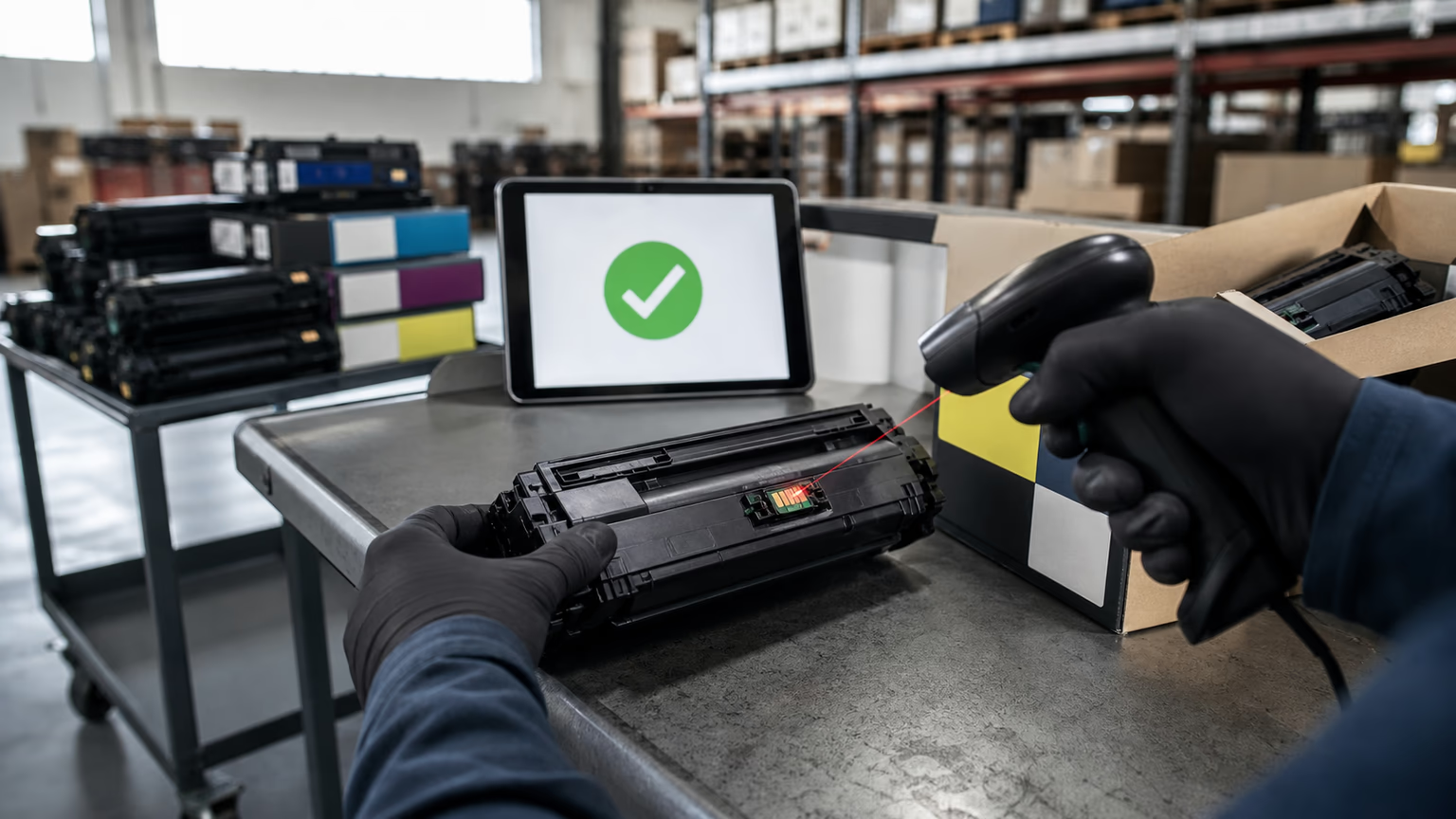

The hidden cost of a 2-cent component: why toner chips drive B2B profitability
Most B2B toner distributors evaluate cartridges by powder quality, page yield, and unit price.
Yet the small electronic chip attached to a laser toner cartridge often determines whether that cartridge works at all.
A chip that fails to communicate with an office printer can trigger a false empty alert, cause the printer to reject the cartridge, or report a yield number that does not match the toner actually consumed.
Those failures do not stay in the field as minor technical glitches.
They become return authorizations, emergency replacement orders, and service dispatches that quietly eat into distribution margins.
For printer service companies and managed print providers, chip-related errors are often misclassified as toner quality defects.
A customer reports low toner despite a recent replacement, and the technician swaps the cartridge.
The returned unit may still contain usable toner, but the chip has already signaled the end of life.
The true cost is hidden in labor, freight, customer trust, and lost invoicing for pages that were never printed.
This guide treats toner chips as a strategic supply-chain control point, not as a commodity component.
Distributors who ignore chip behavior often find themselves in a reactive cycle: a firmware update blocks a batch of cartridges, customers complain, returns pile up, and the supplier blames the printer.
Proactive chip management breaks that cycle.
It starts with understanding how chips communicate, which failure modes exist, and how to validate chip performance before cartridges ever reach a customer site.
How recognition works: chip-to-printer handshake and firmware gates
Every laser printer or multifunction device expects a specific communication sequence when a new toner cartridge is installed.
The chip acts as an electronic identifier and data gateway.
It may store toner level, page count, region code, or other parameters that the printer's firmware reads during startup.
If that handshake fails because the chip is from an incompatible batch, has corrupted data, or uses an outdated protocol, the printer will either reject the cartridge entirely or display persistent error messages.
OEM device manufacturers regularly push firmware updates that modify recognition protocols, security keys, or regional parameters.
A compatible toner cartridge that worked perfectly on Monday can fail on Tuesday after a routine firmware update.
Distributors who manage multi-brand fleets or service customers across different regions must understand that chip compatibility is not static.
It requires ongoing monitoring and supplier support.
The chip-to-printer handshake is not just a simple ID check.
Modern chips may include encrypted authentication, toner level counters, and even regional lockouts.
When a chip fails to answer the printer's challenge correctly, the printer may try to display a non-original supply message, block printing altogether, or show a false empty status.
These failures are often intermittent, making them harder to diagnose and more frustrating for customers.
Yield signals decoded: what page counts, toner levels, and 'empty' really mean
Chip-reported toner levels are not direct measurements of physical toner remaining.
They are algorithmic estimates generated by the chip based on page count, print coverage, and model-specific calibration.
A high yield toner cartridge rated for thousands of pages may show empty at half that number if the chip uses a conservative safety margin or if the printer's coverage assumptions are incorrect.
For distributors, that mismatch creates two opposite risks: premature replacement by cautious customers, and overconfident purchasing based on unrealistic yield claims from a toner cartridge factory.
False empty signals are especially damaging in managed print service contracts where billing depends on accurate page counts.
If a chip reports 10,000 pages but the customer only printed 7,000 before the cartridge was blocked, the MPS provider loses revenue on the missing pages and may face disputes.
Conversely, if the chip underreports usage, the distributor may ship a replacement cartridge before the previous one is physically depleted, increasing supply costs.
Yield accuracy is not a fixed specification.
It varies by printer model, firmware version, and even print job characteristics.
A chip calibrated for text documents may misreport on graphic-heavy pages.
That is why distributors should not rely solely on the supplier's theoretical yield number.
Instead, they should test actual printed pages in a controlled environment and compare against the chip-reported page count.
This simple validation can reveal hidden chip calibration issues before a bulk purchase.
The return loop: how chip mismatches become customer returns and service calls
A single chip recognition failure can trigger a chain reaction: the customer calls their support line, the service desk opens a ticket, a technician is dispatched, the cartridge is removed and tested, a replacement is installed, and the original unit is shipped back to the distributor.
Each step costs labor and freight.
When the returned cartridge is tested at the warehouse, it may be found to have adequate toner, but the chip has already failed or misreported.
That return is often coded as a toner defect, which hides the real root cause and prevents corrective action.
High return rates for compatible toner cartridges for office printers are frequently driven by chip inconsistencies rather than powder quality.
Distributors who do not separate chip-related returns from toner-related returns cannot improve supplier selection or internal QA.
A clear failure classification process is the first step to reducing this loop.
Ask your receiving team to record whether the cartridge was rejected by the printer, showed a false empty, or had a physical powder leak.
Those categories drive different corrective actions.
Each unnecessary return also creates a negative customer experience.
A fleet manager who sees repeated non-original supply warnings may begin to question the entire compatible toner category.
The distributor then faces pressure to lower prices or switch back to OEM supplies.
By addressing chip-driven returns at the source, distributors protect not only their margins today but also their long-term position in the aftermarket supply chain.
Procurement framework: evaluating chip reliability in toner supply
When comparing B2B toner cartridge suppliers, procurement teams should weight chip management as heavily as toner formulation.
A low upfront price on cheap printer toner cartridges may hide the future cost of returns, emergency shipments, and technical support.
The following criteria should be part of any supplier scorecard: chip version control, yield accuracy testing, return handling for chip failures, and transparency on batch traceability.
- Request a chip firmware change log and ask how the supplier monitors OEM firmware updates.
- Ask for yield accuracy testing results against actual printed pages, not just theoretical yield.
- Confirm the return policy specifically covers chip-related failures, including who pays for return shipping.
- Request sample cartridges from multiple production lots to test recognition consistency.
- Evaluate the supplier's technical support for chip troubleshooting and re-flashing.
Do not accept vague assurances that the chip is compatible. A professional toner cartridge factory will document the chip version, the printer models tested, and the firmware levels validated. That documentation is a leading indicator of how seriously the supplier treats field reliability.
Procurement teams should also compare total cost of ownership rather than unit price.
A cartridge that costs a dollar less but generates one extra return per hundred units can easily wipe out any upfront savings.
Include the cost of handling chip-related failures, the labor for technician visits, and the potential SLA penalties into the supplier comparison.
This approach shifts the conversation from price to value and aligns purchasing decisions with service profitability.
Compatibility risk matrix: OEM updates, regional variants, and aftermarket chips
Compatibility risk is not uniform across printer fleets.
The same chip may work flawlessly on one OEM printer model and fail on another from a different regional firmware branch.
Distributors who service customers in multiple countries or import from different channels must map these variables.
A printer model sold in one market may use a different encryption scheme or page count algorithm than the same model sold elsewhere.
A one-size-fits-all chip cannot cover all variants safely.
OEM firmware updates remain the most common trigger of sudden recognition failures.
Some updates include security patches that invalidate aftermarket chips that previously worked.
Distributors should maintain a watchlist of printer models under service contract and monitor OEM update announcements.
When a firmware update is released, test compatible cartridges on a pilot device before allowing field deployment.
This proactive step can prevent a fleet-wide outage.
Regional differences also affect chip logic.
Mono and color printers may require different chip data structures, and even within a brand, engine families can vary.
A chip calibrated for one model may report wrong yields on a close relative.
Distributors should ask suppliers for a compatibility matrix that lists tested printer models, firmware versions, and any regional exclusions.
Suppliers who cannot provide this level of detail are likely hiding gaps in their testing process.
Operational playbook: testing, monitoring, and preventing chip-related failures
Service and operations teams need a repeatable process for validating chips before rollout and for diagnosing field failures quickly. The following practices reduce the number of avoidable on-site visits and return shipments.
- Run pre-deployment compatibility tests on the top five printer models in your fleet using sample cartridges from every new shipment.
- Track chip-related failure rates separately from toner quality failures in your help desk system.
- Create a firmware update watchlist for all OEM printer models under service contract.
- Use batch traceability data from the supplier to isolate problematic chip lots quickly.
- Train technicians to identify whether a printer error is chip-related or toner-related before swapping hardware.
When a chip failure is confirmed, document the printer model, firmware version, chip version, and error code. Share that information with your supplier in a structured format. Suppliers who act on this data and provide rapid batch replacement are partners, not just vendors.
Operational discipline pays off in reduced labor costs and faster resolution times.
Technicians who can quickly rule out chip issues can focus on actual mechanical problems.
Help desk staff who know how to ask the right questions can often resolve false empty alerts over the phone by guiding the customer through a simple chip reset procedure, saving a truck roll.
These small process improvements compound into significant margin protection over a contract term.
Supplier questions that separate transactional vendors from strategic partners
Before committing to a bulk order of toner cartridges for distributors, ask the supplier direct questions about chip lifecycle management.
The answers will reveal whether they treat chips as a quality component or as an afterthought.
Questions include: Do you provide a chip firmware change log and proactive update notifications?
Can you share yield accuracy test results for specific printer models?
What is your return policy for chip-related failures?
How do you manage regional firmware differences?
Do you offer sample batches for validation before a bulk purchase?
A supplier who cannot answer these questions is likely sourcing chips from inconsistent or unverified sources. A supplier who can provide documentation, batch traceability, and a clear return process reduces your operational risk significantly. In B2B toner distribution, the lowest cost per cartridge is rarely the lowest total cost when chips fail in the field.
Strategic suppliers view chip management as part of their value proposition.
They invest in firmware monitoring, yield calibration testing, and quality control across chip batches.
They are willing to collaborate with distributors on field failure analysis and may even provide chip re-flashing tools for older stock.
That level of partnership does not show up on a price list, but it directly impacts your ability to serve customers reliably.
FAQ
What exactly does a toner cartridge chip do?
A toner chip is a small electronic component that enables communication between the toner cartridge and the printer. It identifies the cartridge, tracks toner level and page count, and may include region or model data. Without a working chip, many laser printers will refuse to operate.
Why does my printer show 'empty toner' when the cartridge still has toner?
Because the chip's page count or toner level algorithm is not measuring physical toner. It estimates remaining yield based on usage patterns and model calibration. If the estimation is conservative or the chip is misprogrammed, it may signal empty before the powder is actually depleted.
Can an OEM firmware update make my compatible cartridges stop working?
Yes. OEM manufacturers periodically update printer firmware to change security protocols or handshake parameters. These updates can block aftermarket chips that do not match the new requirements. That is why chip compatibility must be continuously validated against the latest firmware.
How can I identify if a return is caused by the chip or by actual toner quality?
Classify returns by symptom: no recognition by the printer, false empty signal, or physical powder leakage. Test the cartridge in a known-good printer with the same firmware version. If the cartridge works after a chip reset or replacement, the chip is the root cause. If print quality is poor with a working chip, then toner formulation is suspect.
Do all aftermarket toner cartridges use the same chip?
No. Chip quality and programmability vary widely between suppliers. Some chips are fully emulated to match OEM handshakes, while others are older or generic versions that may fail on newer printers. A distributor should always ask for the specific chip version and tested printer models.
Conclusion
Toner cartridge chips are not a trivial accessory; they are data gateways that control printer recognition, yield reporting, and cartridge life.
For B2B distributors, importers, and service providers, chip management is a margin protection strategy.
A chip that fails in the field creates a cascade of avoidable costs: service calls, returns, customer distrust, and lost MPS revenue.
Procurement teams must evaluate chip reliability with the same rigor as toner powder quality.
Operational teams need clear testing and tracking processes.
Suppliers should be selected on documented chip version control, yield accuracy, and a transparent return policy.
By shifting from a price-only mindset to a chip-aware supply chain approach, B2B toner distributors can reduce hidden costs, improve customer retention, and build a more resilient compatible toner business.