
The Warranty Fear That Blocks Smart B2B Procurement
Many B2B buyers and printer service providers hesitate to switch to compatible toner because of one persistent question: will using third-party cartridges void the printer warranty?
That fear often leads to unnecessary lock-in with original consumables, which can inflate operating costs across a multi-brand fleet without delivering proportional value.
The reality is far more nuanced, and treating the warranty question as a yes or no issue misses the real decision.
This guide separates documented facts from fear-based myths and provides a practical supplier evaluation framework to protect uptime and customer trust when deploying compatible toner printer warranties across mixed fleets.
The hidden cost of staying with OEM consumables is not just the price difference per cartridge.
It is the missed opportunity to build a more resilient procurement strategy.
Printer manufacturers and their sales representatives often emphasize warranty risk, sometimes without clarifying that most legal frameworks protect buyers from tied-purchasing requirements.
However, that does not mean compatible toner is risk-free.
The true risk lies in unmanaged quality variance, firmware incompatibility, and supplier accountability.
This article gives B2B distributors, managed print services operators, and procurement teams a decision framework, not legal advice.
Before committing to any compatible toner supplier, buyers should understand three layers of risk: warranty clause language, technical compatibility, and quality consistency.
These layers interact: a toner that damages a printer may lead to a denied warranty claim, while a toner that performs poorly may trigger service calls and customer complaints even without a warranty dispute.
The following sections walk through each layer and offer practical checks.
What Printer Warranties Actually Say About Third-Party Consumables
Most printer warranty documents state that damage caused by non-original consumables is not covered.
That is standard language and does not automatically void the entire printer warranty.
The key legal principle is causation: the manufacturer may deny a specific repair if it can demonstrate that a third-party cartridge caused the failure.
In many jurisdictions, consumer protection laws such as the Magnuson-Moss Warranty Act in the United States and similar regulations elsewhere prohibit manufacturers from conditioning warranty coverage on the use of original supplies unless they provide those supplies free of charge or obtain a waiver.
For B2B transactions, however, contractual terms may differ, and buyers should review the specific service agreement.
This distinction matters because it shifts the conversation from a simple yes or no to an evidence question.
If a compatible toner leaks and damages the fuser, the OEM can likely deny the fuser repair.
If a paper feed motor fails unrelated to the toner, the warranty should remain intact.
The burden of proof generally falls on the manufacturer to show that the third-party consumable caused the defect.
In practice, proving causation can be difficult, but OEM service technicians may still push back, especially if they see non-original supplies installed.
B2B buyers should obtain a copy of the printer manufacturer's written warranty terms and look for specific language about consumables.
Some policies explicitly state that using non-original ink or toner does not void the warranty for other components, while others reserve the right to deny coverage if the printer is damaged by third-party supplies.
Documenting the exact wording can prevent misunderstandings during a service call.
Additionally, local regulations may override restrictive clauses, so consulting regional consumer protection guidance is prudent.
Compatibility Risks Beyond the Warranty Clause: Firmware, Chips, and Mixed Fleets
For many printer service providers, firmware updates are a more immediate threat than warranty clauses.
Printer manufacturers periodically release firmware updates that may alter how the device communicates with toner chips.
A compatible cartridge that works perfectly today may trigger a non-genuine toner warning or be rejected entirely after the next automatic update.
This risk is especially acute in mixed printer fleets, where different models and regional variants require distinct chip versions and firmware behaviours.
Chip compatibility is not static.
A supplier that rigorously tests cartridge chips against the latest firmware releases for each printer model is essential.
Without proactive monitoring, a fleet can experience sudden print failures after an overnight update, causing downtime and service calls.
The challenge is compounded when one toner model works in one printer engine but fails in another due to subtle electrical contact differences or cartridge geometry.
Even original cartridges sometimes suffer from seating issues, but with compatible toner, the variance can be higher if the supplier does not control component sourcing.
For B2B buyers managing laser printer toner across multiple brands, the most practical defense is to require the supplier to provide a compatibility matrix that includes firmware version, chip revision, and printer model coverage.
This matrix should be updated as OEM firmware releases occur.
Without this documentation, buyers are essentially gambling that the next firmware update will not disrupt their fleet.
The hidden risk is not warranty voiding but unplanned downtime that erodes the savings from using compatible toner cartridges.
Mixed-fleet complexity also affects inventory planning. A distributor serving office printer toner needs may stock dozens of SKUs, and a single incompatible batch can create returns, rework, and customer dissatisfaction. The best suppliers treat firmware compatibility as an ongoing service, not a one-time certification.
Quality Variance as the Hidden Total-Cost Driver
If warranty denial is the fear, quality variance is the reality that quietly destroys margins.
Compatible toner quality can vary dramatically between suppliers and even between batches from the same supplier.
The most common failure points are toner formulation, cartridge sealing, and OPC drum quality.
Toner with an incorrect melting point can cause fuser wrap or cold offset in high-speed printers, leading to expensive repairs.
A poorly sealed cartridge can leak toner into the printer, contaminating rollers and paper paths.
A defective drum or wiper blade can produce streaks or backgrounding that frustrates end users.
Page yield shortfalls are another manifestation of quality risk.
A compatible toner cartridge may be underfilled or use a less efficient toner, resulting in fewer printed pages than stated.
Without ISO/IEC yield testing data per SKU, buyers cannot verify claims and may end up replacing cartridges more often, eroding the cost savings.
Office printers in high-duty cycles are particularly sensitive to toner formulation, as heat and pressure stress the fuser over time.
A toner that works acceptably in a low-volume desktop printer may fail prematurely in a workgroup device.
For B2B service providers, quality failures translate directly into service calls.
A technician dispatched to diagnose a print quality issue may spend an hour determining that the toner is at fault, not the printer hardware.
That hour is unbillable in many service contracts and damages customer trust.
Over time, recurring quality issues can cause a client to switch back to OEM supplies or even change service providers.
Therefore, quality consistency is a more critical supplier criterion than the lowest purchase price.
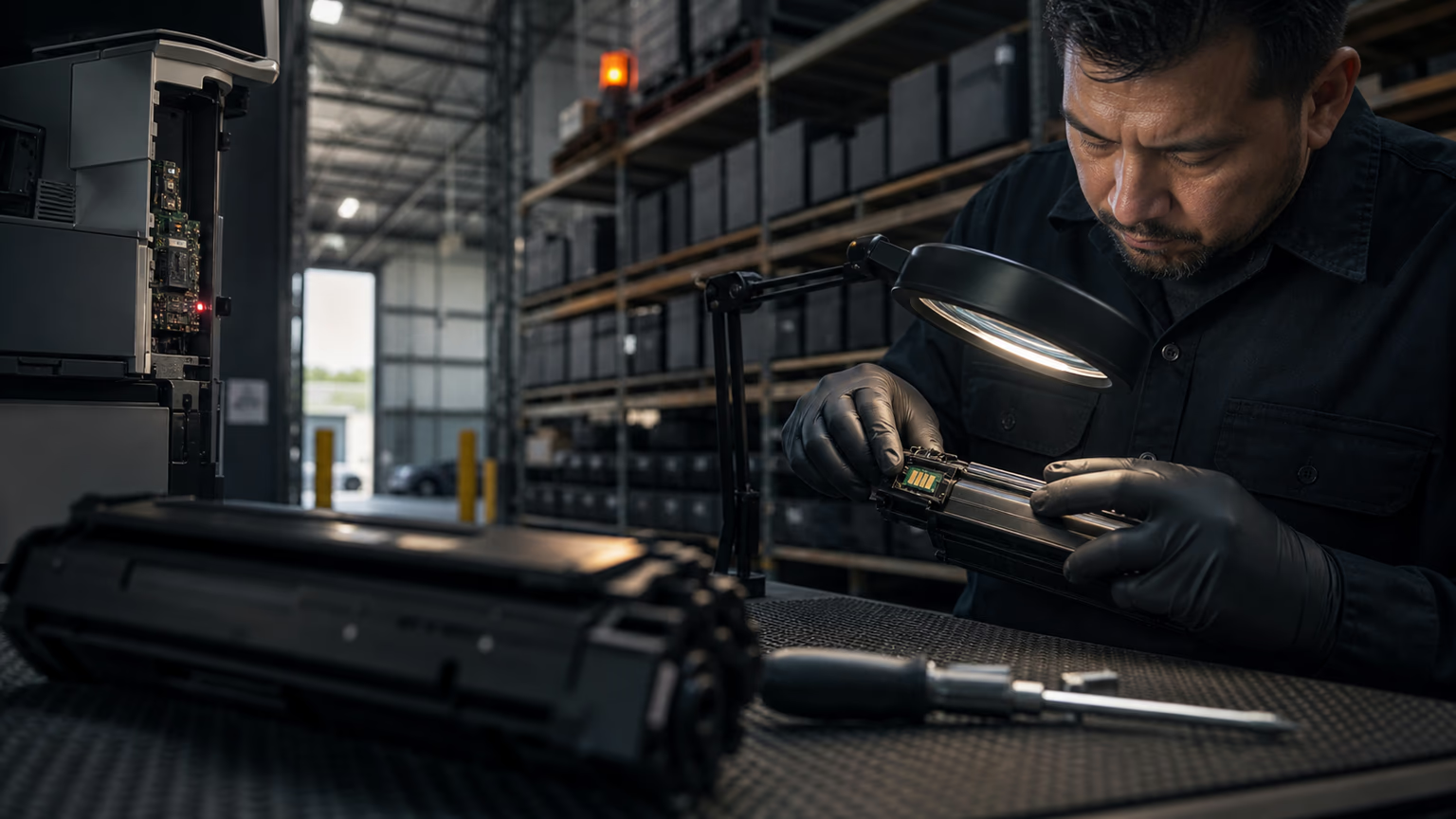
Buyers should request batch-level QC data, including particle size distribution, melting point, and drum sensitivity. The supplier should also have a documented RMA process for defective cartridges, with clear defect criteria and replacement procedures. A supplier that cannot provide this transparency is not ready for B2B distribution.
A B2B Supplier Evaluation Framework for Risk Management
Choosing a compatible toner supplier for mixed printer fleets requires more than comparing prices on cheap printer toner cartridges. The evaluation should focus on accountability, traceability, and technical support. The following checklist provides a foundation for procurement teams and service companies:
- Request documented ISO/IEC 19752 or 19798 yield testing for each cartridge SKU, not just marketing claims.
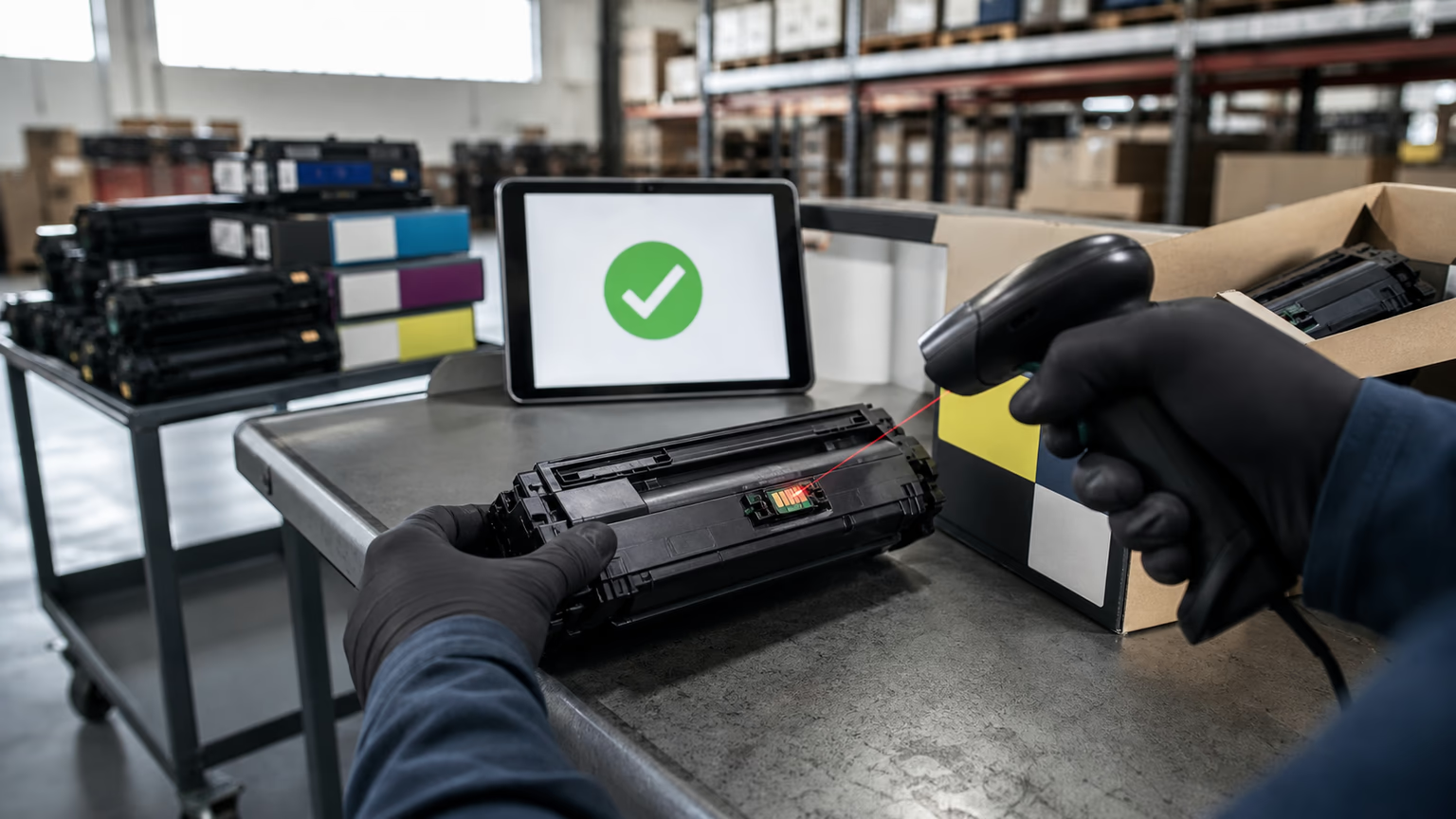
- Require batch-level traceability: toner formulation, OPC drum source, chip version, and manufacturing date.
- Verify the supplier's warranty and RMA process, including defect replacement terms and liability limits.
- Ask about proactive firmware update monitoring and how the supplier validates chip compatibility after each OEM release.
- Evaluate financial stability and track record in B2B distribution; a supplier that disappears after six months creates inventory risk.
- Test technical support responsiveness with a sample issue; the ability to provide root-cause analysis is critical.
- Confirm transparency on component sourcing and regional regulatory compliance, including safety data sheets.
This framework shifts the conversation from asking whether compatible toner is safe to identifying which supplier can prove their product will not disrupt operations.
A supplier that offers only a low price but cannot answer questions about toner melting point or chip revision is a liability.
The cheapest discount printer toner cartridges may end up costing more after factoring in service calls, reprints, and customer dissatisfaction.
For buyers who are also serving end customers, such as managed print services providers, the supplier's ability to handle mixed fleets is paramount.
A distributor that stocks compatible toner cartridges for office printers across several brands must ensure that each SKU has been validated for the specific printer engine and regional firmware.
This cross-brand validation capability reduces the need for in-house testing and accelerates deployment.
Operational Playbook: Pilot Testing, Documentation, and Warranty Dispute Resolution
Deploying compatible toner across a large fleet should never begin with a full rollout.
A structured pilot program on a representative sample of devices allows buyers to identify compatibility and quality issues before they affect the entire customer base.
The pilot should include high-use and low-use printers, different models, and a mix of firmware versions.
During the pilot, document print quality, page yield, and any error messages.
Compare these metrics against the previous OEM baseline.
Documentation is the strongest defense in a warranty dispute.
Every compatible toner installation should be logged with the cartridge batch number, printer serial number, and firmware version.
If a print defect occurs, the service ticket should record whether the issue resolved after replacing the toner cartridge, which helps attribute fault.
If an OEM service provider denies a warranty claim due to the presence of a third-party cartridge, the buyer should request a written explanation of the causal link.
In many cases, a clear service history and batch traceability can overturn unfounded denials.
SLAs with the compatible toner supplier should include defect replacement and, where possible, downtime compensation.
For example, if a batch of cartridges causes printer damage, the supplier should cover the repair cost if causation is established.
This shifts some risk back to the supplier and creates an incentive for quality control.
Buyers should also maintain a sample library of approved cartridges for each printer model in the fleet.
This library helps identify counterfeit or mislabeled products that may enter the supply chain.
Finally, establish a clear process for firmware updates. Ideally, the supplier provides a notification service when an OEM releases an update that might affect compatible chips. The buyer can then decide whether to delay the update, test on a small group, or roll back if possible. Without this process, a single automatic update can cause widespread printing failures overnight.
The Future of Compatible Toner: Firmware Trends and Managed Print Services
Printer manufacturers are increasing the frequency of firmware updates and tightening chip authentication.
This trend is likely to continue as OEMs seek to protect consumables revenue.
For compatible toner suppliers, this means constant investment in chip emulation and testing.
For B2B buyers, it means that compatibility cannot be assumed; it must be actively managed.
A cartridge that works today may become obsolete after a firmware update, but a proactive supplier can often provide an updated chip or a workaround.
The shift toward managed print services and outcome-based contracts also changes the risk calculus.
In an MPS agreement, the service provider is responsible for uptime and print quality, regardless of the consumable brand used.
Using compatible toner can lower the provider's cost, but only if the toner does not increase service calls.
This makes supplier accountability even more critical.
Providers should negotiate with suppliers who are willing to share root-cause analysis data and participate in continuous improvement.
Looking ahead, the legal landscape around third-party consumables may also evolve.
Some regions are strengthening consumer protection against tied-purchasing, while others are clarifying the boundaries of firmware locks.
B2B buyers should stay informed about regulatory changes that affect their ability to use compatible toner without warranty penalties.
Ultimately, the decision to use compatible toner printer warranties is not a one-time purchase but a long-term partnership with a supplier who understands the entire ecosystem.
FAQ
Does using compatible toner void my printer warranty?
Not automatically. In most jurisdictions, using third-party consumables does not void the entire printer warranty. The manufacturer may deny a specific repair if it can prove that the compatible cartridge caused the damage. Review the warranty document and keep service records to protect your position.
Can a printer manufacturer refuse to service my printer if I use compatible toner?
A manufacturer may refuse to cover a repair if the defect is traced to the third-party toner, but they cannot generally refuse all service simply because a compatible cartridge is installed. If you encounter pushback, request a written explanation of the causal link and consult local consumer protection laws or your service agreement.
What should I do if a warranty claim is denied because of compatible toner?
First, obtain the denial in writing with the specific reason. Gather documentation showing the cartridge batch number, printer firmware version, and service history. If you believe the denial is unfounded, escalate within the manufacturer's support structure or seek advice from a legal professional familiar with commercial warranty law.
How can I verify that a compatible toner cartridge will not damage my printer?
Request the supplier's QC documentation, including toner melting point, particle size distribution, and drum quality. Test the cartridge on a pilot fleet and monitor for leakage, streaking, or fuser errors. A transparent supplier should provide batch traceability and yield test data for each SKU.
How do firmware updates affect compatible toner cartridges?
Printer firmware updates can alter chip authentication and cause a previously working compatible cartridge to be rejected or display a non-genuine toner warning. To mitigate this, work with a supplier that monitors firmware releases and tests chip compatibility after each update. Delay automatic updates until compatibility is confirmed.
Conclusion
The question of compatible toner printer warranties is less about a simple legal answer and more about building a risk management process that protects uptime and customer trust.
By understanding what printer warranties actually say, prioritizing firmware and chip compatibility, demanding quality traceability, and selecting suppliers with strong technical support, B2B distributors and service providers can deploy compatible toner across mixed fleets with confidence.
The goal is not to avoid all risk but to make it visible, measurable, and manageable.
A disciplined approach to pilot testing, documentation, and supplier partnerships turns compatible toner from a warranty fear into a strategic cost advantage.