Why Toner Damage Is a Silent Margin Killer in B2B Supply Chains
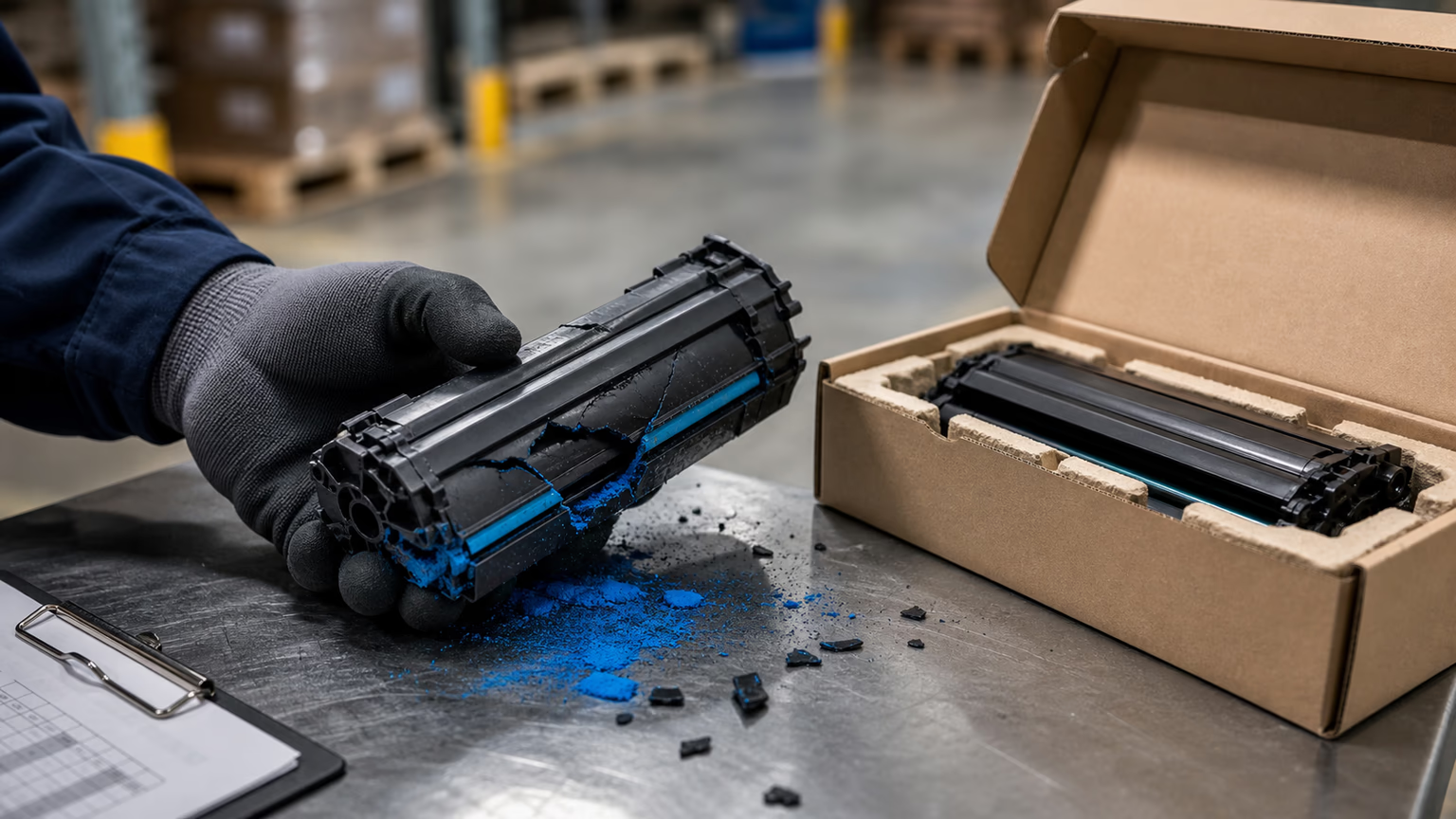
When a toner cartridge arrives cracked, leaking, or non-functional, the immediate reaction is often to file a return and ship a replacement.
But for B2B distributors, printer service companies, and MPS operators, the true cost runs far deeper than a single lost unit.
Return processing consumes labor hours for inspection, repacking, and communication with the supplier.
Reverse logistics add freight charges, often exceeding the cartridge value itself.
Beyond these direct expenses, each damaged cartridge risks a chain reaction: end customers experience unexpected downtime, leading to service calls that erode SLA performance and, ultimately, trust in the provider.
In multi-year MPS contracts, a pattern of toner-related print quality issues can trigger penalty clauses or non-renewals.
Procurement teams that undervalue packaging may see a low purchase price on paper, but the total cost per usable cartridge — including returns, replacements, and lost customer goodwill — can be shockingly high.
This silent margin erosion is rarely tracked in standard ERP systems, making packaging design an invisible competitive lever that forward-thinking distributors are now systematically exploiting.
Distributors that ignore packaging as a quality variable may find themselves locked in a cycle of firefighting returns while competitors quietly build loyal customer bases through reliable deliveries.
How Packaging Engineering Directly Prevents Cartridge Failure
Effective toner packaging is not simply a box with some foam peanuts; it is an engineered system designed to absorb and dissipate mechanical energy before it reaches the cartridge.
During transit, packages experience both dynamic shocks—such as drops from conveyor belts or vehicle potholes—and static compression when stacked in warehouses or trucks.
Shock-absorbing materials like molded pulp inserts, polyethylene foam, or custom die-cut corrugated cradles immobilize the cartridge and gradually decelerate it upon impact, preventing cracks in the housing or dislodged internal components.
Vibration damping is equally critical: constant low-frequency shaking can cause toner powder to compact or leak through seals, leading to print defects and contamination of the printer interior.
Advanced designs incorporate suspension packaging that keeps the cartridge from direct contact with outer walls, while moisture-vapor barriers protect hygroscopic toner powder from humidity that can degrade flow properties and image density.
Even the flute type and wall thickness of the outer corrugated box determine its burst strength and edge crush resistance, directly influencing stackability and resistance to punctures.
Without these protective layers, the cartridge becomes the weakest link in the physical supply chain.
The Real-World Cost of Poor Packaging vs. Smart Packaging
It is tempting to view packaging as a cost center to be minimized, especially when comparing supplier quotes by unit price alone.
A distributor might save a few cents per cartridge by opting for a thinner box with loose fill, only to face a return rate that devours those savings many times over.
Consider the full cost chain: a damaged cartridge requires a replacement shipment, typically sent at expedited cost to maintain customer uptime; warehouse staff must unpack, inspect, document, and dispose of the failed unit; customer service time is spent managing complaints and credits; and the end user may lose productive hours dealing with a jammed or leaking printer.
In contrast, a slightly more expensive packaging solution that reduces damage to near-zero pays for itself through avoided returns, fewer service dispatches, and higher customer retention.
Distributors that have shifted to engineered packaging often discover that the packaging investment yields a rapid payback — in some cases, saving several times its cost within a single order cycle — while also freeing working capital tied up in replacement inventory.
Smart packaging transforms from an expense into a profit-protection tool.
What B2B Buyers Should Inspect in Packaging Before Committing
When auditing a potential supplier, packaging quality must be evaluated with the same rigor as the cartridge itself.
Start with the outer carton: ask for specifications on burst strength (measured in kPa or lb/in²), edge crush test (ECT) rating, and the flute type — C-flute or B-flute offer different cushioning and stacking characteristics.
Inside, examine the immobilization method.
Are there custom-molded inserts that cradle the cartridge securely, or is it simply wrapped in bubble film?
The best solutions use recyclable molded fiber or die-cut corrugated pads that prevent movement along all axes.
Check for tamper-evident seals that indicate whether a cartridge has been previously opened or contaminated.
For moisture-sensitive environments, inquire about vapor barrier coatings or sealed polyethylene over-wrap.
Request packaging samples and perform simple in-house tests: a drop test from typical warehouse handling heights, a vibration test on a small pallet load, and a visual inspection after simulated transit.
Also, observe the supplier’s packaging line — inconsistency in taping, insert placement, or box forming can undermine even a well-designed package.
A supplier willing to provide detailed packaging documentation and test results demonstrates a commitment to quality that directly reduces your business risk.
How Leading Distributors Integrate Packaging Standards into Procurement
Progressive B2B buyers no longer treat packaging as an afterthought; they build it into their formal supplier selection and management processes.
This begins with including packaging KPIs in RFPs and supplier scorecards, such as maximum allowable damage rate, packaging material specifications, and sustainability certifications.
When negotiating contracts, smart procurement teams add clauses that require suppliers to maintain consistent packaging quality across batches and to provide immediate notification and corrective action if a change occurs.
For high-value or high-volume SKUs, joint development of custom packaging solutions — where distributor and supplier collaborate on design and testing — can lock in both protection and cost efficiency.
This collaborative approach also allows for packaging optimization across multiple cartridge models, reducing SKU proliferation and warehouse complexity.
Operational teams then track return data by SKU and packaging type, feeding insights back to suppliers through quarterly business reviews.
This continuous improvement cycle turns packaging into a living component of supply chain reliability, not a static box.
Ultimately, distributors that master packaging standards differentiate themselves to service clients as reliable partners, winning long-term contracts and reducing churn.
Sustainability and Damage Reduction: A Win-Win Strategy
There is a common misconception that robust packaging necessarily means more waste.
In reality, well-designed packaging can significantly advance environmental goals while protecting the product.
Right-sizing the package to the cartridge dimensions reduces material usage, lowers shipping volume, and decreases carbon emissions per unit transported.
When fewer cartridges arrive damaged, the entire cycle of reverse logistics — return shipping, repackaging, and disposal — is eliminated, along with its associated energy and resource consumption.
Many engineered packaging solutions now use recycled and recyclable materials, such as molded pulp from post-consumer fiber or corrugated board with high recycled content, without sacrificing protective performance.
Additionally, single-material designs simplify end-user recycling, addressing the growing demand from B2B customers for responsible waste management.
In some advanced supply chains, reusable packaging systems are being piloted where cartridges are shipped in returnable totes that further eliminate single-use materials, though this requires close coordination with logistics partners.
Distributors that highlight sustainable packaging practices in their own proposals can strengthen their brand reputation and align with clients’ ESG targets, turning damage reduction into a marketable advantage.
Building Your Packaging Specification Checklist for Toner Cartridges
Transforming your approach to toner packaging starts with a structured evaluation of your current state. Use the following checklist to identify gaps and set actionable improvement targets:
- Audit the damage rate by SKU and supplier, categorizing failure modes (cracked housing, leakage, moisture damage, print defects).
- Collect packaging samples from each supplier and conduct drop and vibration tests using ISTA or similar methodologies as a benchmark.
- Define minimum packaging standards for all future orders: outer carton burst strength ≥ 275 lb/in² (or equivalent), ECT ≥ 32, custom inserts for cartridges over a set weight, and moisture barriers where required.
- Include packaging specifications as a binding clause in supplier agreements, with penalties or corrective action plans for non-compliance.
- Pilot new packaging designs with a subset of high-risk SKUs before full rollout; measure return rates and customer feedback.
- Train warehouse receiving teams on spotting packaging failures — a torn moisture barrier or crushed corner can be a leading indicator of internal cartridge stress.
- Integrate packaging performance into quarterly supplier scorecards alongside cost, delivery, and quality metrics.
By codifying these steps, your procurement and operations teams move from reactive damage control to proactive supply chain resilience, turning packaging into a strategic asset rather than an operational expense.
FAQ
What are the most common types of toner cartridge damage caused by poor packaging?
Drop impacts typically crack cartridge housings, dislodge internal components, or break seals.
How can packaging design reduce toner returns without significantly increasing costs?
By optimizing material choices and structure, protective performance can be dramatically improved at modest cost increments. For example, replacing loose fill with custom-cut corrugated inserts may add cents per cartridge while slashing damage rates. The key is to balance protection levels with the cartridge value and typical transit hazards, avoiding both over- and under-engineering.
What packaging materials offer the best protection for laser printer toner cartridges?
Molded pulp and die-cut corrugated inserts provide excellent shock absorption and are recyclable. Polyethylene foam offers consistent cushioning for heavier cartridges. For moisture-sensitive toner, metallized film barriers or sealed poly bags with desiccants are effective. The outer carton should be double-wall corrugated with at least C-flute construction for structural integrity.
Are there industry standards for testing toner cartridge packaging durability?
While no single toner-specific standard exists, established packaging test protocols such as ISTA procedures (e.g., ISTA 3A for parcel delivery) are widely applicable. These simulate drop, vibration, and compression hazards typical in parcel and LTL shipping. Many informed distributors now require suppliers to provide test reports following ISTA or equivalent methodologies.
How do I convince my procurement team to prioritize packaging quality over the lowest unit price?
Build a business case that quantifies total cost per usable cartridge, not just purchase price.
Conclusion
Toner cartridge damage during transit is a preventable expense that silently erodes distributor profitability and customer satisfaction.
By treating packaging design as a critical supply chain component rather than a commodity cost, B2B buyers can dramatically reduce return rates, lower operational friction, and build more resilient service operations.
The path forward begins with a thorough audit of current packaging failures, clear specification of performance requirements, and integration of packaging metrics into supplier management frameworks.
As procurement teams increasingly recognize the hidden ROI of protective packaging, the distributors who act now will gain a lasting competitive edge in reliability and cost efficiency.