The Fragility of Transactional Toner Procurement
When procurement teams treat toner as a simple commodity, they often optimize for the lowest per-unit price.
On a spreadsheet, this looks like a win.
In practice, it plants the seeds of systemic vulnerability.
Relying on a single supplier who competes solely on cost creates a fragile chain where any disruption—port closures, raw material shortages, or sudden quality lapses—can halt operations overnight.
The drive for the cheapest office printer toner often sacrifices supplier viability, encouraging corner-cutting in manufacturing and neglecting the long-term health of the supply relationship.
Transactional buying patterns rarely account for the hidden expenses of emergency orders, expedited shipping, or the labor hours wasted troubleshooting inconsistent cartridges.
Over time, the absence of quality monitoring allows gradual erosion of print performance.
Defect rates climb, page yields fall, and the end-users begin to complain.
But because the initial price was low, the procurement team may not connect the dots until client trust is already damaged.
In many organizations, the real fragility lies in the concentration of supply.
Single-source arrangements, especially those dependent on distant manufacturing with long lead times, leave no fallback.
When that single link breaks, the entire printer fleet is at risk.
A resilient supply chain must be built on the premise that interruptions will happen—and the only meaningful defense is to plan for them.
The cost of a stockout is never just the price of a cartridge; it is the silence of printers in critical offices.
Mapping the Real Cost of a Toner Supply Failure
A toner stockout or quality crisis is never a localized event.
Its impacts ripple outward, damaging operations, finances, and customer relationships.
While a procurement team might focus on the invoice cost of a cartridge, the true cost of failure includes extensive downtime, lost productivity, and the hidden expense of rework.
Consider a managed print services provider with hundreds of clients under contract.
A batch of defective laser printer toner that requires multiple service calls per device can quickly consume margins.
Even worse, it can trigger SLA penalties or, in severe cases, client defection.
For a distributor, a supply interruption that delays shipments to resellers erodes credibility and leaves shelf space empty, forcing customers to seek alternatives.
Quantifying these costs without relying on unverifiable statistics means examining the cascading effects: a printer sitting idle halts document workflows; staff productivity drops; revenue-generating activities like invoicing or proposals stall.
The financial drain is real, but it rarely appears on procurement reports because it is diffused across departments.
Intangible losses such as brand reputation damage and employee frustration compound the issue.
A resilient supply approach must acknowledge and price in these risks to avoid making decisions that are penny-wise and pound-foolish.
Only by elevating the total cost of ownership above the unit price can businesses see the full picture.
Beyond Price: Redefining Toner Supplier Evaluation
To build resilience, procurement must shift from a single-axis price comparison to a multi-dimensional evaluation.
A supplier who appears cheap on paper may be expensive in reality if their lead times are unreliable, their quality inconsistent, or their business fragile.
What criteria separate a resilient supplier from a risky one?
Look for transparency first: a supplier willing to share batch quality data, manufacturing process details, and supply chain maps is far less likely to harbor hidden problems.
The best suppliers treat this transparency as a standard practice, not a concession.
Other critical factors include geographic diversification of production and inventory hubs.
A supplier with manufacturing concentrated in one region is a geopolitical or weather-related event away from failure.
Financial stability and documented business continuity plans indicate whether the supplier can weather their own storms without leaving customers stranded.
Finally, verifiable quality consistency over time, demonstrated through historical yield and defect data, provides the confidence to commit to a long-term partnership.
When evaluating toner cartridges for your fleet, do not accept promises when you can demand proof.
- Manufacturing transparency: Access to batch testing reports and production line visibility.
- Geographic redundancy: Multiple production or warehouse locations to mitigate regional risks.
- Financial health: Evidence of stability and investment in continuity planning.
- Performance history: Trends in on-time delivery, cartridge yield, and defect rates over quarters.
- Flexibility: Ability to scale volume up or down, adjust lead times, and handle custom SKU requests.
- Local support footprint: In-country partners or direct representation for rapid issue resolution.
- Raw material sourcing: Diversified and secure access to critical components and toner formulations.
Inventory Strategies That Absorb Shock Without Bleeding Cash
Holding excess inventory is a blunt and expensive way to manage supply chain risk.
The goal is to design inventory buffers that protect against variability without tying up working capital unnecessarily.
Start by calculating safety stock based on historical demand variability and the supplier’s lead time reliability.
This mathematical approach ensures you hold just enough to cover your exposure during the replenishment window.
For example, if historical daily usage for a popular printer toner SKU is 20 units with a maximum of 30, and lead time ranges from 7 to 14 days, the needed buffer can be precisely defined.
For many distributors, a hybrid inventory model works best.
Identify the top-moving SKUs—the toner cartridges that clients rely on daily—and maintain a strategic safety buffer for those lines.
For stable, predictable SKUs with short lead times, just-in-time principles can keep cash flow healthy.
Vendor-managed inventory programs, where the supplier monitors your usage and replenishes proactively, can further reduce the burden of stock management.
Another powerful option is consignment inventory, where the supplier retains ownership of the stock until you consume it.
This shifts the carrying cost away from your balance sheet while ensuring availability.
The key is to match the inventory strategy to the strategic importance of each SKU, rather than applying a one-size-fits-all rule.
Over-investing in slow movers or under-protecting critical items is the fastest route to both stockouts and cash flow problems.
Quality as the Cornerstone of Supply Chain Immunity
Even a perfectly available supply chain is worthless if the toner inside the cartridge fails to perform.
Quality must be designed into the supply chain from the start, not inspected at arrival only to discover too many defects.
This means moving from reactive incoming quality control to a proactive partnership with suppliers who have embedded quality assurance in their manufacturing processes.
The goal is to prevent disruptions, not just catch failures.
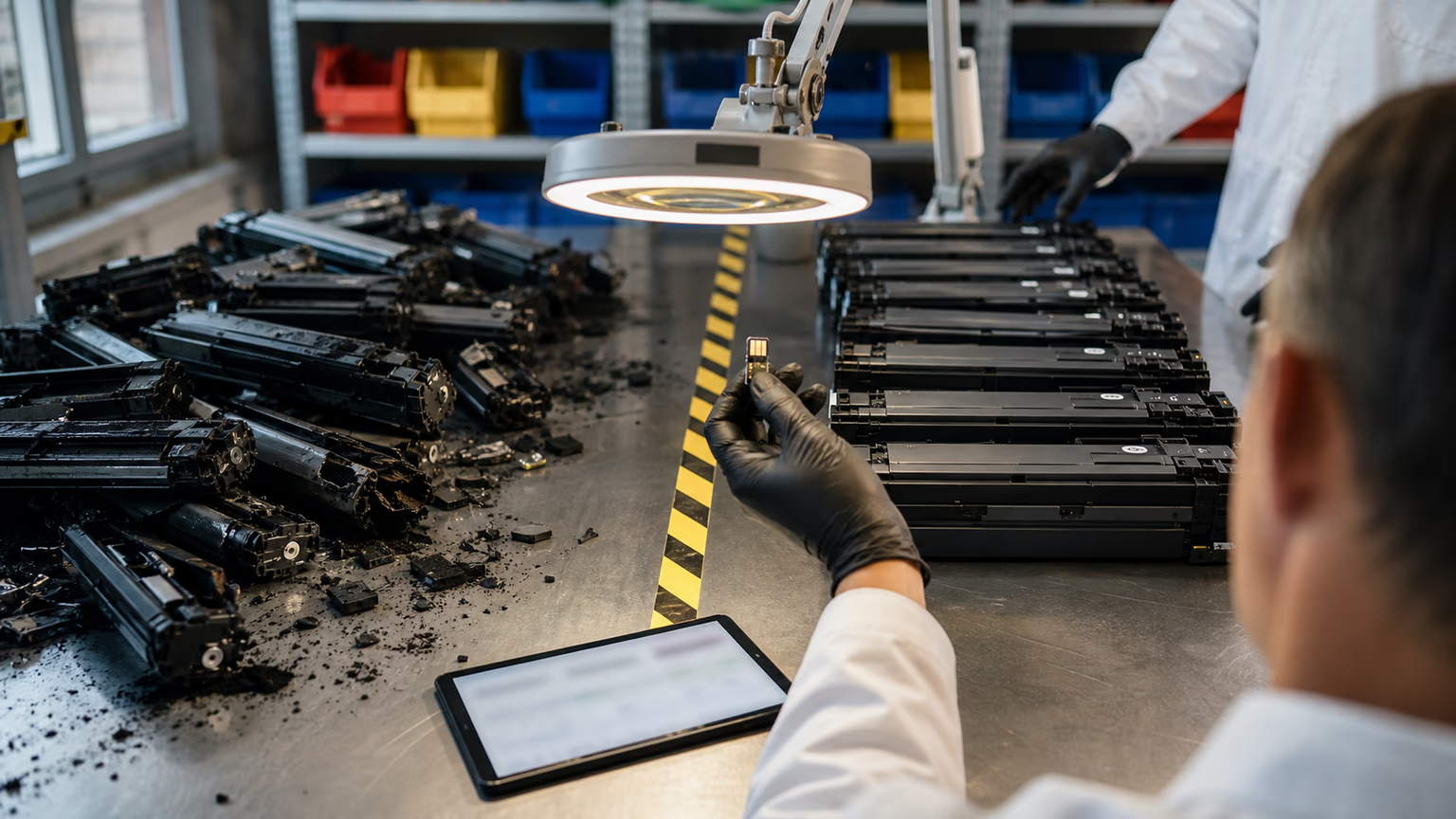
Non-negotiable quality practices include regular third-party testing of every incoming batch, long-term tracking of yield and defect patterns, and clear specifications for cartridge components.
If a supplier self-certifies without sharing data, assume the risk is higher.
The most resilient relationships involve collaboration on continuous improvement—sharing field performance data with the supplier to refine formulations, chipsets, and mechanical parts.
For low-cost toner cartridges for distributors, the temptation to cut corners on quality is high; but sacrificing quality to hit a price point introduces systemic risk that eventually destroys margins.
Remember that quality failures are among the most expensive supply chain disruptions.
A defective cartridge not only generates a return or credit request but also costs you the trust of the end-user.
For MPS operators, inconsistent yields jeopardize the profitability of per-page contracts.
Building quality into every link of the chain is a shield that prevents many other disruptions from ever occurring.
Navigating Compatibility and Regional SKU Complexity
The global toner market is dotted with technical landmines.
Printer manufacturers regularly release firmware updates that can render previously compatible cartridges unusable.
Regional variations in chip design, voltage requirements, and even toner formulation mean that a cartridge working perfectly in one country may fail in another.
For B2B buyers sourcing internationally, these complexities can turn a cost-saving initiative into a compatibility nightmare.
A cartridge that passes tests in a lab may fail in a customer’s printer after a surprise firmware update—and that failure often arrives with no warning.
Resilience in this area demands proactive testing.
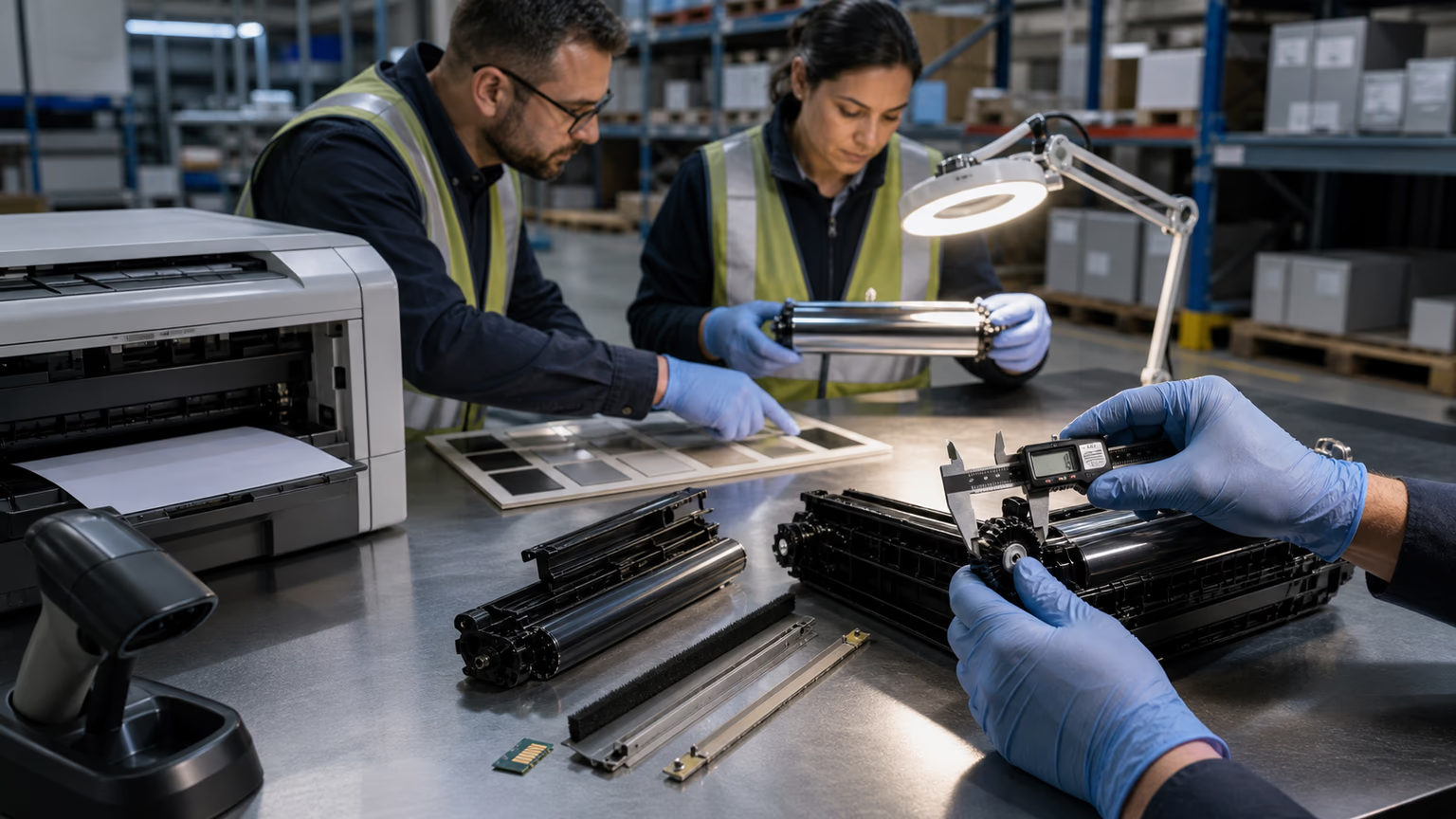
Before committing to a large bulk purchase, validate sample cartridges across the targeted printer models and firmware versions in your fleet.
Collaborate with suppliers who have dedicated engineering teams that monitor firmware releases and adapt chip technology accordingly.
Additionally, rationalize your SKU list: carrying too many obscure cartridge variants increases complexity and the chance of error.
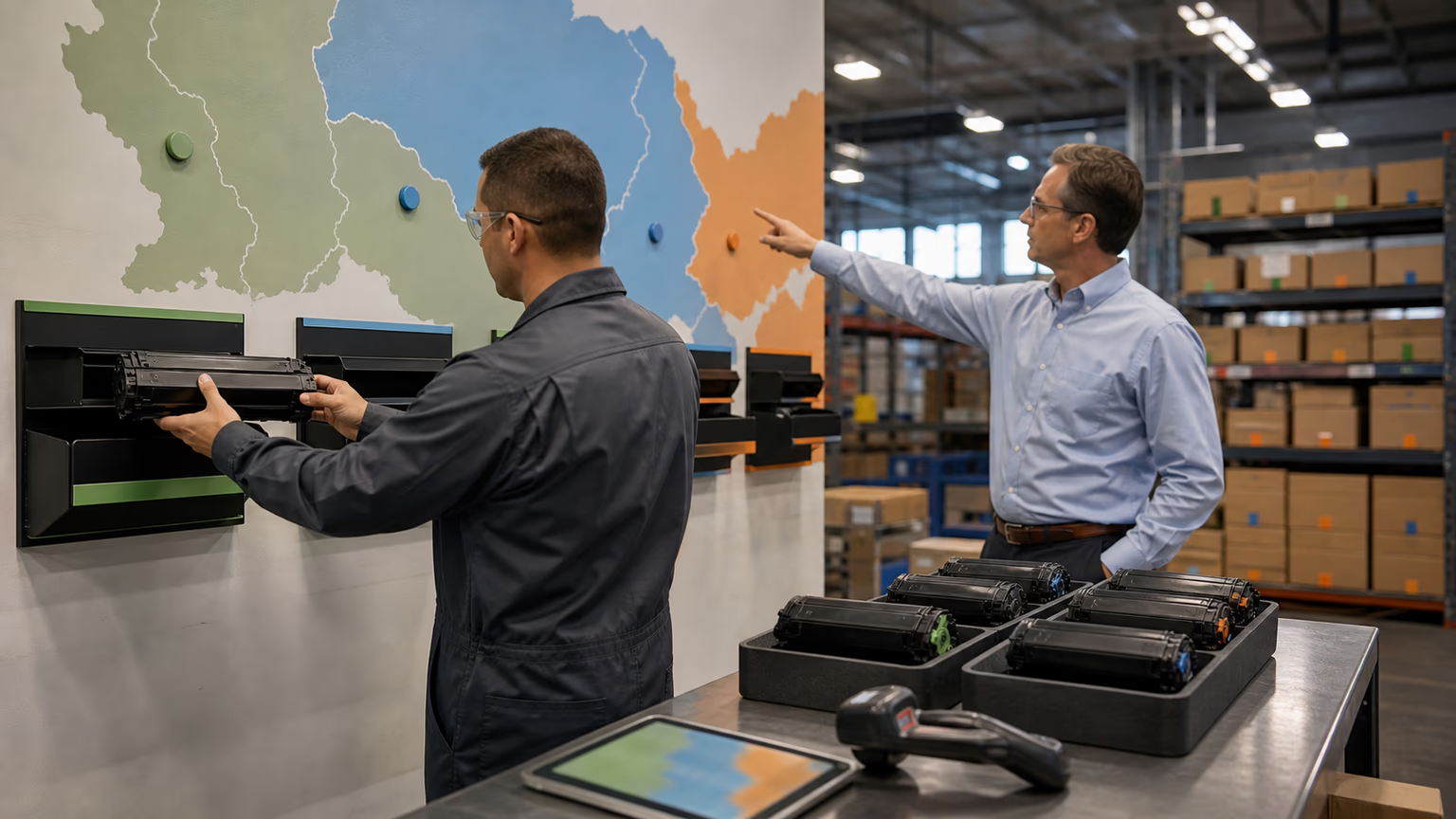
When dealing with multiple regions, insist on regional SKU mapping—the supplier should guarantee that the cartridge variant sourced for a specific market matches the local printer specifications.
Without this diligence, you risk non-operation, printer damage, or voided warranties, all of which undercut supply chain resilience.
Service Resilience: The Often Overlooked Supply Chain Layer
A cartridge is not just a physical object; it is a promise of performance.
When that promise breaks, the speed and quality of the response determine whether the incident erodes or strengthens the relationship.
Service resilience is the layer that catches failures and prevents them from escalating into customer crises.
Essential service capabilities from a toner supplier include local technical support, either directly or through a trusted partner network.
Language barriers and time-zone differences can delay resolutions unacceptably.
An efficient RMA process with advance replacement shipments ensures that a defective cartridge does not translate into days of downtime.
Technical training for in-house staff on common troubleshooting—such as error code interpretation, cleaning procedures, and proper installation—reduces reliance on the supplier for minor issues.
Moreover, a supplier’s willingness to provide ongoing education on new printer models and toner technologies indicates a depth of commitment beyond the transaction.
When evaluating a supplier’s service resilience, ask for case examples of how they handled a major quality escape or supply interruption for other clients.
A supplier who hesitates to share such information or has no documented process likely will not be there when you need them most.
A Procurement Blueprint for Long-Term Toner Stability
Building a resilient toner supply chain is not a one-time project; it is an ongoing discipline.
The following blueprint provides a repeatable process that procurement teams can implement to transform their posture from reactive to resilient.
Begin by diversifying your supplier portfolio.
No single supplier, no matter how reliable, should represent more than a dominant share of your volume.
Develop a secondary and even tertiary source for critical SKUs, each vetted against the criteria outlined earlier.
Conduct quarterly risk assessments that include supplier financial reviews, performance auditing, and disruption simulations (such as a port closure or supplier bankruptcy).
Use the results to update your contingency plans.
Integrate supply chain data into your procurement dashboards.
Monitor leading indicators like on-time delivery rates, quality scores, and lead time stability in real time.
Negotiate contractual terms that include flexibility for volume changes and demand surges, as well as clear protocols for emergency inventory access.
Include in your agreements the right to audit production facilities and review batch records periodically—transparency must be contractual, not optional.
Finally, institutionalize scenario planning—tabletop exercises that walk through the steps your organization would take if a primary supply channel were suddenly cut off.
Preparedness is the ultimate resilience tool, and it requires continuous practice, not just a binder on a shelf.
FAQ
What is the most overlooked risk in toner supply chain management?
The gradual erosion of quality is often overlooked. Because it happens slowly, procurement teams may not notice declining page yields or rising defect rates until customer complaints surface. Without continuous quality verification, small inconsistencies accumulate into a major reliability problem that damages client trust and contract renewals.
How can I detect a failing toner supplier before a disruption occurs?
Look for early warning signs such as increasing lead times, unexplained changes in packaging or cartridge components, delayed responses to technical inquiries, and a reluctance to share batch quality data. Implement a supplier scorecard that tracks on-time delivery, defect rates, and communication responsiveness, and act when trends deteriorate.
Is dual-sourcing toner always more expensive, or can it reduce total cost?
While dual-sourcing may increase administrative overhead, it often reduces total cost by preventing costly emergency purchases, downtime, and loss of customer business. By qualifying a second supplier for critical SKUs, you create competitive pressure and insurance against supply interruptions, which can more than offset the minor price difference.
What quality checks are non-negotiable for compatible toner cartridges?
Incoming visual inspection for physical damage and leaks, print quality testing on a sample of cartridges from each batch, and verification of chip recognition and page yield. Demand third-party test reports from your supplier and periodically send samples to an independent lab to confirm consistency with agreed specifications.
How do I balance inventory costs against the risk of stockouts?
Use a data-driven approach: calculate safety stock based on the formula (maximum daily usage × maximum lead time) minus (average daily usage × average lead time). Then, segment your inventory by criticality: hold buffers for high-velocity SKUs and apply just-in-time principles to low-variance, stable lines. Review these levels quarterly to adapt to demand changes.
Conclusion
Resilience in toner supply is not an abstract ideal; it is a practical competitive advantage.
By moving away from price-driven, transactional procurement and embracing a multi-faceted strategy, B2B buyers can shield their operations from the unpredictable nature of global supply chains.
The frameworks discussed—from supplier evaluation to inventory buffering, quality integration, and service readiness—provide a clear path to a supply posture that absorbs shocks and sustains performance.
Every organization that depends on printer fleets must recognize that the cost of a failure extends far beyond the cartridge itself.
Investing in resilience is an investment in customer loyalty, operational continuity, and peace of mind for the procurement teams tasked with keeping the business running.
The tools are available; the choice to build a resilient supply chain is a strategic one that distinguishes leaders from laggards.