The Economics of Printer OEM Pricing: Razors, Blades, and Lock-in
Printer manufacturers have spent decades perfecting a business model that keeps hardware affordable while generating outsized profits from consumables.
This approach, often called the razor-and-blades model, means that the initial printer purchase is only the entry point.
The real revenue comes from the toner cartridges, drums, and maintenance kits that follow.
For B2B buyers, this creates a persistent tension: the upfront hardware price looks attractive, but the long-term cost of ownership is heavily weighted toward toner.
OEM toner prices are not simply the result of manufacturing costs.
They reflect strategic decisions designed to maximize recurring revenue.
One key mechanism is chip exclusivity.
Modern toner cartridges contain microchips that communicate with the printer.
These chips control page counts, toner level reporting, and even cartridge authentication.
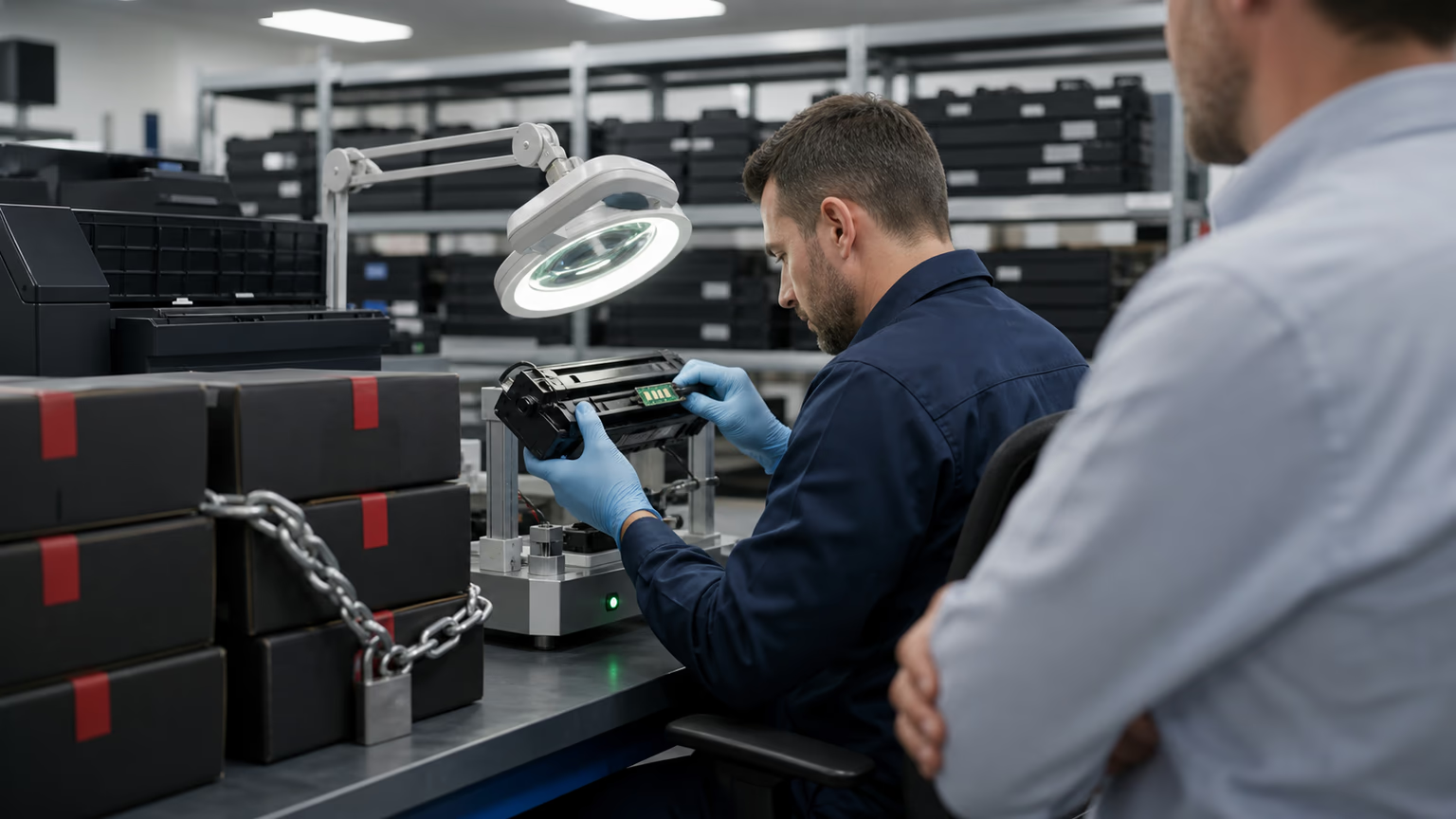
By encrypting these chips and updating printer firmware, manufacturers make it difficult for third-party cartridges to work reliably.
This technological lock-in effectively eliminates price competition from unlicensed alternatives and keeps OEM toner prices elevated.
Another factor is the brand premium.
Printer OEMs invest heavily in marketing and corporate contracts, especially in managed print services.
These contracts often bundle hardware, service, and supplies under a single agreement, with toner prices embedded in opaque cost-per-page calculations.
Buyers rarely see the true unit cost of toner, making it hard to compare against market alternatives.
Over time, OEM toner prices have risen faster than general inflation, squeezing the budgets of distributors, service providers, and end customers alike.
Common OEM tactics that widen the cost gap include:
- Chip encryption and firmware lockouts that reject non-OEM cartridges or trigger warning messages.
- Regional pricing differentiation that allows OEMs to charge different prices in different markets without justification.
- Bundled service contracts that hide toner costs within larger agreements, reducing transparency.
- Aggressive patent litigation designed to deter or delay aftermarket competitors.
- Frequent model refreshes that force buyers to purchase new cartridge designs, limiting the usefulness of existing compatible stock.
Understanding these dynamics is critical for any business that relies on printing. The high price of OEM toner is not an accidental outcome; it is a deliberate strategy to extract maximum value from locked-in customers. This is exactly why a structural gap exists that compatible toner can fill.
How OEM Strategies Create a Structural Cost Gap
The cost gap between OEM toner and compatible alternatives is not a temporary anomaly.
It is a structural feature of the printer industry, created by the manufacturer's control over both the hardware and the consumables.
When printer firmware updates are released, they often include changes that impact cartridge recognition.
For example, a previously working compatible cartridge may suddenly be rejected after a firmware upgrade, forcing the user back to an OEM cartridge.
This uncertainty drives many conservative buyers to stick with OEM toner, even at a higher cost, because they fear downtime and service disruption.
OEM pricing strategies also exploit the lack of transparency in contract pricing.
In many managed print service agreements, the cost per page is quoted as a single number that includes hardware, service, and supplies.
Breaking out the actual toner cost is nearly impossible.
This opacity prevents procurement teams from making apples-to-apples comparisons, and it allows OEMs to maintain premium pricing without direct market pressure.
Furthermore, OEMs have used patent litigation and aggressive aftermarket enforcement to limit the availability of third-party cartridges. While some of these patents are legitimate, many are challenged in court and eventually invalidated, but the legal delays can keep compatible products off the market for years. During that time, OEMs continue to sell toner at high margins without competition.
All these tactics combine to create a persistent price umbrella.
The difference between a typical OEM toner cartridge and a high-quality compatible counterpart can be substantial, even after accounting for yield and quality.
This gap is not closing; in fact, as OEMs push further into subscription models and chip encryption, the gap may widen.
For distributors and service providers, recognizing this structural gap is the first step toward building a more profitable and resilient supply strategy.
The Compatible Toner Opportunity: More Than Just Cheap Cartridges
Compatible toner cartridges are often marketed primarily on price, but the real opportunity goes far beyond a lower unit cost.
For B2B distributors and printer service companies, a well-managed compatible toner program can transform the economics of service contracts and hardware sales.
When you reduce the cost per page without sacrificing print quality, you can either increase your own margins or pass savings to customers to win more business.
In a competitive market, this flexibility is a powerful differentiator.
One of the most significant advantages is margin recovery.
Many service providers operate on thin margins because OEM toner costs consume a large share of the service contract revenue.
By sourcing premium compatible toner from a reliable supplier, you can restore profitability without raising prices for your customers.
This margin recovery can be reinvested in better service, faster response times, or even hardware upgrades that strengthen the customer relationship.
Another benefit is fleet flexibility.
In today's business environment, mixed printer fleets are the norm, not the exception.
A single office may have devices from several different manufacturers, each requiring its own toner cartridges.
Managing OEM toner for a mixed fleet means juggling multiple vendor relationships, maintaining separate inventories, and dealing with different pricing structures.
A compatible toner supplier that supports a wide range of printer models can consolidate these needs, reducing administrative overhead and inventory complexity.
Finally, using compatible toner reduces your dependency on OEM pricing cycles.
When OEMs raise prices annually or push costly firmware updates, compatible toner users can often continue using the same cartridges if the supplier stays ahead of compatibility issues.
This stability helps with budgeting and long-term planning.
The key is to treat compatible toner not as a commodity purchase but as a strategic sourcing decision based on total cost of ownership and supplier reliability.
The Quality Spectrum: Why Not All Compatible Toner Is Equal
One of the most dangerous misconceptions in the B2B printing market is that all compatible toner is essentially the same.
The reality is that compatible cartridges span a wide quality spectrum, from premium products that rival OEM performance to low-cost imports that can damage printers and ruin customer trust.
The difference lies in the toner formulation, the quality of the drum and other mechanical components, and the design of the chip that communicates with the printer.
Premium compatible toner manufacturers invest heavily in research and development to match the exact specifications of OEM toner.
They test for correct particle size, fusing temperature, and charge characteristics.
They use high-quality drums and precision components that meet or exceed OEM specifications.
They also design their own chips, often with the ability to receive firmware updates or emulate OEM chips without triggering printer errors.
These cartridges are typically manufactured in ISO 9001 certified facilities and are tested to ISO/IEC yield standards.
The result is a product that performs reliably and produces print quality indistinguishable from OEM output.
On the other end of the spectrum are low-quality imports and counterfeit rebrands.
These cartridges may use inferior toner that does not fuse properly, leading to smudging, streaking, or premature toner leakage.
The drums may be recycled without proper inspection, causing print defects or even permanent damage to the printer's imaging unit.
The chips may be poorly cloned, causing error messages or cartridge rejection.
Such products often come with inflated page yield claims that are not backed by independent testing.
They may be cheap to buy, but they are expensive to use due to reprints, downtime, service calls, and potential hardware damage.
For B2B buyers, the challenge is to distinguish between premium compatible toner and low-grade imports.
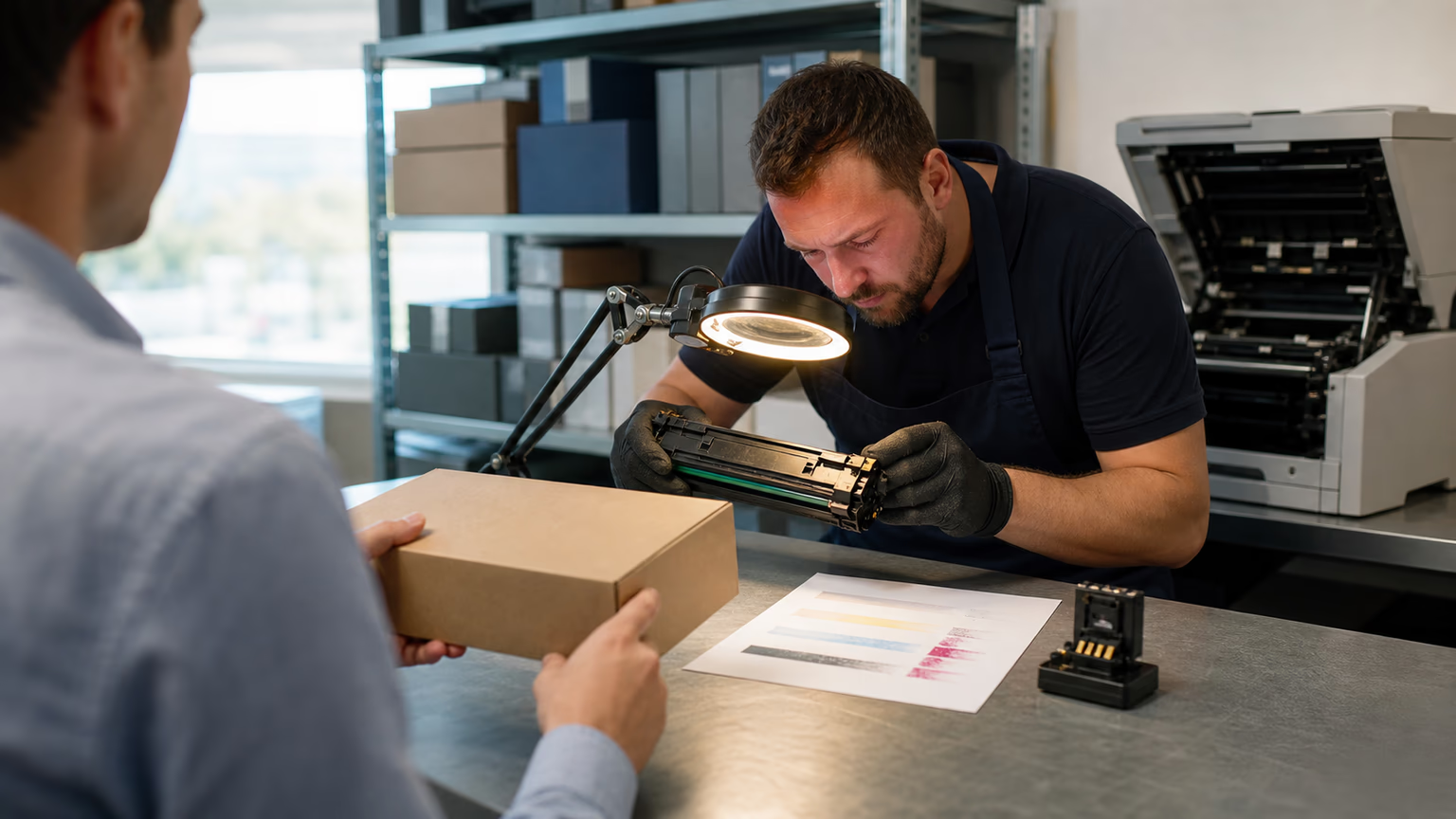
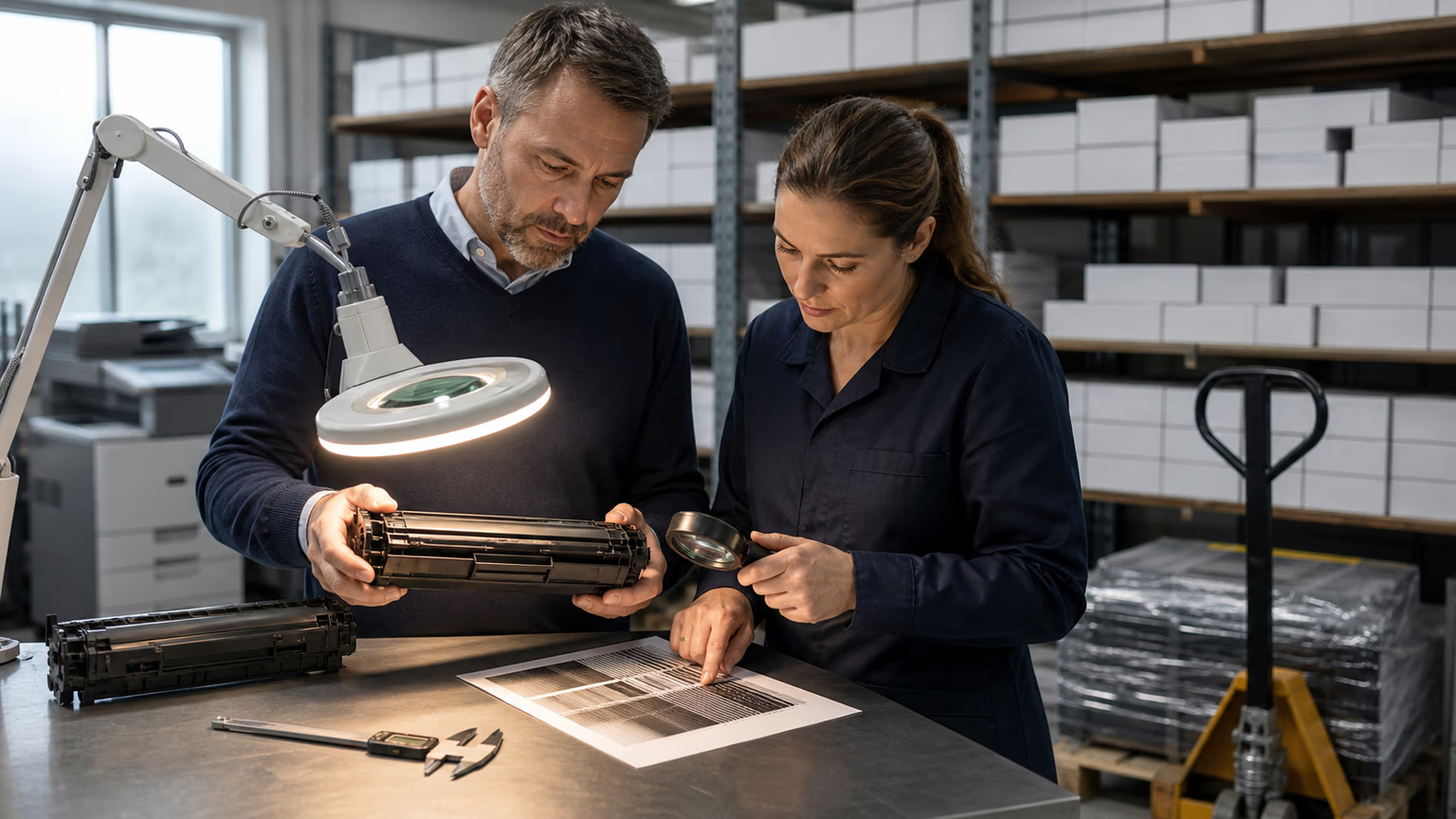
This requires due diligence: request yield test reports, ask about batch consistency data, request samples for testing, and evaluate the supplier's quality control processes.
The price alone is not a reliable indicator.
Some low-quality suppliers charge very low prices, but some premium suppliers also offer competitive pricing due to efficient manufacturing.
The real differentiator is the supplier's commitment to quality and compatibility, not just the sticker price.
Compatibility Challenges in Mixed Printer Fleets
Modern offices rarely standardize on a single printer brand.
Instead, they often have a mix of devices from different manufacturers, each with its own toner cartridge design, chip encryption, and firmware update schedule.
This heterogeneity creates real compatibility challenges for any toner sourcing strategy.
A compatible cartridge that works perfectly in one printer model may fail in another, even if the printers are from the same manufacturer but with different firmware versions.
This is why rigorous compatibility testing is essential.
Printer firmware updates are the most common source of compatibility problems.
Manufacturers regularly release firmware updates to fix bugs, improve security, or add features.
However, these updates often include changes to the cartridge authentication process.
A compatible cartridge that worked yesterday may be rejected after a firmware update.
In many cases, the rejection is not due to a physical incompatibility but to a chip recognition failure.
The printer may display an error message or simply refuse to print.
For a service provider managing hundreds of printers, such issues can quickly escalate into a support nightmare.
Regional variations add another layer of complexity.
The same printer model may use different chips or encryption standards in different geographic regions.
A compatible cartridge sourced from one region may not work in a similar printer sold in another region.
This is particularly relevant for importers and distributors who source toner globally.
Without proper testing across the specific printer models and firmware versions used by your customers, you risk deploying cartridges that fail in the field.
The solution is to partner with a compatible toner supplier that has a robust compatibility testing program.
This includes testing against current and previous firmware versions, across multiple printer models from each manufacturer, and in different regional configurations.
The supplier should also monitor OEM firmware updates proactively and adjust their chip firmware accordingly.
Only with this level of diligence can you confidently deploy compatible toner across a mixed fleet.
Operational and Service Risks of Poor Toner Choices
Choosing the wrong compatible toner is not just a quality issue; it is an operational and financial risk that can undermine your entire service business.
The most immediate impact is increased downtime.
Defective or incompatible cartridges cause printer errors, paper jams, and print failures.
Every minute a printer is down, your customer's workflow is disrupted, and your service team has to spend time troubleshooting.
In a managed print services contract, every service call erodes your margin.
Poor toner quality can also lead to reprints and wasted paper.
Streaks, fading, or incorrect color reproduction force users to reprint documents, wasting toner and paper.
In a high-volume office, this waste can be substantial.
Moreover, if the toner leaks or produces excessive dust, it can contaminate the printer's internal components, leading to premature drum or fuser failure.
These repairs are expensive and may not be covered by the printer warranty, especially if the OEM claims the damage was caused by third-party toner.
Even if you win the dispute, the time and effort spent on warranty claims is a cost in itself.
From a service perspective, the real danger is customer churn.
If your customers experience frequent printing problems, they will lose trust in your ability to manage their print environment.
They may switch to another service provider or revert to OEM toner, eliminating your cost advantage.
In the worst case, they may terminate the entire service contract.
The short-term savings from low-cost compatible toner can quickly be wiped out by the long-term cost of lost customers.
Therefore, when evaluating compatible toner, you must consider the total cost of ownership, which includes not only the cartridge price but also the cost of downtime, reprints, service calls, and potential printer damage.
A cheap cartridge that fails 5% of the time may cost more overall than a premium compatible cartridge that fails rarely.
The key is to base decisions on data, not just on the invoice price.
A Procurement Framework for Evaluating Compatible Toner Suppliers
Given the stakes involved, a systematic approach to sourcing compatible toner is essential. Here is a practical framework that B2B buyers, distributors, and service providers can use to evaluate and select a compatible toner supplier. The goal is to minimize risk while maximizing savings, and this requires a combination of testing, documentation, and supplier partnership.
- Request and verify yield data. Ask the supplier for ISO/IEC yield test reports for the specific cartridge models you plan to use. Compare these reports against OEM yield claims. Be wary of suppliers who cannot provide independent test data or whose claimed yields seem unrealistically high.
- Conduct sample testing on your own fleet. Obtain samples of the compatible cartridges and test them on a representative sample of your printers, including different firmware versions and printer models. Run at least one full toner cycle to observe print quality, error rates, and any compatibility issues. Document the results.
- Evaluate the supplier's firmware monitoring and response process. Ask how the supplier stays informed about OEM firmware updates and how quickly they adapt their chip firmware. A proactive supplier will have a systematic process for testing new firmware and rolling out updated chips.
- Assess supply chain resilience. A reliable supplier should have multiple production lines or regional warehouses to ensure consistent supply. Ask about lead times, inventory depth, and contingency plans for disruptions.
- Review warranty and return policies. Understand what happens if a cartridge is defective or causes printer damage. What is the RMA process? How long does it take to get a replacement? Does the supplier cover printer damage if their toner is proven defective?
- Request references from other distributors or service providers who have similar mixed-fleet profiles. Speaking with existing customers can reveal how the supplier performs in real-world conditions, including responsiveness to issues and commitment to continuous improvement.
By following this framework, you can move from opportunistic buying to a strategic partnership that protects your margins and your reputation.
Future-Proofing Your Toner Strategy: Monitoring OEM Moves and Supplier Agility
The printer industry is not static, and neither should your toner sourcing strategy be.
OEMs are likely to continue their efforts to lock in customers through chip encryption, firmware update strategies, and even subscription-based toner delivery programs.
These moves are designed to make compatible toner less attractive, but they also create new challenges that forward-looking buyers must anticipate.
One emerging trend is the shift toward OEM toner subscription models, where customers pay a monthly fee for a set number of pages and the OEM automatically ships toner when needed.
This model increases convenience but also deepens lock-in, as the subscription often includes firmware that restricts the use of third-party cartridges.
For service providers, this poses a long-term threat to their ability to offer hardware-agnostic services.
Choosing compatible toner suppliers who are actively monitoring these trends and developing countermeasures is essential.
Sustainability regulations are another factor.
As governments push for circular economy practices, there may be new requirements for cartridge remanufacturing or recycling.
Some OEMs are already designing cartridges that are harder to remanufacture, using welded plastics and proprietary chips.
However, these same regulations also encourage the use of remanufactured and compatible cartridges, so the regulatory environment could create new opportunities for compatible toner if suppliers adapt.
For most businesses, a dual-sourcing strategy makes sense.
For critical printers where maximum reliability is required, you may keep using OEM toner for a small subset of devices while deploying compatible toner for the rest.
This approach allows you to test compatible toner in lower-risk areas while maintaining a fallback if issues arise.
Over time, as your confidence in the compatible supplier grows, you can expand its use.
The key is to avoid being locked into a single source, whether OEM or compatible.
Finally, choose a compatible toner supplier that demonstrates agility. The supplier should be able to quickly adapt to new printer models, firmware changes, and chip encryption. They should have a track record of staying ahead of OEM tactics. This agility is what will keep your printing costs low and your service operations smooth in the years ahead.
FAQ
Why are OEM toner cartridges so expensive compared to compatible ones?
OEM toner cartridges are expensive because manufacturers use a razor-and-blades business model, where hardware is sold at low margins and profits are generated from consumables.
How do printer firmware updates affect compatible toner cartridge performance?
Printer firmware updates can change the way the printer authenticates toner cartridges.
What should I look for in a reliable compatible toner supplier?
A reliable compatible toner supplier should provide ISO/IEC yield test reports, demonstrate batch-to-batch consistency, and have a proactive firmware monitoring program.
Can compatible toner damage my printers or void warranties?
In most regions, using compatible toner does not automatically void a printer's warranty, but OEMs may blame third-party toner for any printer damage.
How do I test compatible toner cartridges before rolling them out across my fleet?
Start by obtaining samples from the supplier and testing them on a few representative printers, including different models and firmware versions.
Conclusion
The high price of OEM toner is not an accident.
It is the result of deliberate pricing strategies, technological lock-in, and market control that have created a structural cost gap.
Compatible toner fills that gap, but only when buyers approach sourcing with the same rigor they would apply to any critical supply decision.
By understanding the economics of OEM pricing, recognizing the quality spectrum among compatible cartridges, and using a systematic procurement framework, distributors and service providers can turn this cost pressure into a competitive advantage.
The future of printing will bring new OEM tactics, new compatibility challenges, and new opportunities.
Businesses that build strong partnerships with adaptable compatible toner suppliers, invest in testing, and monitor total cost of ownership will be well positioned to navigate these changes.
Start with a pilot program, measure the results, and scale confidently.
The space for compatible toner is not shrinking; it is growing, provided you choose the right partner and the right product.