The office print landscape has been reshaped by hybrid work, merger-driven fleet consolidation, and decentralized procurement.
Where once a homogenous fleet from a single manufacturer dominated, today’s B2B service providers manage a diverse array of laser printer models from multiple OEMs.
This complexity turns office printer toner management into a high-stakes balancing act between cost, performance, and availability.
Compatible toner cartridges have long been the budget-conscious choice, but the shifting environment demands a more strategic lens.
Post-pandemic print volumes remain unpredictable.
Departments that had shed desktop printers are now reinstalling them, while central multifunction devices face lower but more variable traffic.
This volatility means just-in-time ordering based on historical baselines often fails, leading to stockouts or overstock.
A compatible toner supplier that can offer inventory flexibility and data-driven replenishment becomes a business continuity partner, not just a vendor.
Sustainability has vaulted from a nice-to-have to a boardroom agenda item.
Many organizations now require suppliers to support circular economy initiatives, such as cartridge remanufacturing and take-back programs.
Compatible printer cartridges that reuse post-consumer components align naturally with these goals, offering a concrete way to reduce plastic waste and carbon footprint.
As a result, the conversation has expanded beyond price to include environmental metrics, fundamentally rewriting the value proposition of compatible toner.
The Hidden Cost of Treating Toner as a Commodity
Pursuing the lowest price per unit for compatible toner cartridges often introduces hidden costs that ripple through the entire service delivery chain.
A cartridge that leaks or produces ghosting may prompt an end-user to call for support, initiating a cascade: a technician dispatched, downtime logged against an SLA, and a frustrated customer whose trust wavers.
The true cost of that cheap printer toner cartridge quickly surpasses any acquisition savings.
The Financial Drain of Toner-Related Service Calls
Service desks consistently report that toner issues are among the top triggers for avoidable dispatches.
Even a minor defect—streaking, low density, a persistent error message—can disable a printer until addressed.
When you calculate the fully loaded cost of a field technician visit (labor, travel, parts, and SLA risk), a single incident can erase the margin on dozens of cartridges.
For MPS providers, toner-induced downtime is a direct threat to contract renewal rates.
Supplier Hopping and the Quality Churn
Procurement teams that continuously switch suppliers to chase a marginally lower price inadvertently inject variability into the fleet.
One batch may perform flawlessly; the next may exhibit yield shortfalls or drum wear.
End-users perceive this inconsistency as an overall decline in print quality, and they blame the service provider, not the brand of cartridge inside.
This cycle erodes relationships and increases the temptation to revert to costly OEM cartridges, undoing years of cost-optimization effort.
Future-ready compatible toner strategies demand consistency over price chopping.
Quality is Non-Negotiable: What Future-Ready Compatible Toner Looks Like
Not all compatible toner is created equal.
The difference between a cartridge that strengthens your service proposition and one that generates complaints lies in the rigor of its design and manufacturing.
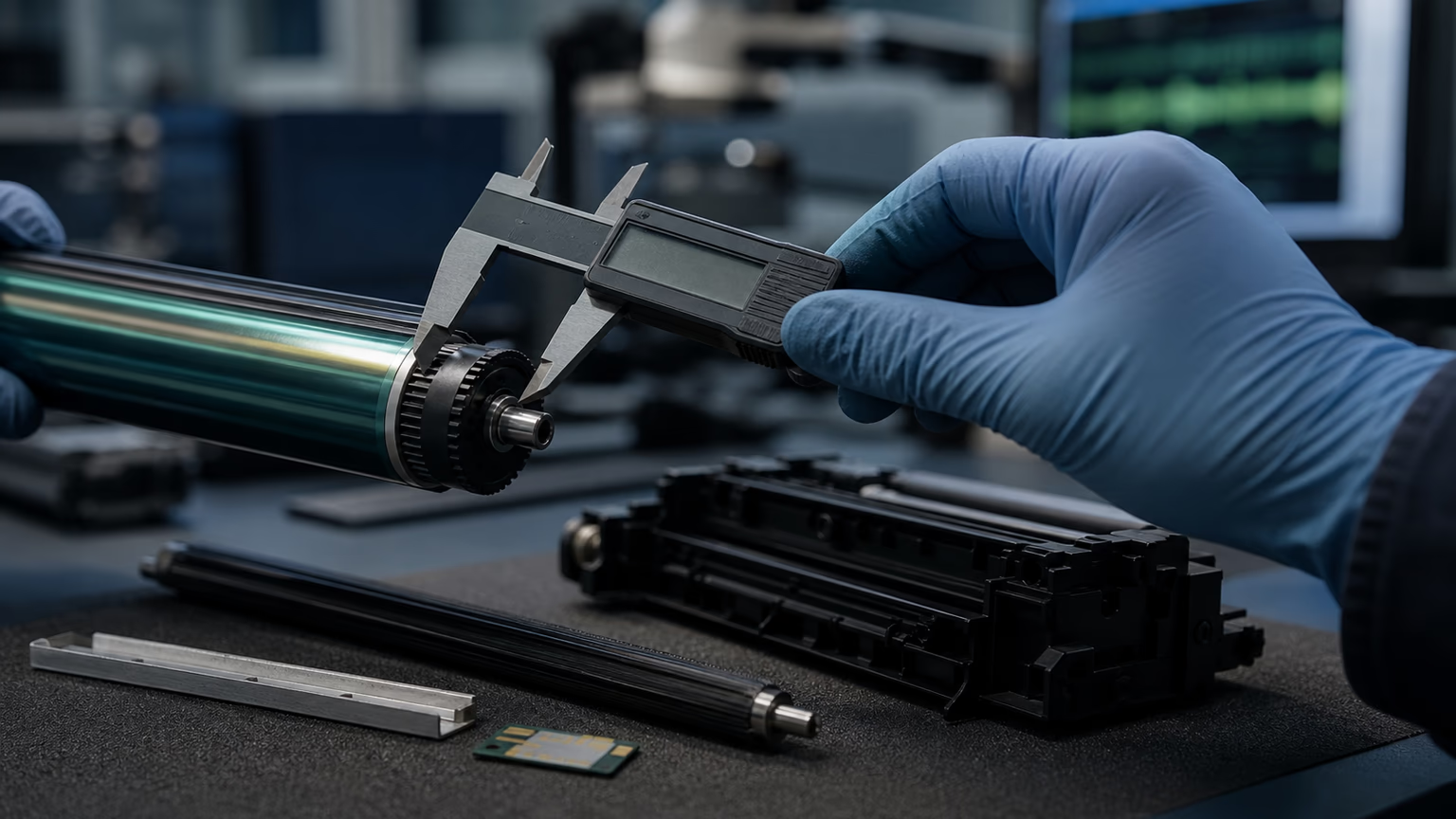
Office printer toner must meet precise physical and chemical specifications to fuse cleanly, charge uniformly, and avoid damaging sensitive imaging components like the OPC drum or developer unit.
Formulation and Component Integrity
The toner powder’s particle size distribution determines print density, background levels, and how well it adheres to paper.
Inconsistent formulations lead to dusting inside the machine, contaminating corona wires and causing premature service.
Beyond the powder, the cartridge’s mechanical parts—primary charge rollers, wiper blades, and magnetic rollers—must be sourced to OEM-equivalent tolerances.
A substandard drum can produce faint prints or repetitive defects that mimic machine failure, wasting technician time on misdiagnosis.
Yield Testing and Real-World Performance
Yield claims based on 5% page coverage are deceptive because real office documents often exceed 10% coverage.
Forward-thinking compatible toner suppliers conduct third-party tests at multiple coverage levels and publish the results.
Ask for test data on your fleet’s top printer models and compare the measured yields against the OEM’s rated capacity.
Furthermore, evaluate how the toner interacts with high-usage devices over hundreds of pages; a sudden drop in density halfway through the cartridge signals an unreliable formulation that will trigger reprints.
Compatibility in the Age of Firmware Wars and Mixed Fleets
Printer manufacturers have weaponized firmware updates to protect their lucrative aftermarket toner revenue. A network-connected device can receive an overnight update that suddenly rejects a previously functional compatible chip. For a mixed fleet spanning multiple brands and model generations, staying ahead of these lockdowns is a perpetual operational challenge.
Firmware Updates: Anticipate, Don’t React
Static chip technology is no longer viable.
The toner cartridges you buy today must incorporate upgradable chips that can be reprogrammed or replaced when OEMs push countermeasures.
Your compatible toner supplier should have a dedicated team monitoring firmware releases across all major brands and should provide advance notification when a risky update is detected.
Without this proactive stance, your service desk will face a wave of user complaints after each seasonal update cycle, each requiring a cartridge swap and a visit.
Managing Multi-Brand Complexity
Large office environments rarely standardize on a single printer brand.
Acquisitions, departmental preferences, and lease cycles produce fleets with devices from several manufacturers.
Sourcing compatible toner cartridges for each brand from separate vendors introduces administrative friction and compatibility gaps.
A unified toner partner that provides consistent chip reliability and print quality across the entire fleet simplifies procurement, reduces training overhead for technicians, and eliminates cross-contamination of quality issues from one brand to another.
The Service Ripple Effect: How Toner Choices Impact Your Maintenance Business
In managed print services, toner is never just a consumable—it is a direct determinant of service costs and customer sentiment. When toner performs consistently, the service team focuses on preventive tasks; when it fails, the team is anchored to firefighting. Smart service managers recognize that compatible toner cartridges are not a procurement afterthought but a frontline reliability tool.
The Real Cost of Toner-Related Downtime
Downtime minutes compound.
A printer that halts during a finance team’s month-end close triggers not only a rush service call but also a loss of confidence that can unravel a multi-year contract.
Many SLAs now include uptime guarantees with financial penalties, making every toner-induced jam or error code a direct cost.
By selecting compatibility-tested cartridges with proven yield and chip resilience, service providers can measurably reduce SLA breaches and protect margins.
Technician Efficiency and Brand Reputation
Technicians develop a mental model of which toner brands cause problems.
When they repeatedly visit sites for toner faults, morale dips and turnover risks rise.
Moreover, end-users don’t distinguish between the cartridge brand and the service provider—they simply experience unreliable printing.
Deploying future-ready compatible toner cartridges allows technicians to concentrate on high-skill interventions, raising the perceived value of the service contract and fostering client loyalty.
Building a Future-Proof Supplier Partnership
The search for a compatible toner partner should be as structured as any other strategic sourcing initiative. Beyond price, evaluate suppliers on transparency, technical agility, supply resilience, and environmental stewardship. A partner that excels in these dimensions will help you navigate the uncertainties of firmware wars, demand spikes, and sustainability reporting.
Criteria for a Strategic Toner Supplier
- Batch consistency data: Ask for real test records, not just certificates. Documented density, yield, and defect rates per shipment build confidence.
- Firmware responsiveness: Confirm their average turnaround time for chip updates after OEM releases have been validated.
- Supply chain robustness: Multiple distribution centers, safety stock for high-volume SKUs, and contingency plans for logistics disruptions are essential.
- Technical support depth: Access to engineers who can assist with integration issues, rather than a sales-only interface, speeds problem resolution.
- Environmental credentials: Look for certified take-back programs, recycled content ratios, and lifecycle emission data that you can pass through to your clients’ ESG reports.
Moving from Transactional to Relational
A quarterly business review cycle transforms the supplier relationship into a collaborative engine for improvement. During these reviews, jointly analyze service ticket data, toner failure rates, and firmware tracking alerts. This data-driven dialogue ensures the supplier continuously refines its product for your fleet’s unique conditions, making the partnership a genuine competitive moat.
Your Action Plan: A Seven-Point Checklist for the Next RFP
To operationalize these insights, incorporate the following checklist into your next request for proposal or supplier evaluation process. Each point directly addresses a risk area identified in this article, helping you select a compatible toner partner that is truly future-ready.
- Fleet audit baseline: Document every printer model, firmware version, and recurring toner-related service ticket. This data will anchor your supplier conversations and highlight critical compatibility gaps.
- Quality KPIs in the contract: Include measurable thresholds for print density, background, yield, and cartridge-out-of-box failure rate. Tie contract incentives to these metrics.
- Pilot program with real workloads: Run a 90-day trial on a cross-section of your fleet, measuring performance under your specific print coverage patterns. Involve end-user surveys to gauge satisfaction.
- Automated ordering integration: Require that the supplier’s system can receive consumption triggers from your remote monitoring platform, enabling just-in-time replenishment.
- Firmware update SLA: Establish a contractual commitment for the supplier to notify you of relevant OEM firmware updates within 48 hours and deliver updated chips within five business days.
- Sustainability documentation: Mandate that the supplier provides auditable data on recycled content, take-back volumes, and carbon footprint per cartridge, aligned with your clients’ reporting frameworks.
- Quarterly business reviews: Schedule regular touchpoints that review performance against the KPIs, discuss upcoming fleet changes, and evaluate innovation opportunities.
FAQ
How can compatible toner improve total print fleet cost without hurting quality?
By shifting the evaluation from per-unit price to total cost of ownership, which includes service call avoidance, drum longevity, and reprint reduction. Suppliers that provide batch consistency data and third-party yield tests enable buyers to select cartridges that perform comparably to OEM across these dimensions, lowering overall fleet expenses.
What makes a compatible toner supplier reliable for multi-brand offices?
A reliable supplier demonstrates consistent quality across all supported brands, not just one or two. They invest in chip technology that adapts to firmware updates across different printer manufacturers and offer technical support that understands the nuances of multi-brand environments. Additionally, they maintain contingency stock and provide transparent quality reporting.
Are compatible toners safe for newer printer models with frequent firmware updates?
Yes, when the cartridges use upgradable chips and the supplier has a proactive firmware monitoring program. The supplier should be able to demonstrate a track record of timely chip updates for each printer model in your fleet. Without such a program, even a single firmware update can disrupt entire workgroups.
How does compatible toner support sustainability goals in corporate printing?
Many compatible toner cartridges are built using remanufactured cores and recycled materials, significantly reducing plastic waste compared to single-use OEM cartridges. Suppliers that operate certified take-back programs further enable circular lifecycles, helping organizations meet their environmental targets and report tangible progress to stakeholders.
What are the hidden costs of only comparing compatible toner by price?
Price-centric procurement overlooks the downstream expenses of toner-caused service calls, downtime, reprints, and technician labor. A cartridge that saves a dollar on the invoice but increases service dispatches by even a fraction wipes out the saving many times over. Additionally, quality inconsistency leads to end-user dissatisfaction that can result in contract churn.
Conclusion
The compatible toner market has matured beyond the low-cost substitute era.
For B2B distributors, MPS operators, and procurement teams, future success depends on treating compatible toner as a strategic lever—one that can enhance service reliability, strengthen sustainability credentials, and deepen client relationships.
Office printing will continue to evolve with more demanding firmware landscapes and mixed fleet realities, but a carefully selected supplier partnership built on transparency, quality data, and proactive support turns these challenges into competitive advantages.
The time to upgrade your toner strategy is not when the next cartridge fails, but right now, at the drawing board of your next procurement decision.