The New Economics of Office Printing: Why Compatible Toner Is Now a Boardroom Issue
The conversation around office printer toner has moved from the supply closet to the executive suite.
Post-pandemic print volumes may have shifted, but the device fleets that power daily workflows still burn through billions of pages annually.
For B2B distributors, MPS operators, and fleet managers, the toner cartridge is no longer a simple consumable—it is a line item that directly shapes operating expense, service quality, and even corporate sustainability reports.
Where OEM-exclusive contracts once signified reliability, they now increasingly represent inflexibility, hidden fees, and a rising total cost of ownership that erodes margins.
Against this backdrop, compatible toner cartridges are gaining ground not as a cheap alternative, but as a strategic lever to regain control over procurement and fleet performance.
The old assumption that compatible supplies mean a gamble on quality no longer holds when proper vetting is applied.
Forward-thinking print service businesses now see that a well-managed transition to affordable printer toner cartridges can stabilize per-page costs, reduce dependence on single-source OEMs, and align with circular-economy goals.
However, the shift demands a rigorous, evidence-based approach—one that addresses the real risks of print quality, device compatibility, and supply chain continuity.
This article unpacks how to de-risk that transition and build a future-ready toner strategy for multi-brand office environments.
The Hidden Costs of OEM Lock-In: Beyond Per-Cartridge Pricing
Many procurement teams focus exclusively on the unit price of a laser printer toner cartridge, but the true financial drain lies deeper.
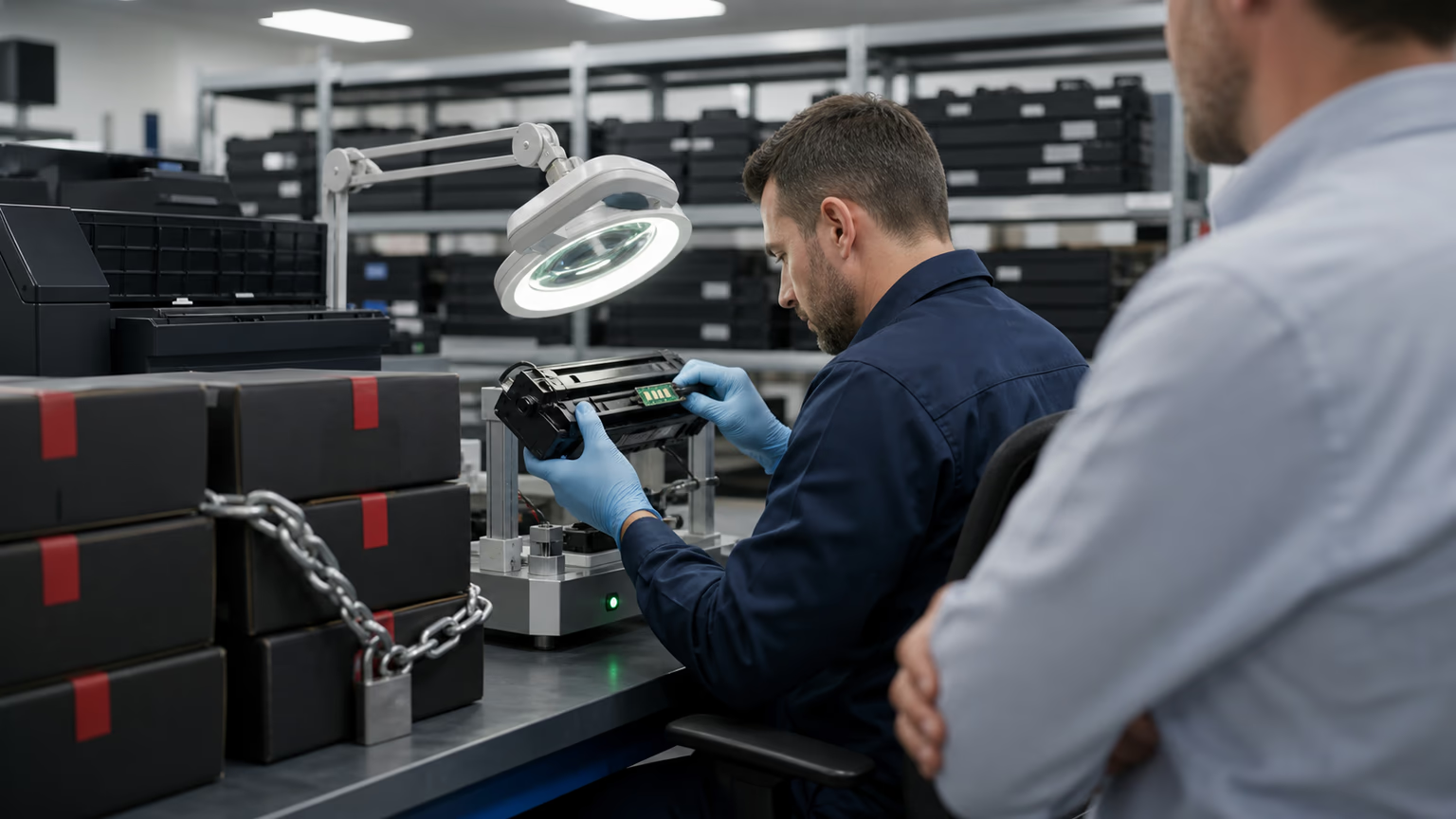
OEM contracts often bundle auto-replenishment services that trigger restocking fees and penalize you for unused cartridges left in inventory.
Per-page service plans may appear predictable until overage charges kick in for volume spikes—a common scenario in seasonal or project-driven offices.
Worse, printer manufacturers routinely link toner supply agreements to forced hardware refresh cycles, pressuring you to upgrade devices before their useful life ends just to maintain supply eligibility.
These lock-in mechanisms inflate the total cost of ownership and strip away the operational flexibility that multi-site fleets require.
When you analyze actual expenditure, the hidden costs of OEM-exclusive sourcing often outweigh the perceived safety net.
Departmental chargebacks become distorted because the real expense is buried in blended contract fees.
Meanwhile, the inability to right-size toner usage across different printer models and user groups leads to waste—high-coverage departments starved for supply while low-use areas sit on excess inventory.
Breaking free from these contracts requires a clear-eyed audit of current spend patterns and a comparison with a hybrid model that incorporates compatible toner cartridges for office printers where performance is proven.
Demystifying Compatible Toner Quality: What Separates a Reliable Cartridge from a Problematic One
Quality variation is the most cited fear when switching to compatible toner cartridges, yet it is also the most misunderstood.
A reliable cartridge depends on three tightly controlled elements: toner chemistry, mechanical precision, and chip technology.
Toner particles must have a consistent size distribution and melt point to fuse properly across different fuser temperatures—poor chemistry leads to ghosting, background scatter, or smudging that ruins professional documents.
The mechanical assembly—the drum, wiper blade, and developer roller—must match the original engineering tolerances, or you risk uneven coverage, leaks, and premature wear inside the printer.
Chip technology is another critical frontier.
Aftermarket chips must accurately emulate the OEM handshake without triggering error messages or being disabled by firmware updates.
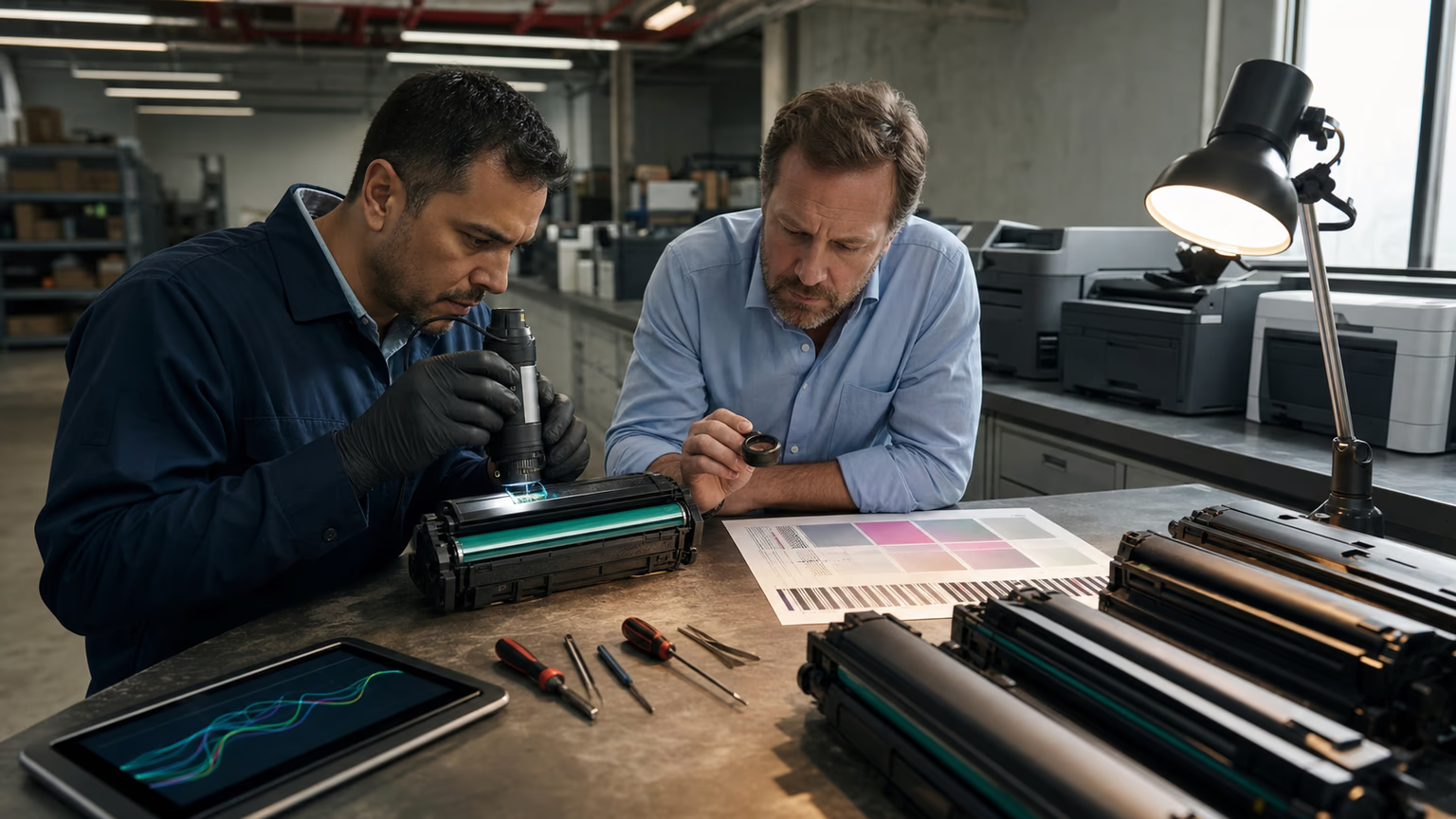
Quality-focused suppliers run their cartridges through ISO/IEC standard yield testing, density measurements, and environmental stress tests, providing batch-level documentation that gives buyers confidence.
When vetting a supplier, ask for third-party lab reports that show actual page yields, optical density, and failure rates—not just marketing claims.
This moves the conversation from subjective trust to objective, repeatable data.
Mastering Compatibility in Multi-Brand Printer Fleets
Real-world office environments rarely run on a single printer brand.
Mixed fleets combining devices from several major manufacturers create a complex compatibility landscape.
Each printer platform uses distinct chip communication protocols, fuser temperatures, and cartridge geometries.
A compatible toner cartridge that works flawlessly in one model may struggle with physical fit, chip recognition, or drum wear in another—even within the same brand family.
The risk multiplies when firmware updates suddenly alter the authentication sequence, blocking previously functional cartridges and triggering service calls.
Managing compatibility proactively means treating firmware as a dynamic risk, not a one-time concern.
Before any rollout, map the exact firmware versions across your fleet and ask your compatible supplier how their aftermarket chips handle update cycles.
Top-tier suppliers maintain a library of chip firmware revisions and can supply updates or replacements when OEMs push new patches.
Also, conduct a physical fit and print quality test on a representative sample of printer models, checking for issues such as cartridge seating, toner leakage, and color calibration drift.
A single-source compatible toner for mixed printer fleets program only works when the supplier demonstrates deep cross-OEM engineering knowledge.
Building a Resilient Toner Supply Chain in an Uncertain Market
Geopolitical tensions, logistics bottlenecks, and raw material shortages have exposed the fragility of global toner supply chains.
The polymers, pigments, and rare-earth elements used in printer toner depend on concentrated supply regions, and a single disruption can cascade into stockouts that idle offices for weeks.
Meanwhile, trade tariffs and currency fluctuations add unpredictable cost layers to imported cartridges.
Buyers who rely on a single supplier from one manufacturing region risk exactly the kind of operational shock that erodes client confidence.
Resilience comes from supplier diversification, buffer stock agreements, and transparent demand forecasting.
Evaluate whether your compatible toner partner holds safety stock in multiple locations and can guarantee lead times even under strain.
Combine this with a rolling forecast shared across your own service delivery teams, so reorder points automatically adjust to actual page counts rather than guesses.
A resilient supply chain may not always deliver the lowest spot price, but it protects uptime and client relationships far more effectively.
The Supplier Evaluation Checklist: 9 Criteria for De-risking Your Compatible Toner Buy
Selecting a compatible toner supplier should be a disciplined procurement exercise, not a trial-and-error process. Use a structured evaluation framework that covers the following non-negotiable areas:
- Quality management systems: Verify factory audits and certifications such as ISO 9001 and ISO 14001 that demonstrate process control and environmental stewardship.
- Batch testing transparency: Require documented AQL sampling, yield tests, and third-party lab reports for each production lot.
- Chip reliability: Confirm aftermarket chip compliance with current OEM firmware and a policy for timely updates when lockouts occur.
- Supply chain visibility: Assess raw material sourcing, secondary supplier networks, and stockholding capacity across multiple warehouses.
- Technical support: The supplier should provide rapid failure analysis and direct access to engineering teams, not just sales contacts.
- Return and credit flexibility: Negotiate clear terms for defective batches, including automatic replacement thresholds and no-penalty returns.
- Regulatory compliance: Cartridges must meet REACH, RoHS, and local safety regulations—ask for compliance statements, not just labels.
- Multi-brand coverage: The supplier should demonstrate deep cross-OEM compatibility and offer lifecycle management for all printer models in your fleet.
- Continuous improvement: Look for evidence of investment in R&D, not just assembly—this signals commitment to staying ahead of OEM countermeasures.
Implementing a Hybrid Procurement Model: From Pilot to Full Deployment
Transitioning to compatible toner does not require an all-or-nothing bet.
A phased hybrid model reduces risk and builds internal confidence.
Start by auditing current device-specific toner spend, failure rates, and service call data to establish a performance baseline.
Then select a small, controlled pilot group of printer models that represent the diversity of your fleet.
Define clear success KPIs: cost per page, cartridge failure rate, print quality consistency, and service ticket frequency.
Run side-by-side tests comparing OEM and compatible cartridges under identical usage conditions.
Document output using standardized test pages and keep a log of any cartridge-related service interventions.
Negotiate pilot terms with your supplier that include free evaluation samples and immediate swap-out of any defective units.
Simultaneously, train your service team on compatible cartridge diagnostics—many print quality issues blamed on toner are actually fuser, transfer roller, or paper problems.
Once the pilot proves stability, scale the rollout in stages, continuously monitoring the same KPIs and feeding data back to the supplier.
This data-driven approach makes the adoption curve manageable and defensible to stakeholders.
The Next Frontier: Smart Cartridges, Circular Models, and Toner-as-a-Service
The future of office printing is being shaped by three converging trends: IoT-enabled smart cartridges that report usage and health in real time, closed-loop remanufacturing programs that recover and reuse components, and subscription-based toner-as-a-service models bundled with managed print platforms.
For B2B buyers, these developments promise even tighter control over fleet performance.
Imagine cartridges that automatically trigger reorders when toner levels reach a threshold, alert service teams to an impending drum failure, and provide data for predictive budgeting.
Circular economy initiatives are pushing suppliers to design for remanufacturing, reducing waste and lowering the carbon footprint per printed page.
Meanwhile, toner-as-a-service agreements shift the focus from transactional cartridge sales to guaranteed uptime, aligning supplier incentives with your own operational goals.
While these models are still maturing, forward-looking procurement teams should already be evaluating partners who invest in smart chip technology, remanufacturing infrastructure, and integrated service platforms.
This is the direction that will separate truly future-ready compatible toner programs from commodity resale.
FAQ
What are the real risks of switching to compatible toner for office printers?
The primary risks include print quality inconsistencies, premature cartridge failures, firmware lockouts that prevent cartridge recognition, and potential printer contamination from leaks. However, these risks are manageable through rigorous supplier vetting, pilot testing, and proactive firmware management. A controlled transition with batch-tested cartridges significantly reduces these threats.
How can I prevent firmware updates from disabling compatible toner cartridges?
Work with a supplier that actively maintains an aftermarket chip firmware database and provides timely chip updates when OEMs release new printer firmware. Before deploying, configure printer settings to delay or test firmware updates on a isolated device. Establish an SLA with your supplier that includes guaranteed chip replacements if new firmware causes recognition issues.
What should I look for in a compatible toner supplier to ensure consistent quality?
Look for ISO 9001 and ISO 14001 certifications, documented batch-level testing (yield, density, failure rates), third-party lab reports, and transparent supply chain sourcing. The supplier should also demonstrate cross-OEM chip compatibility, offer responsive technical support, and have flexible return policies for defective lots.
Is compatible toner safe for all printer brands in a mixed fleet?
Compatibility varies by printer model, chip architecture, and toner formulation. A qualified supplier will provide detailed compatibility matrices and recommend cartridges engineered for specific fuser temperatures and drum coatings. Always pilot test on a representative sample of your fleet before full deployment, paying special attention to physical fit and color output consistency.
How does compatible toner impact overall cost per page compared to OEM?
When sourced from a reliable supplier, compatible toner reduces cost per page significantly while maintaining comparable yield. However, hidden costs from failures—such as increased service calls and device damage—can erode savings. The net benefit depends on rigorous supplier selection and monitoring failure rates against your OEM baseline.
Conclusion
The future of compatible toner in office printing is not about choosing the cheapest cartridge on the shelf.
It is a strategic procurement decision that touches operational expense, service reliability, and sustainability.
By moving beyond fear-based objections and adopting a structured evaluation framework, B2B buyers can unlock flexible, cost-effective print supply chains that outperform rigid OEM-only arrangements.
Success depends on three pillars: a ruthless focus on verifiable quality, proactive management of firmware and compatibility risks, and supplier partnerships built on transparency rather than sales promises.
Organizations that master this balance will be best positioned to navigate the next decade of print fleet management with confidence.