
Introduction: The Hidden Complexity of Global Toner SKUs
A procurement manager at a mid-size European print service provider orders a pallet of high-yield laser printer toner cartridges based on an OEM part number that has been a staple in their catalog for years.
The shipment arrives, gets installed at a client's office, and within hours the help desk lights up: cartridge not recognized, 'non-genuine' alert, printer locked.
After a frantic investigation, the team discovers that the cartridges, while carrying the same core code, were actually a regional SKU intended for the Asia-Pacific market.
The chips inside spoke a different electronic dialect, and the local firmware rejected them on sight.
This scenario is not an edge case; it is a daily reality for distributors, managed print services (MPS) operators, and procurement teams navigating the opaque world of regional toner SKUs.
Understanding why a cartridge code that works in one country fails in another is not a trivial detail—it is a mission-critical competency that separates profitable, reliable toner distribution from costly, reputation-damaging chaos.
The focus keyword here, regional toner skus, encapsulates a hidden layer of complexity in the imaging supplies supply chain.
For B2B buyers, the stakes are high: incorrect inventory ties up working capital, disappoints end customers, and can even trigger service-level agreement (SLA) penalties.
In the following sections, we will unpack the business and technical forces that give rise to region-specific cartridge variants, explore the real financial and operational impact of ignoring them, and provide a practical framework for procurement and supplier selection that turns regional SKU mastery into a competitive advantage.
Why Do Regional Toner SKUs Exist?
OEMs do not create regional SKUs arbitrarily.
They are a calculated byproduct of market segmentation, local pricing strategies, regulatory compliance, and supply chain optimization.
First, market segmentation allows manufacturers to offer different warranty terms, starter cartridges, or yield configurations tailored to regional expectations.
A cartridge sold in Western Europe might come with a longer guarantee and a higher page yield than the same-looking unit for a developing market.
Second, pricing strategies aim to prevent grey market arbitrage.
If every cartridge were globally interchangeable, buyers would always source from the cheapest region, eroding OEM profit margins and disrupting local channel economics.
Regional codes act as a soft barrier; they do not always physically stop cross-region use, but they create enough friction to protect regional pricing.
Third, regulatory requirements such as CE marking in Europe, RoHS directives, and REACH chemical compliance often lead to slightly different component formulations, packaging, or labeling, which are then assigned unique SKUs.
Finally, from a logistics standpoint, localizing packaging, manuals, and chip settings streamlines regional hub operations.
A cartridge destined for Latin America might ship with Spanish and Portuguese documentation and a chip pre-set to communicate with printers configured for that region's power standards and date formats.
For B2B toner cartridge suppliers and distributors, ignoring these drivers means ordering blind.
The Real-World Impact on Distributors and Service Companies
The consequences of regional SKU mismatches go far beyond a simple return.
Financially, a bulk order of incorrect cartridges can strangle cash flow.
Unlike standard inventory, regionally mismatched stock is often non-returnable, because many suppliers classify it as a special order or because the cartridges are opened and cannot be resold.
Worse, if the cartridges have been installed even once, their chips may register the attempt, making them electronically useless for any other printer.
Operationally, service organizations face a spike in emergency call-outs.
When a technician visits a client site to troubleshoot a printer that is showing a cartridge error, only to find that the cartridge is region-locked, the wasted time directly hits profitability and SLA compliance.
In MPS contracts, repeated cartridge issues erode the trust that underpins long-term partnerships.
A client who sees persistent toner problems may question the competence of the provider and take their business elsewhere.
The soft cost of churn is often far greater than the hard cost of the cartridges themselves.
Consider a European distributor that sources office printer toner from a US broker without rigorous regional checks.
A batch of cartridges that works perfectly on US-configured machines might fail on EU printers simply because the firmware expects a different regional identifier in the chip's communication.
The distributor is then stuck with inventory they cannot sell locally, faces return shipping costs, and may even eat the price difference when repurchasing the correct regional units.
Technical Deep Dive: Chips, Firmware, and Regional Locking
To effectively manage regional toner SKU risks, B2B buyers need a baseline understanding of what is happening inside the cartridge and the printer.
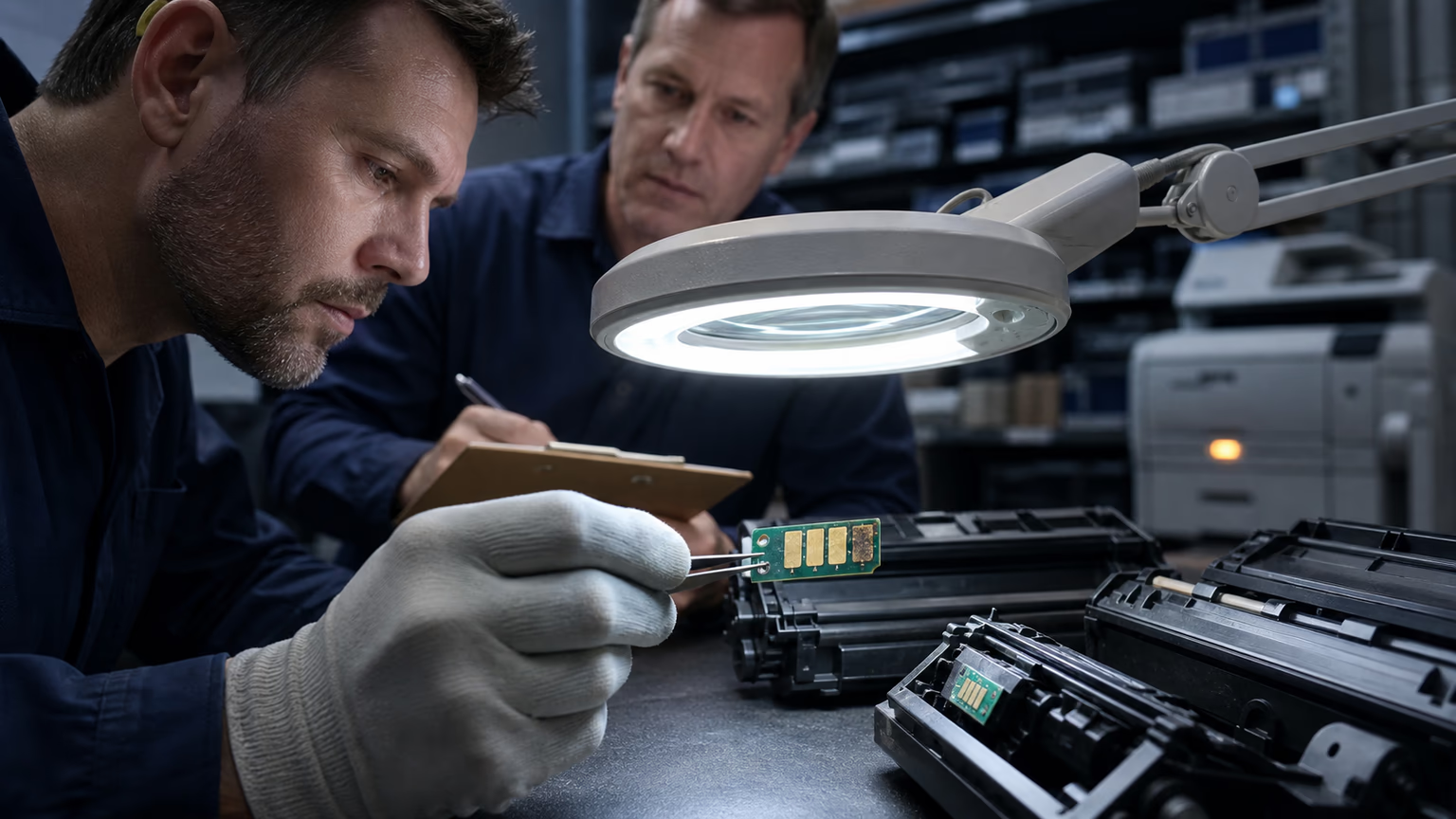
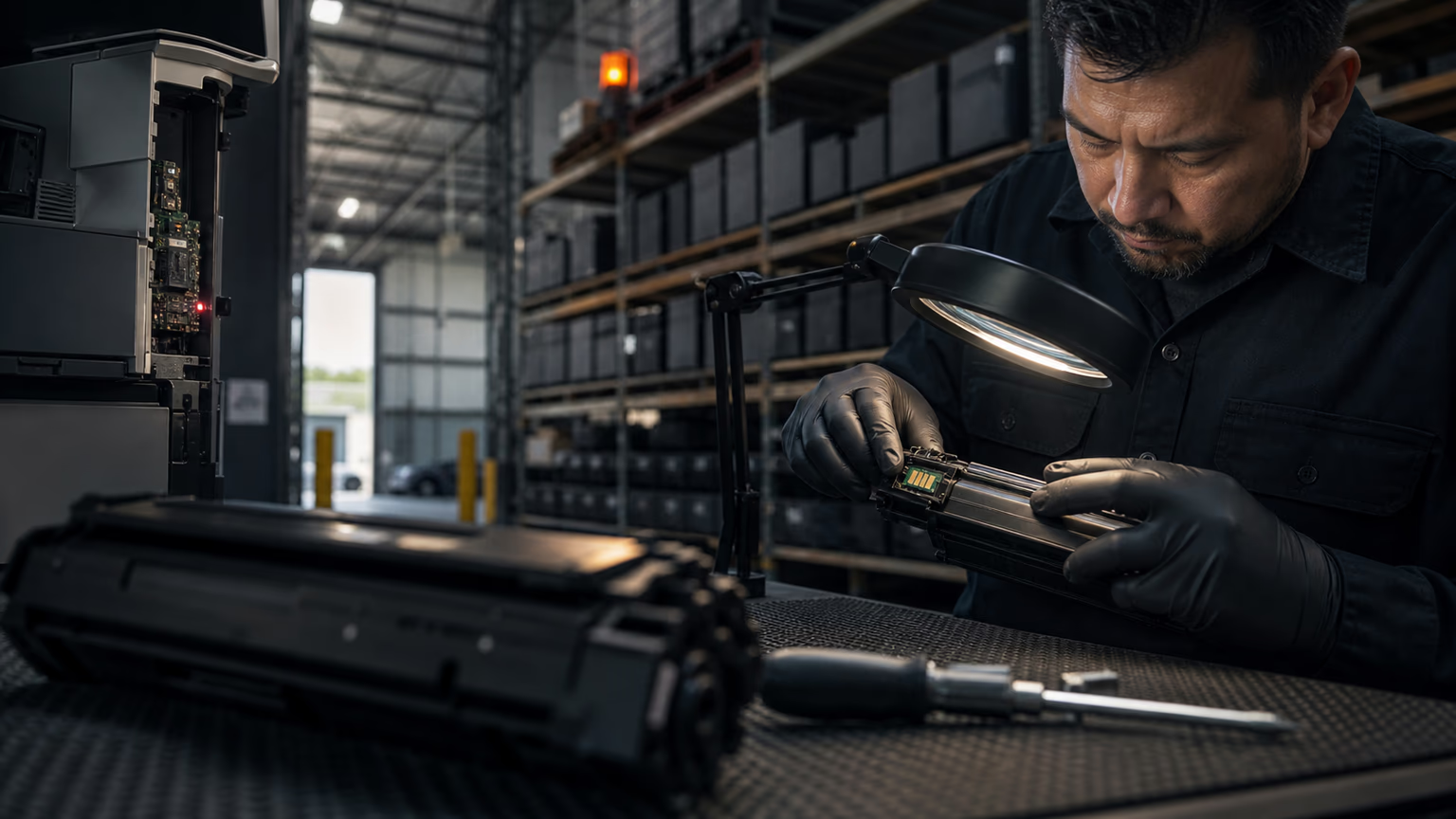
At the heart of the issue lies the tiny chip fixed to every modern toner cartridge.
This chip is far more than a passive identifier; it stores data on region, yield, serial number, and sometimes even toner formulation parameters.
On startup or at regular intervals, the printer queries the chip and compares its regional code against the value stored in its own firmware.
If the codes do not match, the printer can refuse to operate, display a non-genuine or counterfeit warning, or record the event in consumable tracking logs used by MPS software.
Regional locking is not static.
Major printer manufacturers periodically release firmware updates that tighten validation rules.
A cartridge that worked yesterday may be blocked after an overnight update because the firmware now checks for a revised regional signature.
This dynamic lockdown poses a continuous risk for fleet managers who rely on compatible toner cartridges for office printers.
Even OEM cartridges can fall victim to regional mismatches when, for example, a printer manufactured for the North American market is shipped overseas without being re-flashed.
In the realm of compatible toner, chip manufacturers have developed multi-region or universal chips that attempt to auto-detect the printer's region and present the correct code.
However, these solutions are in a constant cat-and-mouse game with OEM firmware updates.
A supplier that does not actively test and update their chip versions in line with the latest firmware leaves its customers exposed to sudden fleet-wide rejections.
How to Verify a Regional SKU Before Ordering
Preventing a regional SKU mishap requires a deliberate verification process that moves beyond simple part-number matching.
The first step is to decode the full OEM part number, including suffixes and prefixes that are frequently ignored.
Many OEMs append region codes like -EMEA, -AP, -LATAM, or numeric region identifiers at the end of a base part number.
A quick visual check of the label against official OEM regional catalogs or reputable databases can flag a mismatch.
The second step is to cross-reference with the supplier's compatibility expert.
Online catalogs often list only the base code, while a knowledgeable account manager can confirm the exact chip version and regional encoding.
Third, for high-stakes purchases, test a sample cartridge on a target printer with the latest firmware installed.
This live test is the most reliable way to catch chip-firmware incompatibilities before a bulk order is placed.
During the test, monitor the printer's boot sequence, watch for any warnings, and print a configuration report that often includes the cartridge's serial number and region code.
Fourth, request chip ID documentation from the supplier.
A transparent supplier should be able to provide a revision history and specify which printer firmware versions their chips have been validated against.
Finally, maintain clear communication: ask the supplier directly which markets their cartridges are built for, and whether they offer region-specific stock.
A vague answer is a red flag.
Procurement Best Practices for Regional Toner SKUs
Integrating regional SKU awareness into procurement workflows can dramatically reduce risk.
Start by adopting a regional-first quoting template.
Every purchase order or RFQ should explicitly state the target country and the critical firmware version(s) of the printers in the fleet.
This forces suppliers to confirm compatibility at the quoting stage rather than after delivery.
Second, consider splitting supplier pools regionally.
If your business serves multiple geographies, it may be safer to source cartridges from a network of regionally specialized suppliers rather than relying on a single global source.
Local suppliers are more likely to stock and validate against the precise regional firmware used in that market.
Third, negotiate return clauses specifically for firmware-related incompatibility.
Standard return policies often exclude electronic components or opened consumables, but you can include a clause that requires the supplier to take back cartridges that fail due to regional chip issues, provided you have tested them within a certain timeframe.
Fourth, use blanket orders with region-based release schedules.
This allows you to lock in pricing and availability while only pulling inventory for specific regions as needed, reducing the risk of dead stock.
Fifth, build a small buffer of pre-verified regional SKUs for urgent service calls.
When a critical client needs a same-day replacement, having a handful of region-validated cartridges can save an account and avoid SLA penalties.
For buyers searching for low cost printer toner or affordable printer toner cartridges, it is vital to understand that the lowest unit price is meaningless if the cartridges arrive regionally incompatible.
The true cost includes downtime, returns, and lost clients.
Choosing a Toner Supplier That Masters Regional Compatibility
Not all B2B toner cartridge suppliers are equally equipped to handle regional complexity.
When evaluating a toner cartridge factory or supplier, probe their regional compatibility capabilities thoroughly.
First, ask if they have in-house firmware testing labs with physical printers from multiple regions.
A supplier that tests its chips on actual, region-locked printers running the latest firmware provides a much higher confidence level than one that only does theoretical compatibility checks.
Second, inquire about their chip revision history and whether they proactively alert customers to firmware updates that could affect compatibility.
A responsible supplier tracks OEM firmware releases and notifies distributors when a chip update is necessary.
Third, transparency is key: a good supplier will clearly label which markets their cartridges are designed for, and will not claim that one SKU works everywhere.
Fourth, consider the geographical footprint.
Suppliers with regional warehouses can often store and dispatch region-correct inventory, reducing cross-border shipping mistakes.
Finally, ask for references of other distributors operating in your target markets.
Hearing how they have handled past regional firmware crises can reveal a supplier's true commitment.
For those seeking a partner who can supply compatible toner cartridges for office printers across multiple regions, the ability to cross-reference OEM and compatible SKUs without error is non-negotiable.
Future-Proofing Against Regional Lockdown and Firmware Surprises
The landscape of regional toner SKU management is not static.
OEMs are increasingly moving toward cloud-based consumables management, where printers authenticate cartridges in real time via internet connections.
This makes regional checks dynamic and almost impossible to bypass through chip re-engineering alone.
Moreover, AI-driven firmware updates can adapt locking behavior per device, learning from fleet data to tighten regional restrictions selectively.
In response, the aftermarket is investing in more sophisticated universal chips that can auto-adjust to the printer's detected region and even mimic the latest regional signatures.
However, these chips require ongoing updates, and distributors must partner with suppliers who have agile R&D teams.
Another avenue is to lobby for transparency through industry associations.
As a collective voice, B2B buyers can pressure OEMs to make regional coding standards clearer, reducing accidental misorders and promoting fair competition.
On an operational level, MPS operators should invest in centralized consumable tracking systems that flag any cartridge showing a region mismatch, allowing them to intervene before the end user faces an error.
Preparing for the future means treating regional toner SKU compatibility not as a one-time fix but as an ongoing discipline embedded in supplier management, procurement, and technology monitoring.
FAQ
Why does the same cartridge code not work in different regions?
Even though the base part number looks identical, manufacturers often add hidden regional suffixes or encode regional data into the cartridge chip. Printers in different regions have firmware that expects a specific regional identifier. If the chip does not present that identifier, the printer may reject the cartridge as unrecognized or counterfeit.
How can I check if a toner SKU is compatible with my target country?
Start by decoding the full part number on the cartridge label, looking for region-specific suffixes. Then, cross-reference with your supplier's compatibility expert, request chip ID documentation, and if possible, test a single cartridge on a printer running the latest local firmware. A live test is the most foolproof method.
What happens if I install a cartridge from a different region in my printer?
The printer may display errors such as cartridge not recognized, non-genuine supply, or counterfeit warning. In some cases, it may refuse to print at all. Even if it works temporarily, a subsequent firmware update can block the cartridge. The printer's usage logs may also record the event, complicating MPS reporting and warranty claims.
Are regional SKU differences only a problem for OEM cartridges or also for compatible ones?
Both can be affected. OEM cartridges purchased on the grey market often carry chips pre-coded for a specific region, leading to the same rejection issues. Compatible cartridges, if not equipped with the correct regional chip version, will similarly fail. Therefore, any toner cartridge, whether OEM or compatible, must be region-verified.
What should I ask my supplier to ensure I receive region-correct cartridges?
Ask specifically which regional markets the cartridges are built for and what chip version they are using. Request documentation on which firmware versions their chips have been tested against. Inquire if they have a process to alert you when a new firmware update could affect compatibility. A supplier that hesitates or gives vague answers is a risk.
Conclusion
Regional toner SKU differences are not a minor nuisance; they are a systemic challenge embedded in the way printer manufacturers design, distribute, and update their products.
For B2B distributors, MPS operators, and procurement teams, failing to account for regional coding translates directly into financial loss, service disruptions, and damaged client relationships.
By understanding the business logic behind regional SKUs, implementing rigorous verification processes, and selecting suppliers who invest in firmware testing and transparent communication, companies can turn a widespread industry pain point into a source of reliability.
In a market where margins are thin and trust is fragile, mastering the regional toner SKU puzzle is an essential step toward building a resilient, future-proof imaging supplies business.