
The Hybrid Work Reality: A Tale of Two Print Environments
Hybrid work has moved from an experiment to a permanent fixture in the business world.
Recent industry surveys indicate that most companies now support flexible arrangements, with a mix of remote and in-office days.
This shift has not killed printing, as some predicted.
Instead, it has splintered print behavior into two profiles.
Shared spaces—conference rooms, hot-desk hubs, and collaborative zones—remain active, often generating print volumes comparable to pre-pandemic levels.
Meanwhile, individual offices and cubicles can go days without a single page.
This is not a uniform decline; it is a fragmentation of demand that makes traditional supply models obsolete.
For distributors and service providers, the operational challenge is stark.
A client that once ordered a predictable number of toner cartridges each month now exhibits erratic consumption patterns.
One month, a sudden project sends print volumes soaring; the next, near-zero usage leaves stock gathering dust.
The old per‑seat forecasting method is dead, and those who cling to it face mounting inventory costs and service‑level breaches.
Understanding this dual nature of the hybrid print environment is the first step toward building a resilient supply chain.
Why Traditional Toner Supply Models Are Failing
The legacy model of toner supply rested on three pillars: a fixed number of employees, an assumed average pages per employee, and a regular delivery cadence.
Under hybrid work, all three crumble.
Office attendance fluctuates weekly based on company policies, team schedules, and even weather.
The average number of pages per employee becomes meaningless when half the workforce prints once a month.
Fixed delivery schedules lead to overstock when demand dips and stockouts when it spikes unexpectedly.
Financially, this model punishes distributors in multiple ways.
Holding safety stock for sporadic demand ties up capital that could be deployed elsewhere.
Emergency shipments to cover shortages eat into margins, while excess inventory risks obsolescence—especially when printer manufacturers update firmware that renders older cartridge chips incompatible.
Moreover, clients increasingly resist paying for toner they haven't used, eroding the predictability of recurring revenue.
The solution lies in shifting to consumption‑based agreements that flex with real‑world usage, supported by real‑time data.
The Quality Drain: How Intermittent Use Kills Toner Performance
Laser printer toner is engineered for consistent use cycles.
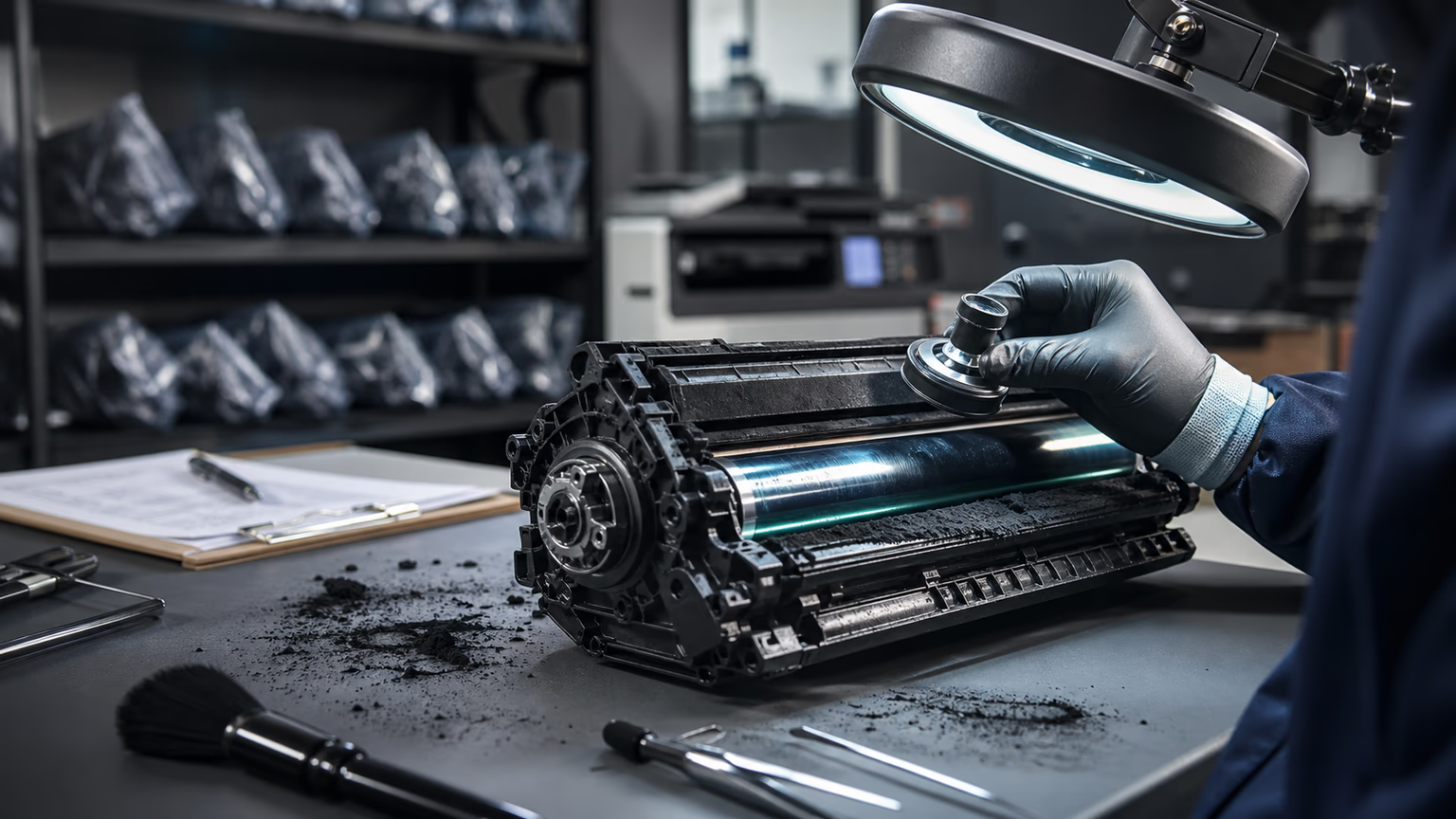
When a machine sits idle for days or weeks, the toner powder can settle and compact, leading to uneven flow and poor print quality.
Drum blades and developer rollers, which rely on regular rotation to stay lubricated, can develop flat spots or residue buildup.
The first print after a long pause often emerges with streaks, ghosting, or faded areas—defects that the end user immediately blames on the cartridge.
These issues are not simply cosmetic.
They trigger service calls, cartridge returns, and technician dispatches that erode profitability.
In a hybrid office, a single defective print can damage a client relationship, especially if it happens before a critical meeting.
Standardized toner testing usually assumes continuous high‑volume printing, which does not reflect real‑world hybrid conditions.
Distributors must seek out toners that have been validated for intermittent use, with stable performance across start‑stop cycles.
Cutting corners on toner quality to save a few cents per page can lead to multiplied costs in service and reputation damage.
Compatibility Landmines in a Shifting Fleet
Hybrid workers often shuffle devices between home and office, or companies may redeploy older printers to handle sporadic office days.
This fluid fleet creates a moving target for cartridge compatibility.
Printer manufacturers routinely issue firmware updates that can block aftermarket chips, sometimes without warning.
A cartridge that worked flawlessly on Monday may be rejected on Tuesday after an automatic overnight update.
For distributors holding thousands of these cartridges, the result is obsolete stock and frantic reordering.
Beyond firmware, the mechanical fit and performance with legacy printers introduces another layer of risk.
Older devices may have worn fusers or pick-up rollers that interact poorly with certain toner formulations, leading to jams or poor adhesion.
When a client reports a printer malfunction, the cause may be a compatibility mismatch rather than a faulty cartridge—yet the service provider absorbs the diagnostic cost.
Strong supplier partnerships include proactive notification of firmware changes and rigorous compatibility testing across the exact printer models in a client's fleet.
Without this, every shipment is a gamble.
Rethinking Procurement: From Volume Discounts to Adaptive Partnerships
The procurement playbook for profitable toner distribution must be rewritten.
For decades, the logic was simple: buy in bulk, get a lower unit price, and push inventory to clients.
Hybrid work breaks this equation.
Bulk purchases now carry disproportionate risk, as demand can vanish overnight.
What was once a smart hedge becomes a cash‑flow burden.
Forward‑thinking distributors are pivoting to flexible supply relationships that prioritize speed, data sharing, and shared risk over static volume commitments.
Vendor‑managed inventory (VMI) models offer a compelling alternative.
A supplier that monitors client usage data and automatically replenishes toner based on actual consumption eliminates the guesswork.
Shared‑risk agreements, where the supplier carries the inventory and bills only for what is used, realign incentives.
Additionally, evaluate a supplier’s ability to handle small, frequent shipments without apply surcharges.
Geographic proximity of distribution centers becomes a critical factor in reducing lead times and shipping costs.
The new mantra: partnership agility over bulk discount obsession.
Using Data to Predict the Unpredictable
Managed print service (MPS) data is the closest thing to a crystal ball in today's toner market.
Modern printers capture granular telemetry: page counts per device, toner level percentages, error logs, and even usage by time of day.
When aggregated across a client’s fleet, patterns emerge that enable smarter forecasting.
For example, you might discover that a particular department always ramps up printing in the last week of the quarter, regardless of in-office attendance.
Or that certain printer models have higher toner consumption per page when used intermittently.
Integrating this data into your ERP or inventory management system enables dynamic safety stock calculations.
Instead of setting a one‑size‑fits‑all reorder point, you can let the system adjust thresholds based on recent usage trends and seasonality.
The aim is not perfect prediction—that's impossible with erratic demand—but rather a responsive system that learns and adapts faster than a manual process.
Combine quantitative data with qualitative insights from account managers, and you build a demand‑sensing capability that distinguishes market leaders.
The Service Playbook for Hybrid Toner Support
Reducing toner‑related service calls is half operational efficiency and half client education.
Many end‑users simply don't know that leaving a printer dormant can cause quality issues.
Providing simple best practices—like storing spare cartridges in a cool, dry place and printing a test page weekly—can prevent a large portion of complaints.
Equally important is training your service desk to troubleshoot toner problems remotely, using guided checks before dispatching a technician.
Proactive replacement strategies reduce emergencies.
Set automated alerts when a printer’s page count approaches the toner yield threshold, and ship a replacement before the machine runs out.
This preemptive move eliminates the dreaded “out of toner” call and shows clients you’re on top of their needs.
Combine these with remote health monitoring that detects developing issues—like frequent paper jams or error codes—and your service operation shifts from firefighting to predictive maintenance, raising both client satisfaction and contract margins.
Future-Proofing Your Toner Supply Chain: A Checklist
The transition to a hybrid‑ready toner supply chain requires deliberate steps, not just intent. Below is a practical checklist to guide your team.
- Audit client print logs for the past 12 months to identify usage volatility patterns and outlier events.
- Conduct a service call analysis: what percentage of calls are toner‑related, and do they spike after low‑activity periods?
- Test your top‑selling toner SKUs in a controlled simulation that mimics hybrid on/off cycles, measuring print quality after idle periods.
- Review all supply contracts for volume flexibility; renegotiate terms to allow for consumption‑based billing and lower volume commitments.
- Interview at least three hybrid‑work clients about their printing pain points and satisfaction with current toner service.
- Evaluate toner suppliers against criteria including speed of small shipments, data integration capabilities, and proactive firmware update alerts.
- Implement remote monitoring alerts for toner levels and integrate them into your service dispatch workflow.
Each step addresses a specific weakness in the traditional model and builds the foundation for a resilient, profitable toner business in the era of hybrid work.
FAQ
How does hybrid work affect the average number of pages printed per employee?
While total office print volumes often decline, per‑employee averages become less meaningful. Instead, print demand clusters around collaborative spaces and specific tasks. Some employees may print nothing for weeks, while others print intensively during project sprints. The net effect is greater variability, not a simple drop.
Why are toner cartridges failing more frequently in hybrid offices?
Infrequent use leads to toner settling and component degradation inside the cartridge. Laser printer cartridges have moving parts and sensitive rollers that can dry out or seize when left idle. This results in print defects that mimic cartridge failure, often requiring replacement sooner than expected.
Should I switch from OEM to compatible toner to reduce costs in a hybrid environment?
Compatible toner can offer significant savings, but it demands rigorous testing for hybrid use.
How can I predict toner demand when office attendance changes weekly?
Leverage telemetry data from managed print devices. Track weekly page outputs per printer and per department, and use rolling averages to forecast near‑term needs. Couple this with qualitative input from your account managers about upcoming office events, and you’ll have a workable demand‑sensing system that adjusts faster than any fixed schedule.
What SLA changes should I propose to clients with hybrid work setups?
SLAs need to reflect the new reality.
Conclusion
Hybrid work is not a temporary blip but a structural change in how offices consume print.
For B2B distributors and service providers, the stakes are high: outdated supply models breed waste, service failures, and client churn.
By embracing data‑driven inventory, adaptive procurement, and a proactive service mindset, you can turn toner volatility from a threat into a competitive edge.
The future belongs to those who stop selling boxes and start managing print outcomes in a flexible, intelligent way.