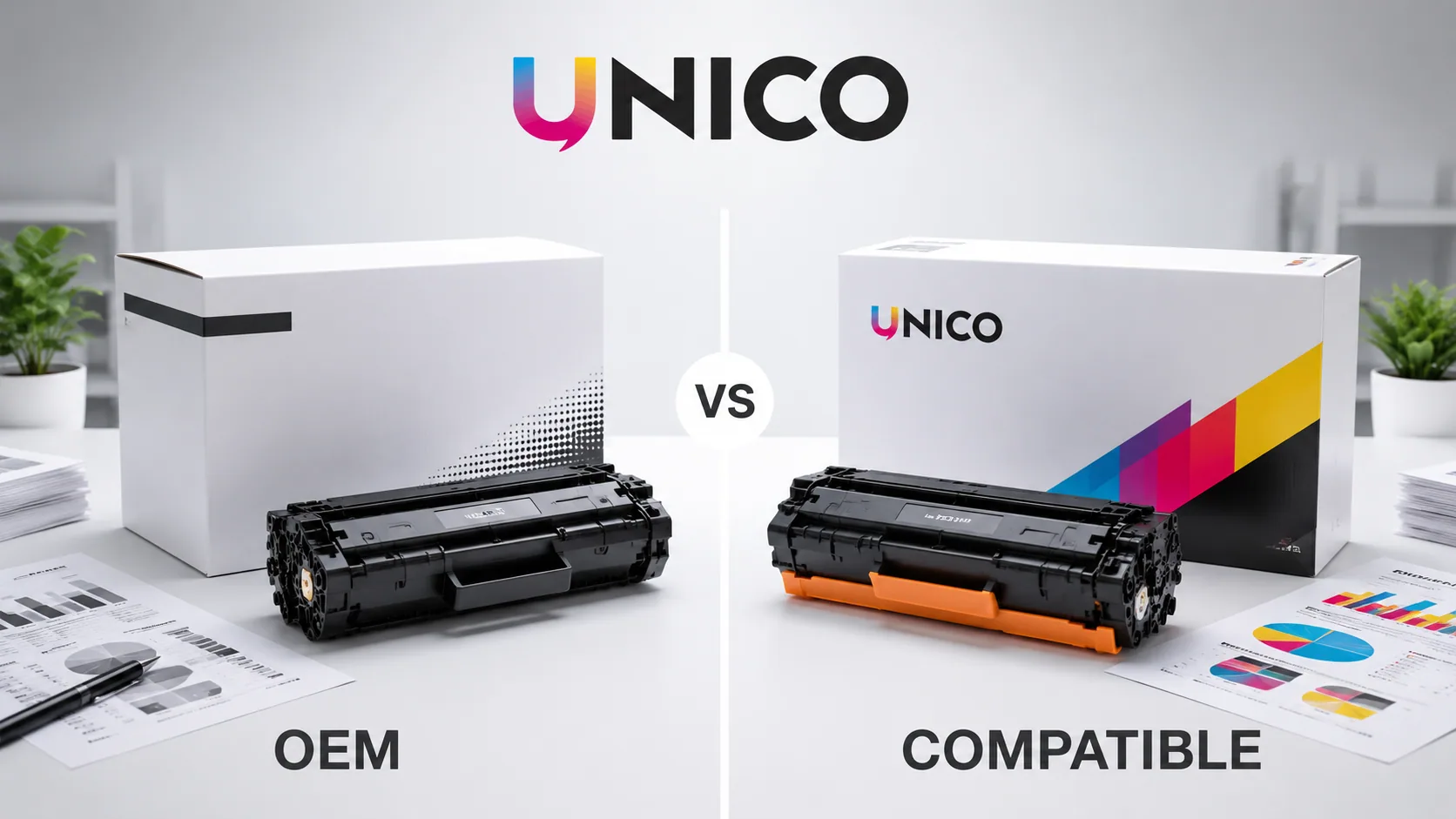
The debate around OEM and compatible toner usually starts with price. That is natural. OEM cartridges are often expensive, and buyers who manage a large printer fleet, a dealer network, or recurring office supply contracts quickly start looking for alternatives.
But in real B2B purchasing, price is only the beginning of the conversation.
A toner cartridge is not a decorative product on a shelf. It goes inside a machine, works under heat, pressure, electrical charge, paper dust, firmware rules, and customer expectations. If it works, nobody notices. If it fails, the complaint lands on the dealer, the service team, or the procurement manager.
That is why the question should not be “Is compatible toner cheaper than OEM?”
A better question is: where does compatible toner make sense, how should it be tested, and what risks must be controlled before scaling it across customers or fleets?
What OEM Toner Usually Gives You
OEM toner is supplied under the printer or copier manufacturer’s brand. It is designed for that machine platform, sold through official channels, and usually comes with the lowest decision risk for the end user.
For many companies, OEM toner feels like the safe option. The model number is clear. The packaging is familiar. The customer knows what they are buying. If a machine is under a strict service contract, or if the customer has internal rules requiring original supplies, OEM may be the only acceptable option.
That does not mean OEM is always the best commercial choice. It means it has a clear role.
OEM toner is usually strongest when:
- the customer refuses alternatives;
- the machine is under a sensitive warranty or service agreement;
- print volume is low and savings are not worth the qualification work;
- the buyer does not have time to test alternative products;
- the application is critical and risk tolerance is low.
In other words, OEM is often the simple answer. But simple does not always mean economical.
What Compatible Toner Must Prove
Compatible toner is produced by an independent manufacturer and designed to work with specific printer or copier models. A good compatible product is not just “a cheaper cartridge.” It has to match the machine’s practical requirements: fit, toner flow, fusing behavior, density, chip recognition, and expected yield.
This is where many buyers make a mistake. They compare OEM toner with the cheapest compatible cartridge they can find, test one or two pages, and then make a decision. That is not a proper evaluation.
A serious compatible toner program needs qualification. At minimum, the buyer should verify:
- whether the cartridge installs smoothly;
- whether the chip is recognized;
- whether density stays stable;
- whether gray background appears after longer use;
- whether fusing is clean;
- whether the cartridge leaks during shipping or printing;
- whether page yield is realistic;
- whether future batches are likely to perform the same way.
If you are building a purchasing strategy, not just buying one box, start with a proper toner procurement checklist before comparing prices.
Price Difference: Useful, but Dangerous Alone
Compatible toner is usually selected because it can lower cost per page. That is a valid reason. Distributors, dealers, and service companies need margin. Fleet operators need cost control. Procurement managers are often asked to reduce operating costs without reducing output.
Still, the cheapest cartridge can become the most expensive one if it creates field problems.
A few examples are familiar to anyone who has handled toner complaints:
- the first batch prints well, the second batch produces backgrounding;
- a cartridge works in one machine but is rejected after a firmware update;
- the printed page looks acceptable at first, but density drops too early;
- the cartridge leaks inside the box after long-distance shipping;
- the customer complains, and the dealer sends a replacement at their own cost.
That is why buyers should calculate more than unit price. They should look at cost per page and cartridge yield, complaint handling, return rates, and the time spent by service teams.
A cartridge that saves money on paper but creates service pressure is not really cheaper.
Print Quality Is Not One Test Page
A single test print is useful, but it does not tell the full story.
A better test includes text pages, grayscale blocks, charts, mixed graphics, and longer runs. For color products, it is important to test the full set: cyan, magenta, yellow, and black. One color may behave well while another creates balance problems.
When comparing OEM and compatible toner, look for practical signs:
- clean background;
- readable small text;
- stable black density;
- no ghosting;
- no streaks;
- no toner rub-off after fusing;
- no unusual noise during printing;
- no visible powder leakage;
- consistent output after multiple pages.
If the buyer is a distributor or service company, testing should also include installation and handling. A cartridge can print well but still be annoying to install, poorly sealed, or too fragile in shipping.
This is exactly why a factory audit or supplier review matters. Before placing repeated orders, buyers should understand how the manufacturer tests batches. A useful starting point is how to audit a compatible toner factory.
Chip and Firmware Risk
In older machines, compatible toner evaluation was often mostly about print quality. Today, chip compatibility can be just as important.
Modern printers and copiers may reject a cartridge if the chip is wrong, region-mismatched, outdated, or affected by firmware changes. This is one of the most frustrating problems for dealers because the cartridge may be physically correct and the toner may be fine, but the machine refuses it.
Before switching from OEM to compatible toner, ask:
- Does the cartridge need a chip?
- Which region does the chip support?
- Is the chip new, reused, reset, or replacement?
- What happens after a firmware update?
- Is there a known issue with this model series?
- How does the supplier handle chip complaints?
For high-volume B2B supply, this information should not be vague. “It should work” is not enough. You need a clear policy.
Page Yield: The Number on the Box Is Not the Whole Story
Page yield is another area where buyers need to slow down.
A cartridge may list a yield figure, but real-world yield depends on coverage, document type, print settings, machine condition, and user behavior. In office environments, actual coverage rarely matches a perfect standard test pattern.
If an OEM cartridge and a compatible cartridge both claim similar yield, that does not automatically mean they will perform the same in your fleet. The only useful answer comes from testing.
For large fleets, pay special attention to complaints like:
- cartridges running empty earlier than expected;
- inconsistent yield between batches;
- high variation between users or locations;
- customers replacing cartridges before actual end-of-life.
If this becomes a recurring issue, it affects trust quickly. A deeper guide to this problem is covered in low page yield in B2B fleets.
When OEM Is the Better Choice
There are situations where OEM is the right answer, even if compatible toner is cheaper.
OEM may be better when:
- the customer has strict procurement rules;
- the equipment contract requires OEM supplies;
- the print environment is mission-critical;
- the buyer cannot test properly;
- the machine model is new and compatible chip support is uncertain;
- the cost saving is too small to justify risk.
This is not a weakness. Good procurement is not about forcing compatible toner everywhere. It is about knowing where it makes sense and where it does not.
A mixed strategy is often more realistic than a full switch.
When Compatible Toner Is the Better Commercial Option
Compatible toner becomes attractive when print volume is high, margins matter, and the buyer has control over testing and supplier selection.
It can be especially useful for:
- distributors serving price-sensitive markets;
- copier service companies managing fleets;
- office supply dealers building recurring sales;
- private label programs;
- customers with many mature printer models;
- high-volume monochrome or office document printing.
In these cases, a qualified compatible product can reduce cost while maintaining acceptable performance. The word “qualified” matters. A random low-price product is not the same as a tested product from a stable manufacturer.
For buyers building a long-term supply program, the supplier matters as much as the cartridge. If you are still choosing manufacturing partners, review how to choose a compatible toner manufacturer before committing to volume orders.
A Practical Switching Process
Switching from OEM to compatible toner should be controlled. Do not change an entire fleet overnight.
A safer process looks like this:
- Choose a limited group of printer or copier models.
- Select compatible products from one or two qualified suppliers.
- Test installation, chip recognition, and print output.
- Run longer print tests, not just sample pages.
- Compare real yield and customer feedback.
- Start with a pilot order.
- Track complaints and replacement requests.
- Scale only after results are stable.
For dealers, it is also useful to document which compatible products are approved internally. This avoids a common problem: different managers buying different alternatives for the same model, creating inconsistent customer experience.
What Managers Should Track After Switching
The work does not end after the first order. Once compatible toner is used in real customer environments, track what happens.
Useful metrics include:
- complaint rate by model;
- complaint type;
- page yield feedback;
- chip recognition issues;
- return rate;
- replacement cost;
- customer repeat order rate;
- batch number linked to complaints.
This information helps you separate a product issue from a machine issue, installation issue, or customer expectation issue.
If a problem repeats across many machines, the product or batch may need review. If it happens only at one site, the cause may be machine condition, paper, humidity, or usage pattern.
Red Flags When Comparing Suppliers
A compatible toner supplier should not be judged only by the quotation sheet. Watch how they respond before the order.
Be careful if the supplier:
- cannot confirm compatible models clearly;
- avoids sample testing;
- gives unrealistic yield promises;
- has no batch traceability;
- cannot explain chip options;
- changes packaging often;
- gives unclear answers about complaints;
- pushes large orders before testing.
A good supplier does not need to sound perfect. In fact, the best suppliers usually explain limitations clearly. That is more useful than a perfect sales pitch.
The Best Answer Is Often Not “OEM or Compatible”
For many B2B buyers, the right answer is a policy.
For example:
- OEM for contract-sensitive customers;
- compatible toner for tested high-volume models;
- pilot testing before any new model rollout;
- approved supplier list;
- complaint tracking by batch;
- regular review of cost per page and return rates.
This gives the sales team confidence, the service team fewer surprises, and procurement a better way to defend cost savings.
The goal is not to prove that one category is always better. The goal is to buy intelligently.
FAQ
Is compatible toner always lower quality than OEM?
No. Quality depends on the manufacturer, formulation, components, chip solution, and batch control. A well-qualified compatible toner can work well in many B2B environments, but it must be tested.
Can compatible toner damage a printer?
A poor-quality cartridge can create leakage, fusing issues, contamination, or other problems. That is why sample testing and supplier qualification are important before large orders.
Should a company switch from OEM to compatible toner all at once?
Usually no. A controlled pilot test is safer. Start with selected models, measure performance, and scale only after results are stable.
What is the biggest risk with compatible toner?
For modern printers, chip and firmware compatibility can be a major risk. For copier cartridges, print quality, backgrounding, leakage, and batch consistency are also important.
How should buyers compare OEM and compatible toner?
Compare real cost per page, print quality, yield, chip behavior, complaint rate, packaging, supplier support, and repeat order consistency. Do not compare only unit price.
Work With UNICO on Compatible Toner Supply
Choosing between OEM and compatible toner is easier when buyers have the right product information, samples, and technical support. UNICO works with distributors, dealers, and B2B customers that need compatible toner and cartridge supply for international markets.
If you are reviewing compatible toner options, preparing a pilot test, or building a private label program, share your target printer models and purchasing requirements with the UNICO team. We can help match products, prepare samples, and support a practical sourcing plan.