Choosing a compatible toner manufacturer is not only a purchasing decision. For distributors, copier service companies, wholesale buyers, and managed print providers, it directly affects print quality, customer retention, warranty conversations, inventory planning, and margin stability.
A low unit price may look attractive at the first quotation stage, but the real cost of a toner supply program depends on consistency. If one batch prints well and the next creates backgrounding, poor density, chip errors, or complaints from end users, the buyer loses time, trust, and service capacity.
For that reason, professional B2B procurement should evaluate a compatible toner manufacturer through a structured process. The goal is not simply to find a supplier that can ship toner. The goal is to find a manufacturing partner that can support stable quality, predictable supply, clear communication, and long-term product development.
What a Compatible Toner Manufacturer Actually Provides
A compatible toner manufacturer produces toner, cartridges, or related imaging supplies designed for use in printer and copier systems without being an original equipment manufacturer. This means the product must be engineered to match the functional requirements of specific machines, including toner flow, fusing temperature, density behavior, cartridge fit, chip compatibility, and page yield expectations.
For B2B buyers, this creates a more complex sourcing process than buying a simple commodity. The product must perform inside a technical system. A toner that looks correct in packaging may still fail in real office use if the formulation, cartridge components, sealing, chip, or quality control process is not stable.
A strong manufacturer should be able to explain:
- which printer or copier models the product is designed for;
- what type of testing is performed before shipment;
- how batch consistency is controlled;
- how packaging protects the product during transport;
- how compatibility issues are handled;
- what support is available for private label or wholesale programs.
The best suppliers do not only sell products. They help reduce procurement risk.
Why Batch Consistency Matters More Than a Single Sample
Many buyers start with a sample order. This is a good first step, but it is not enough. A sample can prove that one product unit works, but it does not prove that future batches will remain stable.
For wholesale programs, batch consistency is critical. Distributors may supply hundreds or thousands of units over time. Copier service companies may install the same compatible cartridge across many customer sites. If the toner changes unexpectedly between batches, the buyer may face repeated complaints even if the first test was successful.
A reliable compatible toner manufacturer should have a system for controlling:
- toner particle behavior;
- density and backgrounding;
- fusing performance;
- cartridge sealing;
- chip or reset compatibility;
- packaging consistency;
- batch identification and traceability.
Batch traceability is especially important in B2B trade. If a problem appears in the field, the buyer needs to identify which production batch is affected, what changed, and how the issue will be resolved. Without traceability, every problem becomes harder and more expensive to investigate.
Evaluating Print Quality Before Placing Larger Orders
Print quality should be tested in conditions that are close to real customer use. A simple one-page sample print is not enough. A better evaluation includes text pages, grayscale areas, solid fills, mixed graphics, and longer print runs.
Buyers should check for:
- stable black density;
- clean background with no gray haze;
- sharp text edges;
- even toner transfer;
- smooth fusing without rubbing or smearing;
- consistent output after multiple pages;
- no excessive leakage or contamination;
- no unusual noise or cartridge fit issues.
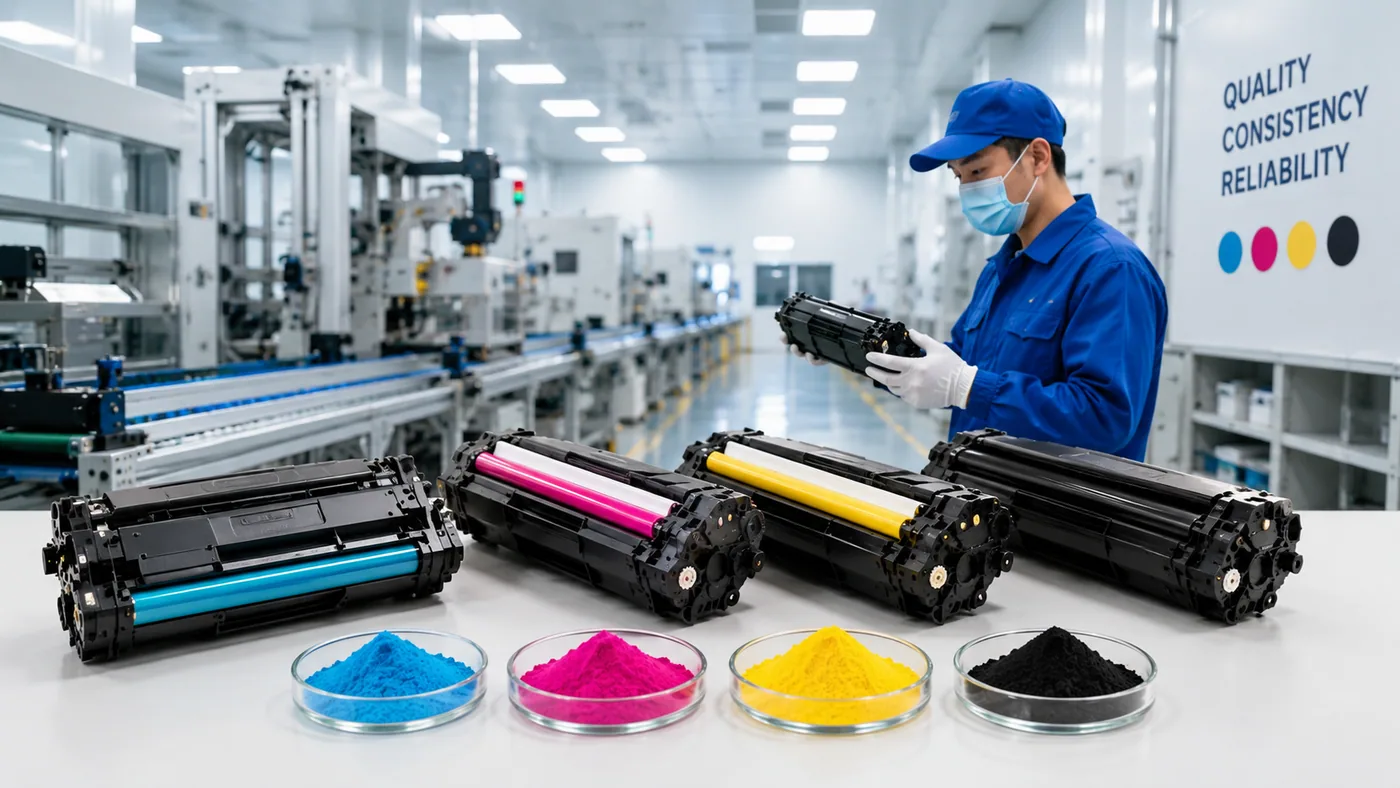
For color products, the evaluation should also include color balance, density control, and consistency across cyan, magenta, yellow, and black. Even if the buyer does not require photographic quality, office users expect stable color output for reports, presentations, and business documents.
A professional manufacturer should be prepared to provide product samples, technical guidance, and compatibility information before a large order. If a supplier cannot explain what has been tested, the buyer should be cautious.
Compatibility Is More Than the Cartridge Shape
A cartridge that physically fits a printer or copier is not automatically compatible. Compatibility includes several layers.
First, the cartridge must fit the machine mechanically. Second, the toner formulation must match the expected fusing and transfer behavior. Third, the chip or reset solution must work with the relevant firmware and regional machine version. Fourth, the expected page yield should be realistic for the application.
Chip compatibility is one of the most common sources of field problems. Firmware updates, regional SKU differences, and machine variations can all affect performance. A good compatible toner manufacturer should understand these risks and communicate clearly about chip policy, supported models, and known limitations.
For B2B buyers, it is also useful to ask whether the supplier can support regional differences. A product that works well in one market may not always perform the same way in another if machine versions, usage patterns, or environmental conditions differ.
Packaging and Logistics Are Part of Product Quality
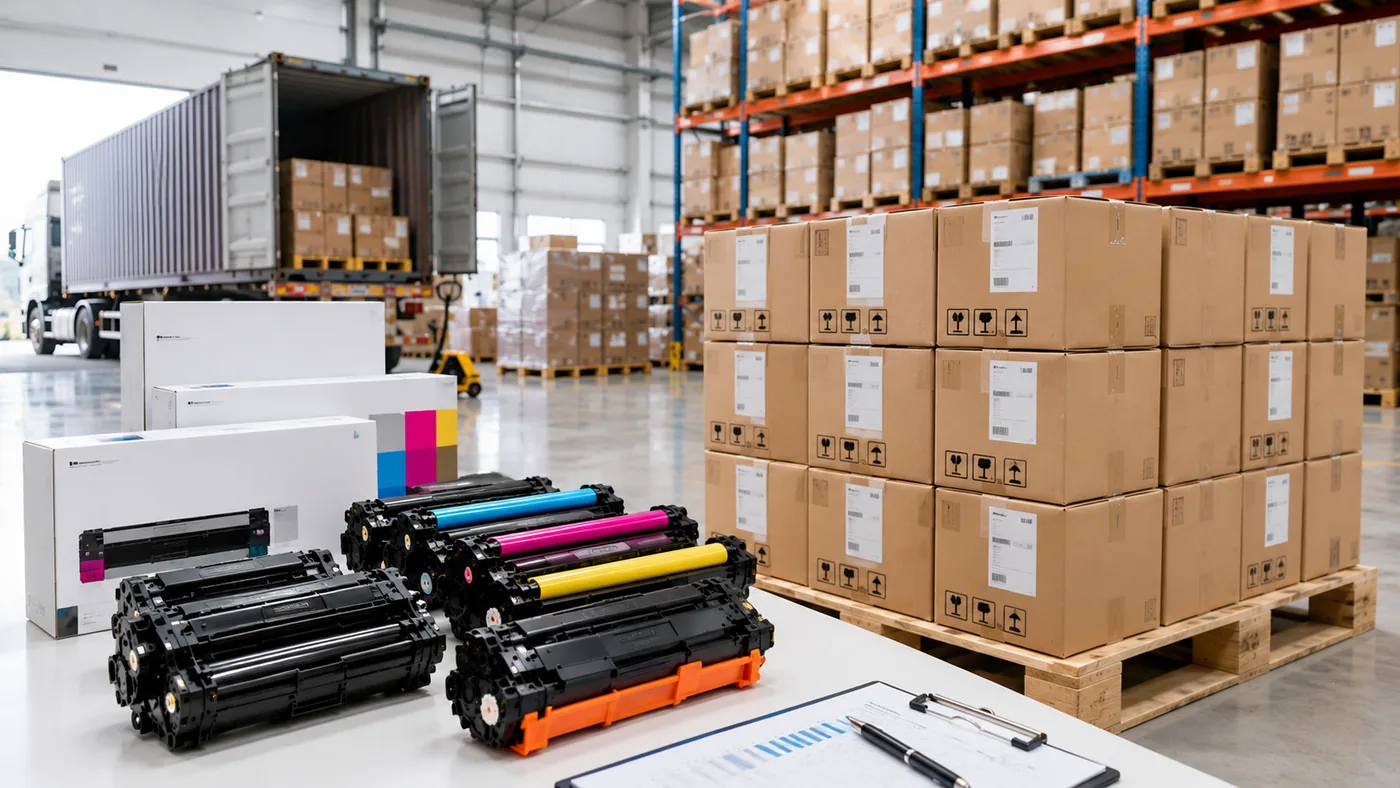
Packaging is often underestimated in toner procurement. Poor packaging can damage otherwise good products during transport. For international wholesale supply, cartons may experience compression, humidity, vibration, and long shipping routes.
A reliable manufacturer should use packaging that protects:
- cartridge housing;
- seals;
- chips;
- toner powder stability;
- printed labels and branding;
- outer cartons during palletized transport.
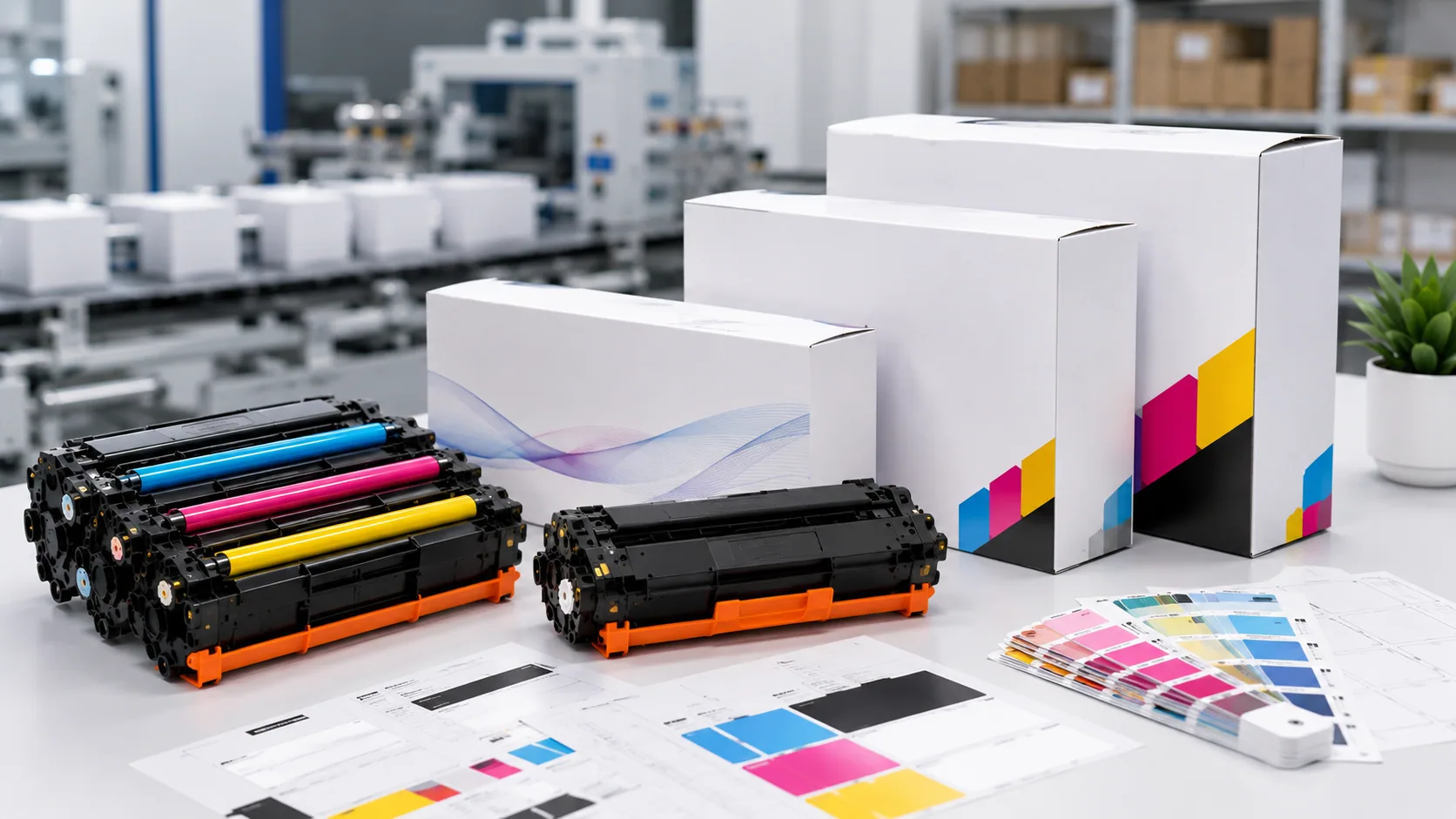
For private label programs, packaging also affects market perception. Clean design, correct model information, barcode control, and consistent labeling help distributors build trust with their customers. Packaging mistakes can create returns even when the product itself works correctly.
Buyers should review packaging samples before scaling an order. This is especially important if the product will be sold under a distributor’s own brand.
Private Label and Wholesale Requirements
Many B2B buyers do not only need products; they need a supply program. A compatible toner manufacturer should be able to support wholesale requirements such as MOQ planning, repeat orders, product documentation, labeling, carton design, and shipment coordination.
For private label buyers, important questions include:
- Can the manufacturer support custom labels and packaging?
- Are product codes and model references consistent?
- Can the supplier handle mixed orders across brands and models?
- How are color variants managed?
- Can the supplier provide product images or catalog data?
- Is there a process for sample approval before bulk production?
Private label is not only about adding a logo. It requires operational discipline. The same product must appear consistently in packaging, catalog listings, invoices, and shipment documentation.
If a buyer plans to build a long-term brand, the manufacturer must be able to support that brand with repeatable quality and stable supply.
Supplier Communication and Technical Support
Good communication is a practical requirement in international B2B supply. When a buyer sends a model list, requests compatibility confirmation, or reports a quality issue, the manufacturer should respond with clear and specific information.
Weak communication usually becomes more expensive later. If the supplier cannot clarify product differences, chip options, supported models, or order details before payment, they are unlikely to provide strong support after delivery.
A professional compatible toner manufacturer should be able to discuss:
- model compatibility;
- OEM reference alternatives;
- toner or cartridge type;
- yield expectations;
- packaging options;
- sample testing;
- delivery timeline;
- issue resolution process.
For distributors and service companies, speed matters. When a customer reports a printing issue, the supplier should be able to help identify whether the cause is toner, cartridge, chip, machine condition, or incorrect product selection.
Price Should Be Evaluated Together With Risk
Price matters in wholesale procurement, but it should never be evaluated alone. A very low price can hide problems in formulation, components, packaging, or quality inspection. If the product causes returns, service visits, or lost customers, the final cost may be higher than a more stable product.
A better purchasing approach is to compare price with:
- tested print quality;
- complaint rate history, if available;
- batch consistency;
- chip reliability;
- packaging quality;
- communication quality;
- delivery reliability;
- after-sales support.
For many B2B buyers, the best supplier is not always the cheapest. It is the one that helps protect customer relationships while keeping margins sustainable.
When to Request a Sample or Trial Order
A sample is useful before placing a larger order, especially for a new model, new color series, or new supplier relationship. However, the sample should be tested carefully.
Before approving a bulk order, buyers should test:
- the target printer or copier model;
- normal office documents;
- high-density pages;
- longer continuous printing;
- cartridge installation and removal;
- chip recognition;
- packaging condition after shipping.
For color products, it is better to test the complete set rather than only one color. Cyan, magenta, yellow, and black may behave differently, and color consistency is important for customer satisfaction.
After the sample test, a trial order can help verify logistics, packaging, and batch consistency at a small commercial scale.
Building a Long-Term Manufacturer Relationship
For distributors and procurement teams, the strongest results usually come from stable supplier relationships. A manufacturer that understands the buyer’s market, product range, packaging preferences, and quality expectations can support growth more effectively than a supplier used only for occasional spot orders.
Long-term cooperation can improve:
- product planning;
- inventory forecasting;
- packaging consistency;
- technical communication;
- private label development;
- response speed when issues appear;
- stability of supply during demand changes.
The right compatible toner manufacturer should be viewed as part of the buyer’s supply chain, not just as a price list.
Practical Checklist for B2B Buyers
Before selecting a compatible toner manufacturer, buyers should verify:
- product compatibility for target printer and copier models;
- sample test results under realistic conditions;
- print density and background control;
- chip and firmware compatibility;
- batch traceability;
- packaging strength and label accuracy;
- MOQ and repeat order process;
- private label options;
- communication speed;
- after-sales support process.
If a supplier performs well across these areas, the buyer can move forward with more confidence.
FAQ
What is a compatible toner manufacturer?
A compatible toner manufacturer produces toner, cartridges, or related imaging supplies designed for use in specific printer and copier systems without being the original equipment manufacturer.
How should B2B buyers test compatible toner?
Buyers should test print density, backgrounding, fusing, page consistency, chip recognition, cartridge fit, and packaging condition. Color products should be tested as a full set when possible.
Is the lowest price always the best option?
No. B2B buyers should compare price with quality stability, batch consistency, packaging, chip reliability, delivery performance, and after-sales support.
Why is batch consistency important?
Batch consistency helps distributors and service companies reduce returns, complaints, and unexpected print quality differences across repeat orders.
When should a buyer request a sample?
A sample should be requested before a larger order, especially when working with a new manufacturer, testing a new model, or preparing a private label program.
Work With UNICO on Compatible Toner Supply
For distributors, copier service companies, and wholesale buyers, compatible toner sourcing should be based on quality control, compatibility, and stable communication. UNICO supports B2B customers with compatible toner and cartridge supply for international markets, including product selection, model matching, and wholesale cooperation.
To discuss product availability, compatibility, samples, or private label supply, contact the UNICO team with your target printer models and expected order requirements.