
Toner cartridges are strategically chosen for modern office printing due to their efficiency and cost-effectiveness. They support high-volume output with consistent quality, reducing operational disruptions and waste. With cartridges yielding over 2,000 pages, they lower replacement frequency and costs, contributing to overall savings. Additionally, their superior print security and compatibility with various paper types enhance resource management. This analysis suggests there are further insights into optimizing office printing supplies for enhanced productivity and sustainability.
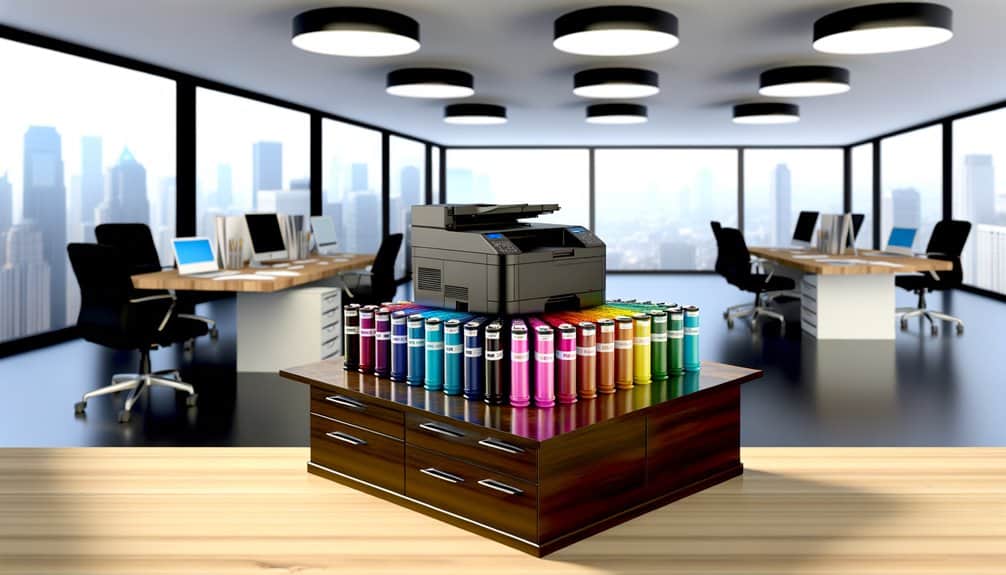
While many businesses may prioritize upfront costs when selecting printing supplies, an all-encompassing evaluation of long-term efficiency reveals that the choice between ink and toner can substantially impact overall operational productivity.
The integration of toner cartridges in office environments enhances color management and guarantees consistent print quality, which is crucial for professional presentations. Additionally, toner’s superior print security mitigates risks associated with sensitive documents.
Effective paper handling practices, facilitated by toner technology, reduce downtime caused by frequent cartridge changes. Moreover, user training is essential in maximizing the benefits of toner systems, ensuring employees are adept in optimizing device integration.
Effective paper handling and comprehensive user training are key to optimizing toner systems and minimizing downtime in the office.
Collectively, these factors underscore the strategic advantage of selecting toner over ink for sustained office efficiency.
In office environments, core printing needs are characterized by high-volume output and the requirement for devices that can accommodate multiple users efficiently.
Cost control is essential, as organizations seek solutions that balance performance with budget constraints.
Understanding these factors is critical for selecting the right printing technology to enhance productivity and minimize expenses.
For offices that operate with high volume printing demands, achieving consistent output is vital for maintaining productivity and efficiency. Toner cartridges excel in this environment due to their superior performance across several key factors:
This combination of attributes positions toner cartridges as the ideal choice for meeting the rigorous demands of modern office printing.
Effective office environments often rely on multi-user shared devices to streamline printing processes and enhance workflow efficiency. These devices, typically laser printers, cater to diverse printing needs, ensuring high print resolution and exceptional color management for various document types.
The significance of cartridge compatibility cannot be overstated, as utilizing the correct toner cartridges minimizes maintenance challenges and enhances reliability. Additionally, integrating ink cartridge recycling programs supports sustainability efforts, reducing waste associated with traditional ink cartridges.
Regular printer maintenance is essential to optimize performance, especially in high-traffic settings. Overall, multi-user shared devices foster a collaborative atmosphere, enabling seamless document sharing while maintaining cost-effectiveness and superior print quality, vital for modern office operations.
Cost control in office printing environments is essential for maintaining budget efficiency and optimizing operational productivity. Organizations can achieve significant savings and enhance sustainability through strategic choices in printing technology and practices.
Key considerations include:
Incorporating these elements fosters a more cost-effective and eco-conscious printing strategy.
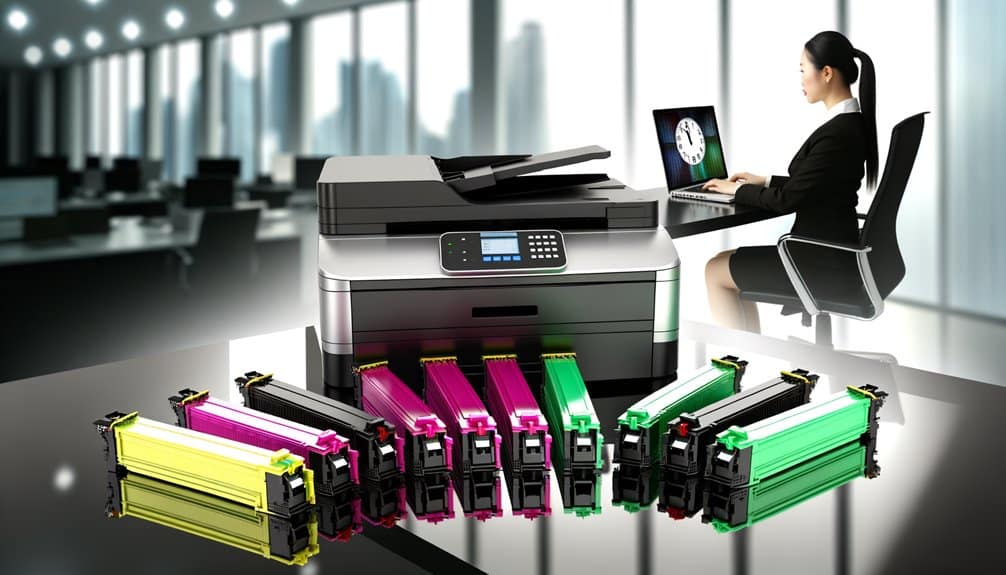
Toner cartridges offer several advantages that enhance their appeal for office use. These include high-speed bulk printing capabilities, a longer lifespan that reduces maintenance frequency, and consistent print quality.
Additionally, their lower Total Cost of Ownership (TCO) and flexible storage options make toner an efficient choice for business environments.
While many businesses seek efficient solutions for their printing needs, the advantages of toner cartridges in high-speed bulk printing cannot be overlooked. Toner cartridges facilitate seamless operations, ensuring that workflow interruptions are minimized. Their capabilities are particularly advantageous in high-volume environments where reliability is vital.
These features collectively enhance productivity, making toner cartridges a strategic choice for offices focused on efficiency and quality.
In high-volume printing environments, the longevity and reduced maintenance needs of toner cartridges present a significant advantage for office operations. Unlike ink cartridges that have limited shelf life and require frequent replacements due to ink drying time issues, toner cartridges can last over 2,000 pages, minimizing the need for regular refills.
This extended lifespan ensures higher cartridge compatibility and less disruption to workflows. Additionally, toner cartridges maintain consistent color accuracy and print resolution, vital for professional documents.
The reduced frequency of maintenance not only enhances productivity but also decreases operational costs, as fewer interventions are necessary to replace or troubleshoot cartridges. Overall, toner cartridges are a strategic choice for organizations prioritizing efficiency and reliability in their printing processes.
How does the use of toner cartridges contribute to achieving consistent, professional-grade print quality in office settings? Toner cartridges excel in maintaining high color accuracy and optimal print resolution, essential for professional documents. Their compatibility with advanced color management systems enhances output consistency, ensuring that colors appear as intended across various media.
Unlike ink, toner eliminates concerns related to ink drying time, allowing for immediate handling of prints without smudging. This reliability considerably boosts productivity in high-volume environments.
Key advantages include:
Achieving professional-grade print quality with toner cartridges is just one aspect of their advantages; they also contribute substantially to lowering the Total Cost of Ownership (TCO) for businesses over time.
Toner cartridges typically yield over 2,000 pages, markedly reducing the frequency of replacements compared to ink cartridges. This longevity not only supports eco-friendly practices by minimizing waste but also aligns with stringent environmental regulations.
Additionally, businesses benefit from cartridge refill options that further decrease costs. Effective color management and printer calibration enhance resource efficiency, ensuring high-quality prints without excessive consumption.
Ultimately, the lower cost per page associated with toner cartridges allows organizations to allocate resources more effectively, optimizing overall operational efficiency.
Toner cartridges offer significant advantages for office printing, particularly in their flexible storage capabilities without environmental concerns. These cartridges maintain their performance and quality over extended periods, enabling organizations to optimize inventory while minimizing waste.
This combination of attributes underscores the practicality of toner cartridges in modern office environments, addressing both operational efficiency and environmental impact.
In evaluating office printing needs, organizations must determine the ideal timing for shifting from ink to toner, particularly when evaluating long-term cost efficiency.
An analysis of the return on investment (ROI) from upgrading to toner-based systems can reveal significant savings and enhanced productivity over time.
These considerations are essential for informed procurement decisions that align with both budgetary constraints and operational demands.
When evaluating the shift from ink to toner for office printing needs, several key factors must be considered. Organizations should assess their current and future printing requirements to determine the most effective changeover.
Incorporating these considerations can lead to cost savings through reduced cartridge refilling and improved productivity, making toner a strategic choice for modern office environments.
Evaluating the return on investment (ROI) for an upgrade in office printing technology requires a thorough analysis of both quantitative and qualitative factors. Key considerations include print resolution, which impacts the clarity of documents, and paper compatibility, ensuring that existing supplies are utilized effectively.
Additionally, examining the ink drying time of current printers versus toner can reveal efficiency gains in high-volume environments. Color matching capabilities are vital for businesses that require consistent branding.
Moreover, the longevity of cartridge storage should be examined, as toner cartridges typically offer indefinite shelf life, reducing waste and replacement frequency. A comprehensive evaluation of these elements will facilitate informed decision-making regarding printing technology upgrades.
Toner cartridges considerably reduce maintenance costs by extending cartridge lifespan, minimizing the frequency of replacements, and lowering repair expenses. This results in decreased downtime and overall cost reduction, enhancing operational efficiency in printing environments.
The environmental impact of toner versus ink cartridges reveals complexities. While recycling programs exist, toner often utilizes eco-friendly materials, promoting waste reduction and sustainable practices, ultimately leading to a lower carbon footprint compared to traditional ink cartridges.
Toner cartridges can be refilled or reused, enhancing sustainability. Recycling toner and using remanufactured cartridges extend toner cartridge lifespan, while proper used toner disposal guarantees environmental responsibility, ultimately reducing waste in office printing practices.
Toner cartridges substantially enhance print quality over time, ensuring print longevity, color consistency, and image sharpness. They minimize toner wear and fading prevention, resulting in superior, sustained output ideal for professional environments.
Storing toner cartridges requires stringent storage guidelines, emphasizing temperature control and sealing techniques. Effective inventory management guarantees ideal shelf life, preventing degradation and maintaining performance. Proper practices enhance reliability and efficiency for high-volume printing needs.
In conclusion, as businesses navigate the complexities of modern operations, the choice between ink and toner cartridges becomes a pivotal decision. With toner cartridges offering unparalleled durability, cost-effectiveness, and quality, they emerge not merely as a preference but as a necessity for efficiency-driven workplaces. Ultimately, opting for toner is akin to choosing a sturdy vessel in turbulent waters, ensuring that organizations can sail smoothly through the demands of high-volume printing while minimizing waste and expense.