
Toner cartridges greatly influence print quality and performance. High-quality toner guarantees sharpness, clarity, and accurate color reproduction. Compatibility with the printer model is essential for peak efficiency and page yield. Additionally, environmental factors, such as humidity and temperature, affect toner longevity. Regular maintenance is imperative to prevent performance issues, such as smudges and streaks. Understanding these variables allows users to maximize output and reduce costs. Exploring the intricate details further reveals additional strategies for improved printing efficiency.
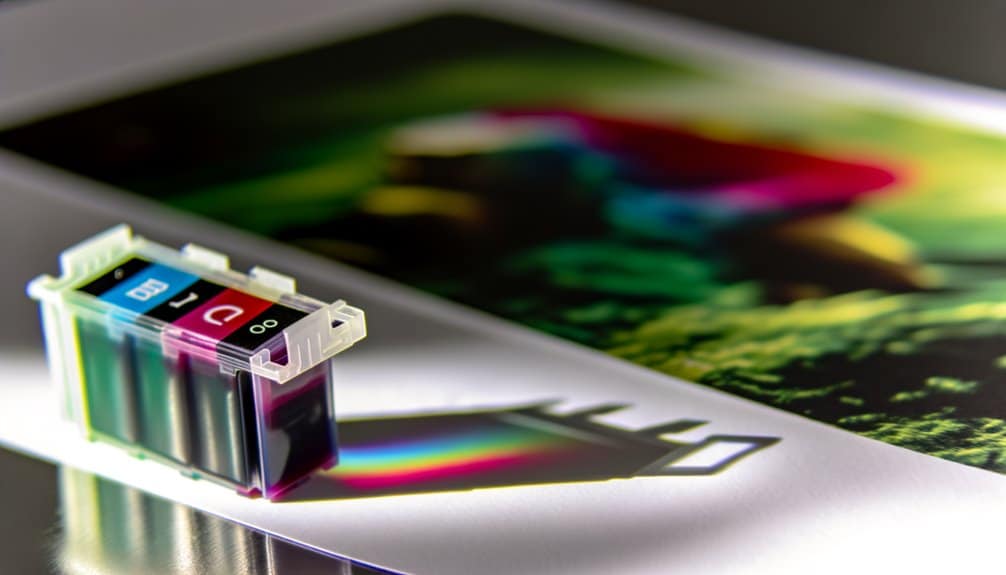
In the domain of printing technology, understanding the distinction between toner cartridges and ink cartridges is vital, as it directly influences the quality and efficiency of print outputs.
Toner cartridges, utilized in laser printers, employ a powder-based medium, offering superior longevity compared to liquid ink cartridges used in inkjet models. This longevity is greatly enhanced through effective toner longevity strategies, including ideal cartridge storage tips.
Toner cartridges in laser printers provide enhanced durability over ink cartridges, benefiting from optimal storage practices for extended lifespan.
Additionally, maneuvering through prevalent print quality myths is important, as misconceptions can lead to less-than-ideal performance.
The choice between laser and inkjet technologies further impacts sustainability in printing practices. A thorough grasp of these elements empowers users to maximize print quality while minimizing environmental impact, fostering informed decisions in cartridge selection and usage.
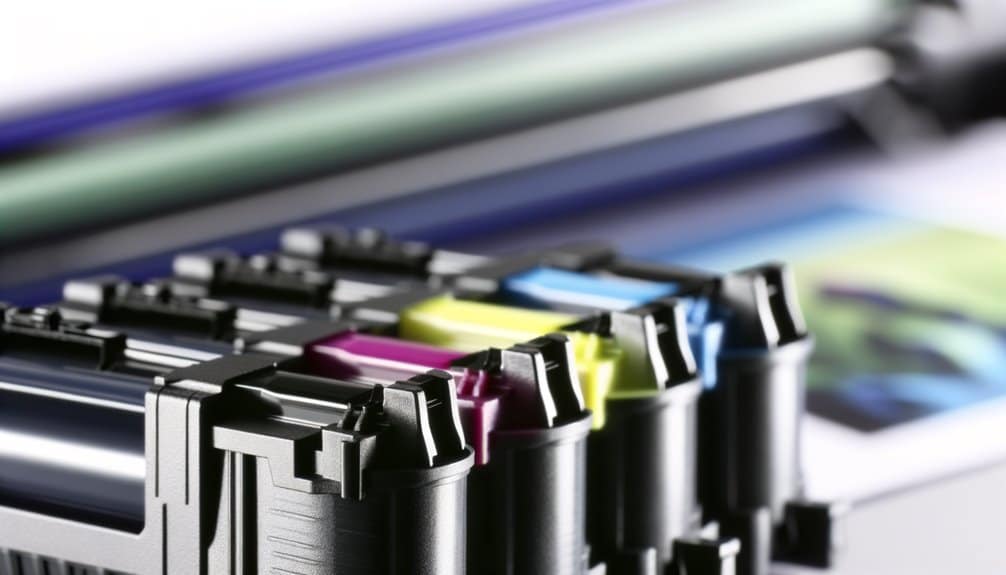
Toner cartridges serve as essential components in laser printing technology, containing finely powdered toner that is fused onto paper to create high-quality text and images. Various toner cartridge types cater to specific printer models, emphasizing the importance of toner cartridge compatibility. Proper toner cartridge storage is vital, as environmental factors can affect toner quality and performance. Innovations in toner cartridges have introduced high-capacity options that extend toner cartridge lifespan and enhance print efficiency. The following table summarizes key aspects of toner cartridges:
| Feature | Importance | Considerations |
|---|---|---|
| Toner Cartridge Types | Defines compatibility | Align with printer specifications |
| Toner Cartridge Storage | Affects longevity | Store in a cool, dry environment |
| Toner Cartridge Innovations | Enhances performance | Explore latest technologies |
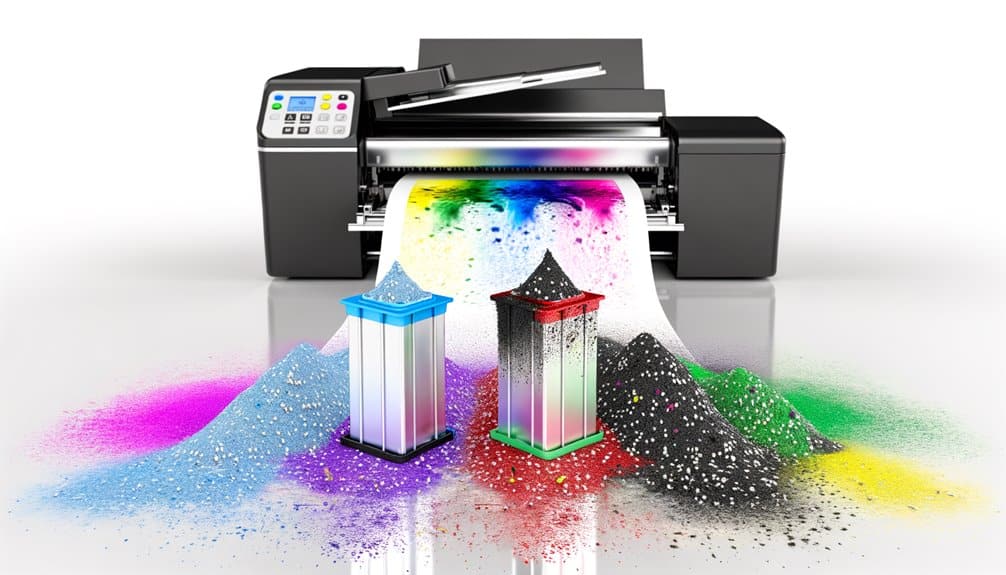
The quality of toner directly influences print sharpness, clarity, and overall output consistency.
High-quality toner guarantees accurate color reproduction while maintaining efficiency in page yield, ultimately leading to reduced operating costs.
In contrast, inferior toner can compromise print integrity, resulting in blurred images and inconsistent color fidelity.
While various factors influence print quality, the caliber of toner used plays a vital role in determining print sharpness and clarity. High-quality toner guarantees ideal print resolution, yielding crisp, defined images and text. Conversely, low-quality toner may result in blurred lines and uneven textures, undermining overall performance.
Impact factors such as paper choice and printer settings further complicate the equation, as they interact with toner quality. Effective color management techniques can enhance visual fidelity, but they hinge on superior toner characteristics.
Regular maintenance practices are necessary to sustain toner functionality, assuring consistent output across various printing technologies. A thorough understanding of these elements is fundamental for those seeking mastery in achieving exceptional print sharpness and clarity.
Achieving ideal color accuracy and consistency in printed materials hinges greatly on the quality of the toner used. High-quality toner facilitates precise color calibration techniques, ensuring that colors rendered on paper closely match those intended by the designer.
The selection of appropriate print media options further enhances this process, as different surfaces interact uniquely with toner. Effective color management software and monitor profiling methods are essential for translating digital color specifications into printed outputs, but their effectiveness is largely contingent upon the toner’s color fidelity.
Furthermore, ink formulation advancements contribute to the vibrancy and consistency of colors produced. Consequently, the interplay of these factors underscores the critical role of toner quality in achieving superior print results.
Effective page yield and efficiency in printing are greatly influenced by the quality of the toner used. High-quality toners typically offer superior page yield, reducing the frequency of cartridge replacements and enhancing cost efficiency.
This efficiency is essential for businesses with high printing frequency, as it directly correlates to operational costs. Additionally, proper toner maintenance, including regular checks and adherence to manufacturer guidelines, guarantees peak performance and longevity of the cartridge.
Compatibility between the toner cartridge and the printer model also plays a significant role; mismatched cartridges can lead to wasted resources and diminished print quality.
Ultimately, selecting the right toner is vital for maximizing page yield while maintaining budgetary constraints.
Print settings and usage behaviors greatly influence toner cartridge performance, impacting both longevity and output quality.
Adjustments such as selecting draft, normal, or high-resolution modes directly affect toner consumption and print clarity, while enabling toner save mode can conserve resources at the expense of detail.
Additionally, the choice between duplex and simplex printing, along with print density adjustments, further complicates the balance between achieving desired print results and maintaining cartridge efficiency.
Various print quality settings—draft, normal, and high resolution—significantly influence toner cartridge performance and longevity.
Draft mode, designed for high-speed printing, utilizes less toner, thereby extending the toner cartridge lifespan but may compromise clarity. Normal quality offers a balanced approach, ensuring acceptable print quality suitable for everyday documents.
In contrast, high-resolution settings demand greater toner consumption, enhancing detail but reducing cartridge longevity and increasing operational costs. Print speed variations are evident across quality settings, with draft mode achieving the fastest output.
Adopting maintenance best practices, such as regularly evaluating print quality needs and optimizing settings, leads to effective cost-saving strategies, ensuring efficient usage of toner while maintaining satisfactory print results.
While toner save mode can markedly reduce toner consumption, its implications for print quality and overall performance warrant careful consideration. The toner save features enhance cartridge usage, resulting in long-term savings; however, this comes with print quality trade-offs.
Users often experience lighter prints and diminished text sharpness, which may not meet professional standards. The impact of user behavior is significant, as frequent reliance on this mode can lead to subpar output for critical documents.
Additionally, maintenance practices must be adjusted, as reduced toner output may affect printhead performance and longevity. Ultimately, balancing toner save mode utilization with print quality requirements is essential for maintaining peak performance in various printing contexts.
Toner usage is markedly influenced by the choice between duplex (double-sided) and simplex (single-sided) printing methods. Duplex printing generally enhances toner efficiency by reducing total paper consumption, thereby extending cartridge life. However, it may impact print speed due to the additional processing required for double-sided output. Conversely, simplex printing typically allows faster print speeds, but at the cost of higher paper usage and potentially increased toner consumption per printed page. The choice of method greatly affects paper handling logistics as well.
| Printing Method | Toner Efficiency | Print Speed |
|---|---|---|
| Duplex | Higher | Moderate |
| Simplex | Lower | Faster |
Adjusting print density settings plays an essential role in optimizing cartridge performance and longevity.
Print density adjustments directly affect the amount of toner applied to each page, influencing both image quality factors and overall cost efficiency. By employing toner calibration techniques, users can fine-tune print resolution settings to achieve desired output while minimizing toner consumption.
High-density settings yield sharper images but may deplete cartridges more rapidly, whereas lower densities extend cartridge life at the cost of print quality. Balancing these adjustments is vital for effective cartridge performance optimization, ensuring that users achieve professional results without compromising sustainability.
Mastery of print density adjustments ultimately leads to more economical and high-quality printing outcomes.
The choice between compatible and OEM toner presents significant implications for print quality and cost efficiency.
While compatible toner offers advantages regarding affordability and accessibility, it also carries the risk of inferior performance, potentially compromising print quality and printer integrity.
Conversely, OEM toner, though typically more expensive, is often essential for business-critical applications where reliability and high-quality output are paramount.
Numerous benefits arise from utilizing compatible toner cartridges, particularly regarding cost-effectiveness and accessibility.
Cost savings are a primary advantage, as compatible toners generally come at a lower price point than OEM alternatives, reducing overall printing expenses.
Toner availability is another key factor; compatible options are often more readily accessible, allowing users to avoid delays associated with OEM shortages.
Performance consistency is frequently reported by users who find that compatible toners deliver reliable print quality comparable to that of established brands.
In addition, many manufacturers of compatible toners have garnered positive user experiences, enhancing brand reliability.
Consequently, businesses and individuals can leverage these benefits to optimize their printing operations without compromising on quality.
While compatible toner cartridges can offer cost savings and accessibility, the risks associated with poor-quality options must not be overlooked.
The proliferation of counterfeit cartridges introduces significant performance degradation factors that can compromise print quality. Inconsistent toner formulation may lead to issues such as smudged prints and decreased longevity of compatible options.
Moreover, customer satisfaction ratings for low-quality cartridges often reflect a lack of reliability, adversely affecting brand reputation impacts. Users may experience frequent cartridge failures, resulting in increased operational costs due to additional replacements.
Ultimately, while the initial savings may be appealing, the long-term repercussions of using inferior toner must be carefully considered to avoid detrimental effects on both print quality and printer health.
Considering the drawbacks of poor-quality compatible toner cartridges, it becomes important to evaluate scenarios where their use may be justified, particularly in home or light-use environments.
In such contexts, compatible toner benefits manifest prominently through a cost savings analysis, allowing consumers to access affordable printing solutions without significant print volume demands.
Performance comparisons reveal that while OEM toners may excel in high-stakes environments, compatible options can still yield satisfactory results for everyday documents.
Consumer experiences often indicate a trade-off between brand reputation factors and cost efficiency, with many users reporting adequate satisfaction with reputable compatible brands.
Consequently, in non-critical settings, the strategic selection of compatible toner can provide a viable solution for budget-conscious consumers.
When evaluating the suitability of toner cartridges for business-critical printing, the distinction between original equipment manufacturer (OEM) toners and compatible alternatives becomes essential.
OEM advantages include enhanced printer reliability, which is vital for maintaining business continuity. The use of OEM toners guarantees quality assurance, yielding consistent print quality that aligns with professional standards.
In environments where print quality directly impacts client perception and operational efficiency, the cost justification for selecting OEM rather than compatible toners becomes clear.
While compatible options may offer lower upfront costs, the risk of compromised quality and potential printer malfunctions can lead to higher long-term expenses.
Consequently, businesses prioritizing print integrity should adhere to OEM toners for peak performance and reliability.
In evaluating the performance of toner cartridges, several factors beyond toner quality must be considered.
Paper type and its coating greatly influence toner consumption and print output, while printer model compatibility can affect overall efficiency.
Additionally, environmental conditions such as humidity and temperature, alongside user habits like frequent start-stop cycles or prolonged idle times, play essential roles in determining print quality and cartridge longevity.
The choice of paper type and its coating greatly influences the performance of toner cartridges, impacting both print quality and cartridge longevity.
Different paper textures and finish options, such as glossy, matte, or uncoated, affect ink absorption rates, altering the interaction between toner and print media. Coating types, including those designed for high-quality images, can necessitate a greater toner application, thereby depleting cartridges more rapidly.
Conversely, standard uncoated paper typically requires less toner, enhancing cartridge lifespan. Understanding these dynamics is vital for optimizing print outputs; selecting appropriate paper guarantees that the toner adheres correctly while maintaining vibrancy and detail in printed materials.
Consequently, paper selection plays an integral role in achieving the desired print performance.
Selecting the appropriate paper type is just one aspect that influences the overall performance of printer cartridges.
Printer model compatibility is critical; using cartridges designed for specific printer brands guarantees ideal functioning and prevents damage.
Variations in toner storage conditions can also greatly impact performance; cartridges stored improperly may degrade before their expiration dates, leading to subpar print quality.
In addition, printing frequency plays a role; infrequent use can cause toner settling and clumping, necessitating maintenance to guarantee consistent output.
Adhering to toner maintenance tips, such as regular cleaning and checks, can additionally enhance performance.
Ultimately, understanding these factors enables users to maximize the efficiency and longevity of their toner cartridges, guaranteeing superior print results.
Although toner quality is essential for ideal print performance, environmental factors such as humidity and temperature greatly influence the efficacy of toner cartridges.
Humidity effects can lead to moisture absorption in toner, resulting in clumping and inconsistent print quality. Temperature control is critical; extreme heat can alter toner properties, impacting its ability to fuse properly onto paper.
Effective environmental monitoring is essential to mitigate these climate impacts, ensuring superior printing conditions. Key considerations include:
Frequent start-stop printer usage and prolonged idle times greatly impact overall printer performance and toner efficiency.
These usage patterns can result in inconsistent toner melting and application, leading to diminished print quality. Idle time effects compound this issue, as toner can settle or clump, necessitating frequent maintenance to maintain ideal performance.
The cyclical nature of start-stop printing can strain mechanical components, further influencing productivity impact by increasing downtime.
Additionally, printers that experience long periods without use may face issues such as dried toner in the cartridge, adversely affecting future print jobs.
Understanding these dynamics is vital for users aiming to maximize the longevity and effectiveness of their toner cartridges while ensuring high-quality outputs.
In the domain of toner cartridges, the initial purchase price can be misleading, as low-quality options often lead to hidden costs through increased maintenance and printer damage.
Investing in high-quality toner not only enhances print output but also contributes to a lower Total Cost of Ownership (TCO) by reducing the frequency of replacements and service interventions.
Analyzing the long-term implications of toner choices is essential for optimizing both budget and print performance.
While it may seem economical to opt for low-quality toner cartridges, the hidden costs associated with their use can considerably outweigh the initial savings. Such cartridges often compromise toner longevity and diminish print productivity, leading to frequent replacements and increased maintenance practices.
The implications include:
Investing in high-quality toner guarantees quality assurance, ultimately enhancing long-term value and reducing hidden costs.
Investing in high-quality toner greatly impacts the Total Cost of Ownership (TCO) for businesses and individuals alike. A thorough cost analysis reveals that high-quality toner extends toner lifespan, leading to fewer replacements and lower operational costs.
Brand reliability is paramount, as trusted manufacturers consistently meet performance metrics, ensuring ideal print quality and reducing maintenance needs. Additionally, high-quality toner often produces less waste, thereby mitigating environmental impacts associated with disposal.
While initial costs may be higher, the long-term benefits of reduced downtime and improved print efficiency culminate in significant savings. Ultimately, the adoption of superior toner not only enhances print outputs but also substantiates a more sustainable and economically viable printing strategy.
Sustainability in the context of toner cartridges encompasses several critical factors, including recyclability, remanufacturing processes, and the management of waste toner, which can contribute to pollution.
The selection of eco-certified products is essential for minimizing environmental impact while maintaining print quality.
Analyzing these elements offers insights into more responsible printing practices that align with contemporary sustainability goals.
As awareness of environmental issues grows, the recyclability and remanufacturing of toner cartridges have become critical components of responsible printing practices. Effective recycling programs facilitate the proper toner disposal and minimize the environmental impact associated with waste.
Remanufactured cartridges not only contribute to resource conservation but also offer a sustainable alternative to new cartridges. Key considerations include:
Emphasizing these aspects encourages consumers to make informed decisions, aligning their printing practices with sustainability goals while ensuring peak performance.
Effective recycling and remanufacturing practices address not only the responsible disposal of toner cartridges but also the management of waste toner produced during the printing process.
Waste toner, often considered hazardous, poses considerable challenges in waste management. Inadequate disposal can lead to environmental pollution, as toner particles may infiltrate ecosystems.
Sustainable practices, including toner recycling programs, mitigate this impact by converting waste into reusable materials, thereby reducing landfill contributions.
Pollution control measures are essential in ensuring that waste toner is processed in an environmentally responsible manner.
When selecting printer cartridges, opting for eco-certified products can greatly influence both environmental impact and print quality.
Eco-certified cartridges are designed to minimize their carbon footprint while guaranteeing peak performance. These products often incorporate:
To maximize toner cartridge life, users should implement a series of strategic practices that enhance both efficiency and longevity. Adhering to toner longevity tips, such as maintaining ideal storage conditions, is essential; cartridges should be kept in a cool, dry environment to prevent degradation.
Regular cartridge cleaning methods also play a pivotal role in sustaining performance, as they remove dust and debris that can hinder print quality. Additionally, adopting performance monitoring practices enables users to track toner usage accurately, facilitating timely replacements before quality diminishes.
Finally, considering refillable options benefits both cost and sustainability, as they reduce waste and offer an economical solution to frequent replacements, thereby extending the overall lifespan of toner cartridges.
Toner cartridges can be refilled using various refilling techniques, enhancing toner longevity while offering cost savings. However, performance comparison between refilled and original cartridges reveals potential environmental impact and varying print quality that users should consider.
To determine low toner status, one can utilize toner level indicators, observe print quality symptoms, assess cartridge weight difference, respond to low toner alerts, and conduct visual inspections for signs of depletion or discoloration.
Using expired toner cartridges can lead to diminished print clarity and color accuracy, resulting in performance issues. Additionally, it may shorten cartridge lifespan and incur cost implications due to potential damage or frequent replacements.
The investigation into third-party toner cartridges reveals potential compatibility issues and print quality concerns. While cost savings may attract buyers, warranty concerns and environmental impact must be considered, emphasizing a thorough evaluation of such alternatives.
Storage conditions considerably influence toner cartridge lifespan. Ideal storage requires controlled temperature, low humidity, and minimal light exposure to optimize shelf life. Deviations in these factors can accelerate degradation, compromising performance and print quality over time.
In summary, the choice of toner cartridges greatly influences print quality and overall performance. Studies indicate that using high-quality toner can enhance print sharpness by up to 30% compared to inferior alternatives. Additionally, users must consider factors such as maintenance and print settings to optimize cartridge efficiency. A thorough understanding of these elements not only guarantees superior printing results but also promotes cost-effectiveness and sustainability in the long run, underscoring the importance of informed choices in toner selection.